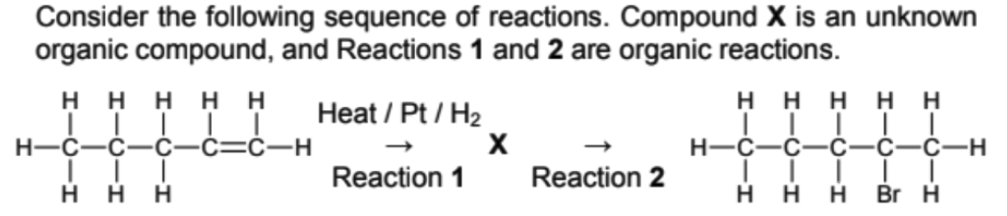
THE FOLLOWING QUESTION IS BASED ON THIS FLOW DIAGRAM:
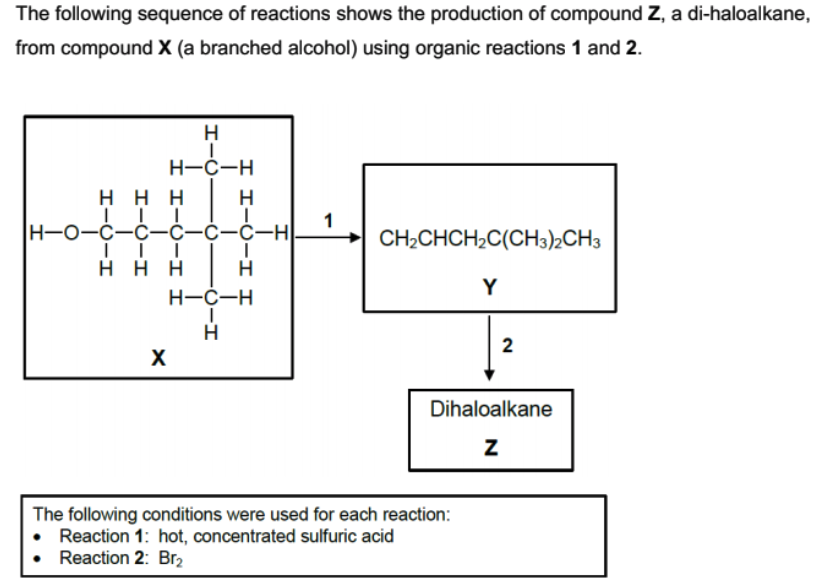
What is the general and specific types of reaction for reaction 1 and reaction 2?
substitution
hydrohalogenation
dehydration
dehalogenation
addition
hydration
halogenation
elimination
dehydrohalogenation
Reaction 1
Reaction 2
Required
2 points
2
Question 2
2.
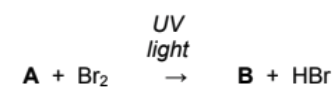
When pentane undergoes substitution with bromine gas, what products are formed?
Required
2 points
2
Question 3
3.
What reactant is needed to convert hexene into 2,3-diflourohexane?
Required
2 points
2
Question 4
4.
Which reaction is NOT an elimination reaction?
Required
2 points
2
Question 5
5.
Which one of the options is a reactant used in the making of this compound?
Required
2 points
2
Question 6
6.
What kind(s) of reaction(s) can alkenes undergo? Select all that apply.
Required
2 points
2
Question 7
7.
Identify the general type of reaction occuring in reaction 2 (addition or substitution) and then identify the specific type of reaction taking place in reaction 2.
Required
2 points
2
Question 8
8.
USE THE MATHS KEYBOARD FUNCTION (CLICK ON ICON) TO SUBSCRIPT THE NUMBERS IN YOUR ANSWER
Write the molecular formula of the organic product formed when methane reacts with a single molecule of chlorine gas.
Required
1 point
1
Question 9
9.
Identify the general type of reaction occuring:
Required
1 point
1
Question 10
10.
Identify the general type of reaction occuring:
Required
1 point
1
Question 11
11.
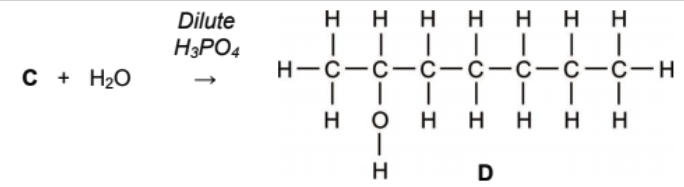
Identify the specific type of reaction occuring:
Required
1 point
1
Question 12
12.
Write the IUPAC name for compound C.
Required
2 points
2
Question 13
13.
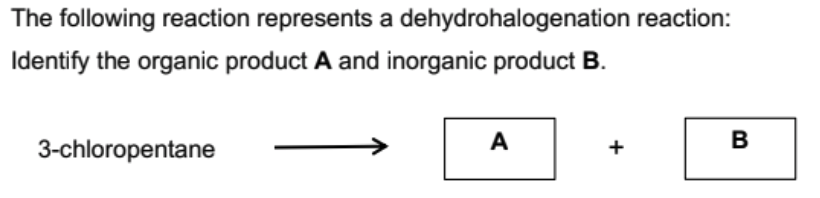
For A write the IUPAC name and for B write its molecular formula
Simply write both answers (A first and then B) separated by a comma