
1
From day 0 to day 5
From day 0 to day 5
1
day 15 to day 20
day 15 to day 20
Illustrative Math
From day 0 to day 5
day 15 to day 20
A study was conducted to analyze the effects on deer population in a particular area. Let f be an exponential function that gives the population of deer years after the study began.
If
Function models the population, in thousands, of a city years after 1930.
The average rate of change of f from
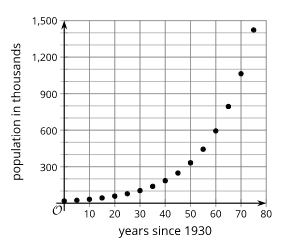
Is this value a good way to describe the population change of the city over that time period? Explain or show your reasoning. I will have to check your answer. Convince me!
The function, f, gives the number of copies a book has sold w weeks after it was published. The equation
Select all domains for which the average rate of change could be a good measure for the number of books sold.
The graph shows a bacteria population decreasing exponentially over time. Let's call it G.
The equation

Which bacterial population decays more quickly? G, the graph example, or F, the formula example. Explain how you know. Hint**This is easier than it looks!
Here is a graph of Han’s distance from home as he drives.
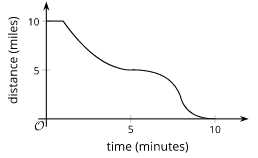
Identify the intercepts of the graph and explain what they mean in terms of Han’s distance from home.
Here is an image showing the highest point of the path of a ball after one bounce.
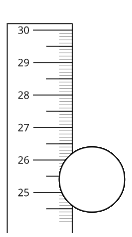
Someone is collecting data to model the bounce height of this ball after each bounce. Which measurement for the location of the top of the ball would be the best one to record?

Round to nearest inch.
yes or no. then back it up.
Select original ball or new ball and back it up.
This question refers to the original ball.
After its second bounce, a ball reached a height of 80 cm. The rebound factor for the ball was 0.7. From approximately what height, in cm, was the ball dropped?
Which equation is most appropriate for modeling this data?
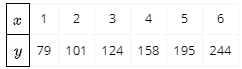
The table shows the number of employees and number of active customer accounts for some different marketing companies.
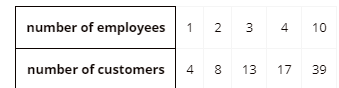
Would a linear or exponential model for the relationship between number of employees and number of customers be more appropriate? Explain how you know.

Use the format of : because ________depends on ____________
start with f(t)=