Log in
Sign up for FREE
arrow_back
Library

APUSH Chapter 18, Part 2: Renewing the Sectional Struggle (1848-1854)

star
star
star
star
star
Last updated almost 2 years ago
12 questions
1
IIWD.01
Welcome to part 2 of your Chapter 18 reading! As you read, consider the following essential question:
  • What are the causes of the U.S. Civil War?
As always, "Focus Questions" should guide your reading and notes, but you do not necessarily have to explicitly answer them.
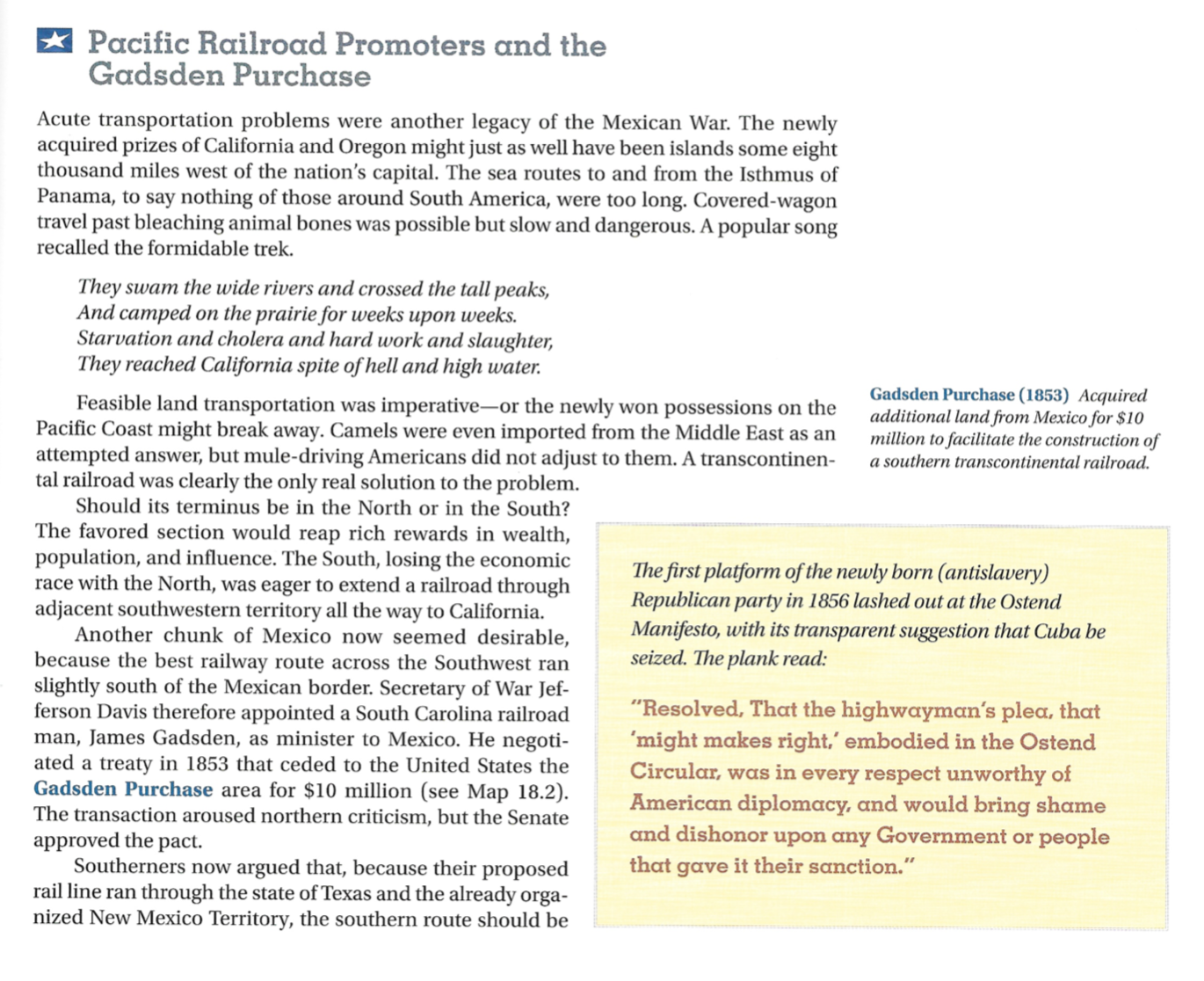
An isthmus is a narrow strip of land that connects two larger landmasses and separates two bodies of water.

Isthmuses have been strategic locations for centuries.
1
IIRC.01
Question 2
2.

1
IIRC.02
1
IITE.01
1
IIRC.01
1
IITE.01
1
IIRC.01
1
IIWD.01
1
IIUR.01
Bleeding Kansas is the term used to describe the period of violence during the settling of the Kansas territory. Proslavery and free-state settlers flooded into Kansas to try to influence the decision. Violence soon erupted as both factions fought for control.
1
Question 10
10.

What was the most significant cause of the American Civil War?

In order to earn full credit on this assignment, your response should cite and explain a specific key term to support your claim in 2-3 complete sentences.

0
0
Question 1
1.

As used in line 9, "trying" most nearly means
struggling
litigating
demanding
attempting
Question 3
3.

Question 4
4.

Question 5
5.

Question 6
6.

Question 7
7.

Ironically, Senator Sumner would suffer one of the first physical blows of the Civil War as his "Crime Against Kansas" speech against popular sovereignty would lead Representative Preston Brooks to literally attack him with a cane on the Senate floor... Historians will eventually refer to this event as Bleeding Sumner.
Question 8
8.

Question 9
9.

Question 11
11.

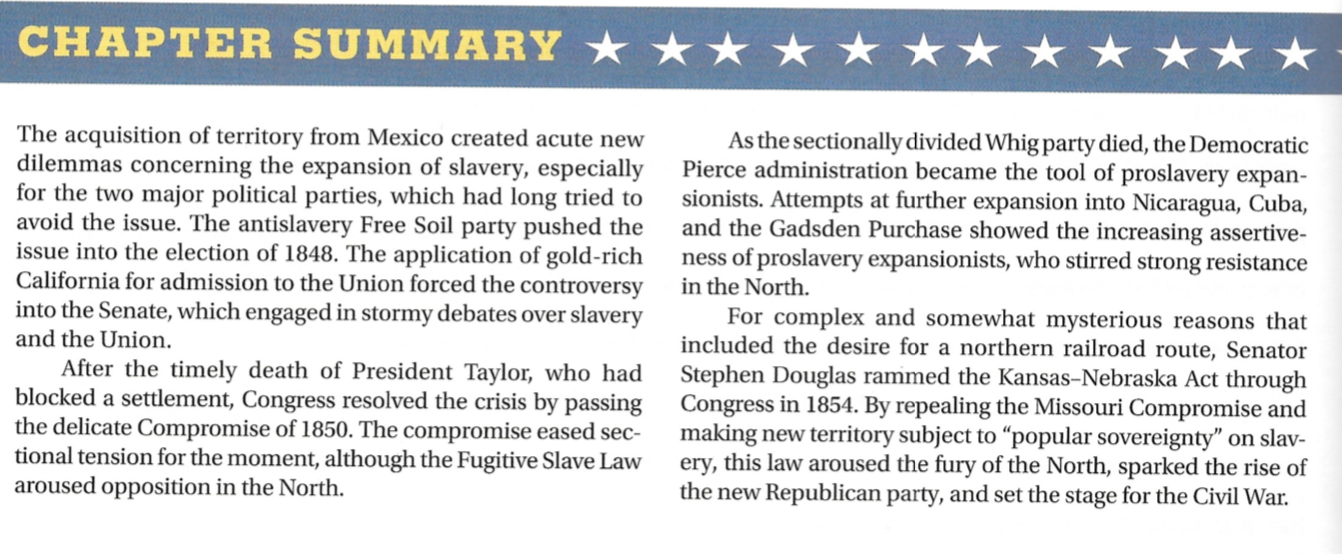
Excellent reading! Close out this Chapter by reviewing the "Chapter Summary" and using the "rectange" tool to box the 5 most important key terms in the space provided.

Question 12
12.

Do you have any feedback or questions about the Formative reading or comprehension questions that you want to go over in class?

The passage indicates that the United States was fighting over the isthmus in Central America because we
wanted to prove ourselves after losing the Mexican-American war.
sought control of the transportation routes in the strategic waterway.
were looking for alternative markets to sell cotton.
wanted to colonize Nicaragua before Geat Britain had the chance.
It can be reasonably inferred that the only way for the U.S. to maintain control of the new Pacific Coast was to
build a string of military forts across the West.
build a canal across Central America.
construct a transcontinental railroad.
grant the territories quick statehood.
Which choice provides the best evidence for the answer to the previous question?
Paragraph 1, Line 1-3 ("The newly... nation's capital")
Paragraph 1, Line 3-4 ("The sea... too long")
Paragraph 3, Line 13-14 ("A transcontinental... the problem")
Paragraph 4, Line 15-17 ("Should its... and influence")
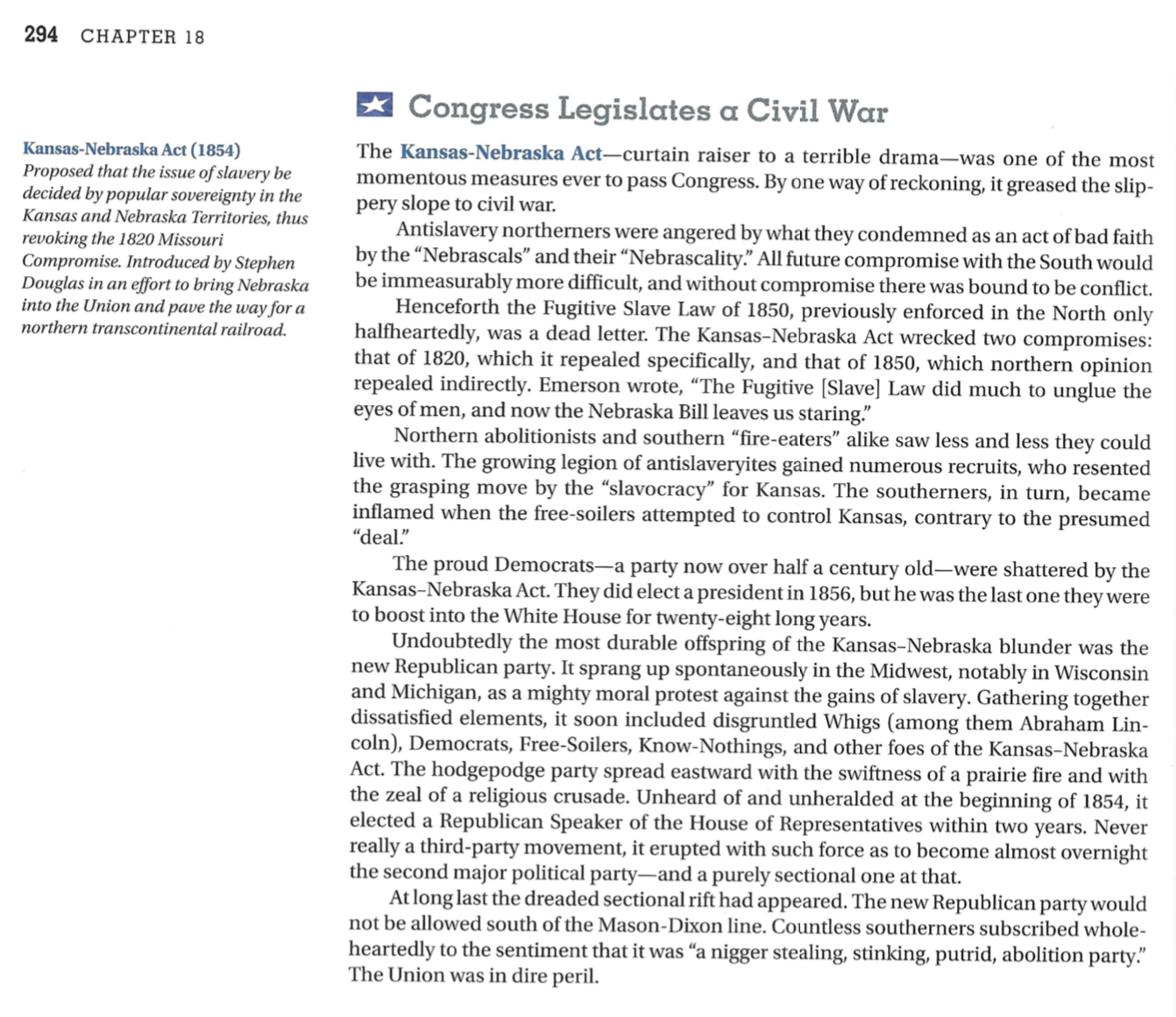
The passage suggests that Stephen Dougas' plan for deciding the slavery question in the Kansas-Nebraska Act would
ban slavery from spreading into new territory.
strengthen public support for the Compromise of 1850.
jeopardize negotiations between the city of Chicago and the Pacific Railroad Company.
require the repeal of the Missouri Compromise of 1820.
Which choice provides the best evidence for the answer to the previous question?
Paragraph 3, Line 4-5 ("This bold... of 1850")
Paragraph 3, Line 1-3 ("Douglas's Kansas-Nebraska... 36°30' line")
Paragraph 1, Line 6-8 ("He had... Pacific railroad")
Paragraph 2, Line 5-7 ("Kansas, which... free state")
According to the passage, Stephen Douglas made a critical mistake for
underestimating the extent of northern opposition to slavery.
allowing slavery to spread into new territory.
overestimating the protest to the bill.
believing that slavery could not survive in Kansas.
As used in line 2, "measures" most nearly means
units
calculations
laws
considerations
According to the passage, the Kansas-Nebraska Act directly resulted in
the unification of Democratic party factions.
the emergence of the new Republican party.
the political resurgence of the Free Soil party.
the resurgence of the Whig political party.