Log in
Sign up for FREE
arrow_back
Library
8th Grade Module 2; Unit 1 End of Unit Assessment
By Djaris Woody
star
star
star
star
star
Share
share
Last updated almost 5 years ago
5 questions
Add this activity
Note from the author:
End of Unit Assessment for EL 8th Grade/Unit 1 Module 2
1
1
1
1
1
Grade 8
End of Unit 1 Assessment: Analyze the Purpose of Information, Evaluate Mediums, and Analyze Conflicting Information in Video and Text
zoom_in
zoom_in
Directions:
Watch the video “
No Free Lunch
” (
http://eled.org/0258
) twice, and take notes on the speaker’s purpose, motive, and format.
Then, answer the questions that follow the note-catcher.
Note-Catcher
Purpose:
Motive:
Format:
Question 1
1.
What was the purpose of the information provided in “No Free Lunch”? (SL.8.2)
To convince people to spend more money on healthcare that is better quality
To convince people to spend less money on food by moving to a new country
To convince people to spend more money on food that is better quality
To convince people to spend less money on food by seeing their doctor more oftenWhat was the purpose of the information provided in “No Free Lunch”? (SL.8.2)
Question 2
2.
What is the most likely reason this presentation was created? (SL.8.2)
This is a commercial video that is trying to sell a food product.
This is a commercial video trying to get people to use a certain healthcare plan.
This is a social video that is trying to inform viewers on the connection between cost and quality food.
This is a political video intended to make people vote differently in the next election to secure quality food.
Question 3
3.
Which of the following is an advantage of presenting this topic through a video that shows a single speaker presenting an argument?
It’s convincing because watching someone speak in a personal style makes us trust the information.
We can go back and review the statistics about food spending easily if we miss something.
Watching a video is active, and someone watching has many ways to engage with the material presented.
It is easy to annotate or use other active reading strategies while interacting with a video or interview.
Question 4
4.
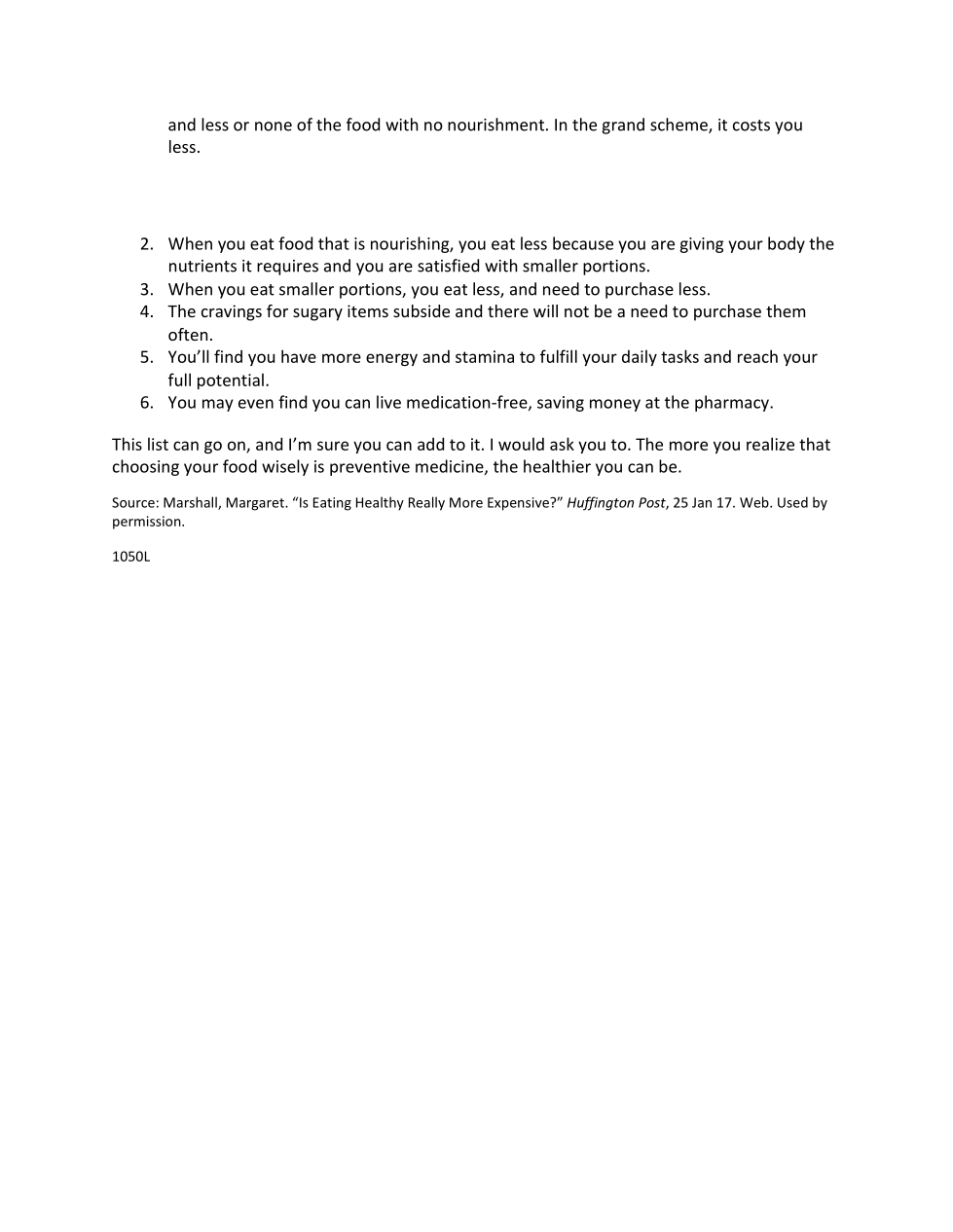
What is one way the information in the video conflicts with the information presented in the article “Is Eating Healthy Really More Expensive?”
The video says it’s possible to get healthy food inexpensively, but the article says we need to spend more money to get better quality food.
The article says it’s possible to get healthy food inexpensively, but the video says we need to spend more money to get better quality food.
The article says health food tastes just as good, but the video says junk food is tastier.
The video says we should spend less on food, but the article says we should spend more on food to be healthy.
Question 5
5.
Both the video and the article address the cost of eating healthy food. How do they differ in how they respond to this concern?
The video suggests that people may worry about the cost of healthy food because the cost of healthcare has gone up so much. But the article suggests that healthy food does not need to be expensive and can lead to better health.
The video suggests that people believe that healthy food costs more than healthcare. But the article suggests that Americans spend less on healthy food than they do on healthcare.
The video suggests that some people do not eat healthily because they make excuses for themselves. But the article suggests it is because some people don’t have access to healthy food.
The video suggests that people want to pay more for healthy food but do not have access to it. But the article suggests that people are unwilling to pay more for healthier food.