Preskoči na glavni sadržaj
Prijava
Sign up for FREE
arrow_back
Biblioteka

Day 15 Ch. 11-13 Test Review

star
star
star
star
star
Posljednje ažuriranje about 5 years ago
31
4
4
4
4
4
4
4
4
4
4
4
4
4
4
4
4
4
4
4
4
4
4
4
4
4
4
4
4
4
4
4
Pitanje 1
1.

A company is testing a new energy drink. Volunteers are asked to rate their energy one hour

after consuming a beverage. Unknown to them, some volunteers are given the real energy

drink and some are given a placebo—a drink that looks and tastes the same, but does not have

the energy-producing ingredients.

Show your work using the following list of random digits to assign each participant listed either the real drink or the placebo.

Give the treatment for each person.

Make sure I can understand your method.

Pitanje 2
2.

The local water authority has received complaints of high levels of iron in the drinking water.

They decide to randomly select 20 houses from each subdivision of 100 houses to visit and test

their water.

Describe how to use random numbers to select the 20 houses in each division.

Pitanje 3
3.

A couple is willing to have as many children as necessary to have two girls.

a. Describe a simulation that can be performed to estimate the average number of children

required to have two girls.

b. Conduct three trials using the list of random digits in the 'show your work' area.

c. Average the results for the three trials.

Pitanje 4
4.

A couple is willing to have as many children as necessary to have two girls.

Now that you have conducted the simulation, give your conclusion. Make sure to include that 'the simulation suggests...' and 'about...'.

Pitanje 5
5.

Match the terms with their definitions

Stavka koja se može prevućiarrow_right_altOdgovarajuća stavka

Law of Large Numbers

arrow_right_alt

Used to find the number of combinations when only one of each category is going to be picked.

Non-Existant Law of Averages

arrow_right_alt

think of multiplication

Combination

arrow_right_alt

think of addition

'AND'

arrow_right_alt

an arrangement of people or items in which order DOES matter.

Fundamental Counting Principle

arrow_right_alt

an arrangement of people or items in which order DOES NOT matter.

Permutation

arrow_right_alt

The more times an event(trial) is repeated, the closer the cumulative frequency comes to the true/theoretical probability.

'OR'

arrow_right_alt

A random event 'owes' you an outcome because it hasn't happened in a long time. This is faulty thinking since we are always dealing with the short run.

Pitanje 6
6.

A raffle has three prizes that can be won when you buy a ticket. Explain why the chances of winning are not 1 out of 3.

Pitanje 7
7.

Including you, there are 11 boys and 18 girls in your chemistry class.

How many ways can one boy and one girl be chosen to run an errand for the

teacher?

Hint: you can only choose one of each, how do you calculate this?

Pitanje 8
8.

Including you, there are 11 boys and 18 girls in your chemistry class.

How many ways can one boy OR one girl be chosen to run an errand for the

teacher?

Hint: only one person will run the errand, how many possibilities are there?

Pitanje 9
9.

There are 12 suspects of a crime.

How many ways can 5 of them be arranged in a lineup?

Choose the set up and the correct answer.

Pitanje 10
10.

A committee of five members is to be randomly selected from a group of nine freshmen and

seven sophomores.

How many different committees of three freshmen and two sophomores can be chosen?

Hint: you need to use two groupings

Pitanje 11
11.

A committee of five members is to be randomly selected from a group of nine freshmen and

seven sophomores.

How many committees of five members are possible?

Pitanje 12
12.

What is the probability that the five person committee will be made up of 3 freshmen and two sophomores?

Hint: use your previous two answers to find the probability.

Round your answer to three places past the decimal before you turn it into a percent.

Pitanje 13
13.

A committee of five members is to be randomly selected from a group of nine freshmen and

seven sophomores.

What is the probability that the committee will consist of all freshmen?

Hint: first calculate the number of all freshmen committees.

THEN use this number and the total number of committees from #11 to find your answer.

Round your answer to three places past the decimal before you turn it into a percent.

Pitanje 14
14.

Thinking about 5-card poker hands...

How many 5-card hands are possible out of a standard deck of 52 cards?

Pitanje 15
15.

Thinking about 5-card poker hands...

How many 5-card hands are possible with exactly 2 Aces? (there are four Aces in a deck of cards)

Hint: you will need to create 2 groupings.

2 Aces from the 4 Aces AND 3 cards from the remaining cards in the deck

Pitanje 16
16.

Thinking about 5-card poker hands...

How many 5-card hands are possible with exactly 2 OR 3 Aces?

(there are four Aces in a deck of cards)

Hint: you will need to create 2 separate calculations, each with 2 groupings.

2 Aces from the 4 Aces AND 3 cards from the remaining cards in the deck OR 3 Aces from 4 Aces AND 2 cards from the remaining cards in the deck

Pitanje 17
17.

Passwords for a cell phone use two letters followed by two digits followed by a special symbol (@, # , $ , %, or &), as in AW52$.

How many different passwords are possible? (repeats are ok, so use the Fundamental Counting Principle)

Pitanje 18
18.

Seven Freshmen, 5 Sophomores, 6 Juniors, and 5 Seniors at AHHS are finalists to participate

in a summer enrichment camp.

From these students, 6 winners will be selected randomly.

How many total groupings of 6 students are possible? (Hint: is this a permutation or a combination?)

Pitanje 19
19.

Seven Freshmen, 5 Sophomores, 6 Juniors, and 5 Seniors at AHHS are finalists to participate

in a summer enrichment camp.

From these 23 students, 6 winners will be selected randomly.

How many groups of 6 students do not contain any of the Seniors?

Pitanje 20
20.

Seven Freshmen, 5 Sophomores, 6 Juniors, and 5 Seniors at AHHS are finalists to participate

in a summer enrichment camp.

From these students, 6 winners will be selected randomly.

What’s the probability there will be no Seniors among the winners if the selection is totally random?

If this occurs, will you suspect foul play? Explain.

Select ALL that apply.

Pitanje 21
21.

Put the descriptions under the correct category.

  • the occurrence of one event does not change the likelihood of the second event occurring.

  • The color of the Skittle you shook out of your bag of Skittles.

  • The type of blood of two donors that are siblings.

  • The color of the light on Tuxedo Ave. and Broadway on Monday and then on Tuesday.

  • The color of the traffic light at the corner of Tuxedo Ave. and Broadway

  • 2 events cannot happen at the same time

  • The type of blood of two donors that are strangers.

  • Disjoint/Mutually Exclusive

  • Independent

  • Not Independent or Disjoint/mutually exclusive

Pitanje 22
22.

The McTofu restaurant is running a contest where customers can match a symbol on the inside

of the wrapper of their “Big Tofu” sandwich to win either food or money prizes.

The restaurant claims the probability of winning a food prize is 0.7,

the probability of winning a cash prize from $1 to $5 is 0.2

and the chance of winning a larger cash prize is 0.2.

Is this probability assignment legitimate?

Explain.

Select both answers.

Pitanje 23
23.

The data shown here were collected via a phone survey in 2010 of 625 cell phones users of age 12 to 17 by the Pew Research Foundation.
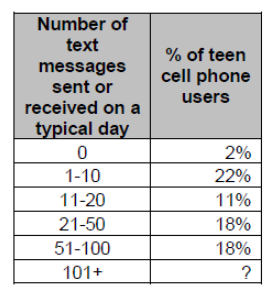
If we select a person at random from this sample, what is the probability that the person responded that s/he

texted more than 100 times per day?

Pitanje 24
24.

The data shown here were collected via a phone survey in 2010 of 625 cell phones users of age 12 to 17 by the Pew Research Foundation.

If we select a person at random from this sample, what is the probability that the person responded that s/he

texted between 21 and 100 times on a typical day?

Pitanje 25
25.

The data shown here were collected via a phone survey in 2010 of 625 cell phones users of age 12 to 17 by the Pew Research Foundation.

If we select a person at random from this sample, what is the probability that the person did not respond that she never texts?

Pitanje 26
26.

The data shown here were collected via a phone survey in 2010 of 625 cell phones users of age 12 to 17 by the Pew Research Foundation.

If we select 2 people at random from this sample, what is the probability that the two people chosen at random both text more than 50 times a day? P(more than 50 times, more than 50 times)=

Hint: this requires use of both of the rules (multiplication and addition)

Round your answer to three places past the decimal.

Pitanje 27
27.

Some studies suggest that approximately 17% of people in the U.S. have blue eyes.

Using the Multiplication Rule, since 0.17 x 0.17 = 0.0289 we might expect there is about a

3% chance of two siblings both having blue eyes.

Do you think it’s okay to use the Multiplication Rule in this case? ________ Why or why not?

Select both answer.

Pitanje 28
28.

The American Red Cross says that about:

45% of the U.S. population has Type O blood,

40% Type A,

11% Type B,

and 4% Type AB.

What is the probability that the next blood donor who enters a donation center has Type O

or Type A blood?

Pitanje 29
29.

The American Red Cross says that about:

45% of the U.S. population has Type O blood,

40% Type A,

11% Type B,

and 4% Type AB.

What is the probability that the next three blood donors all have Type O blood?

Round to three places past the decimal.

Pitanje 30
30.

The American Red Cross says that about:

45% of the U.S. population has Type O blood,

40% Type A,

11% Type B,

and 4% Type AB.

What assumption are you making in computing the probability for the previous question?

Hint: you used the multiplication rule

Pitanje 31
31.

A survey showed that 35% of households in a town have a dog and 12% have a cat.

Is it reasonable to use the Addition Rule to predict that 35% + 12% = 47% of the town’s

households have a dog or a cat?__________

Why or why not?

Select all answers that apply.

Hint: think about the rule that was used to do the calculations.