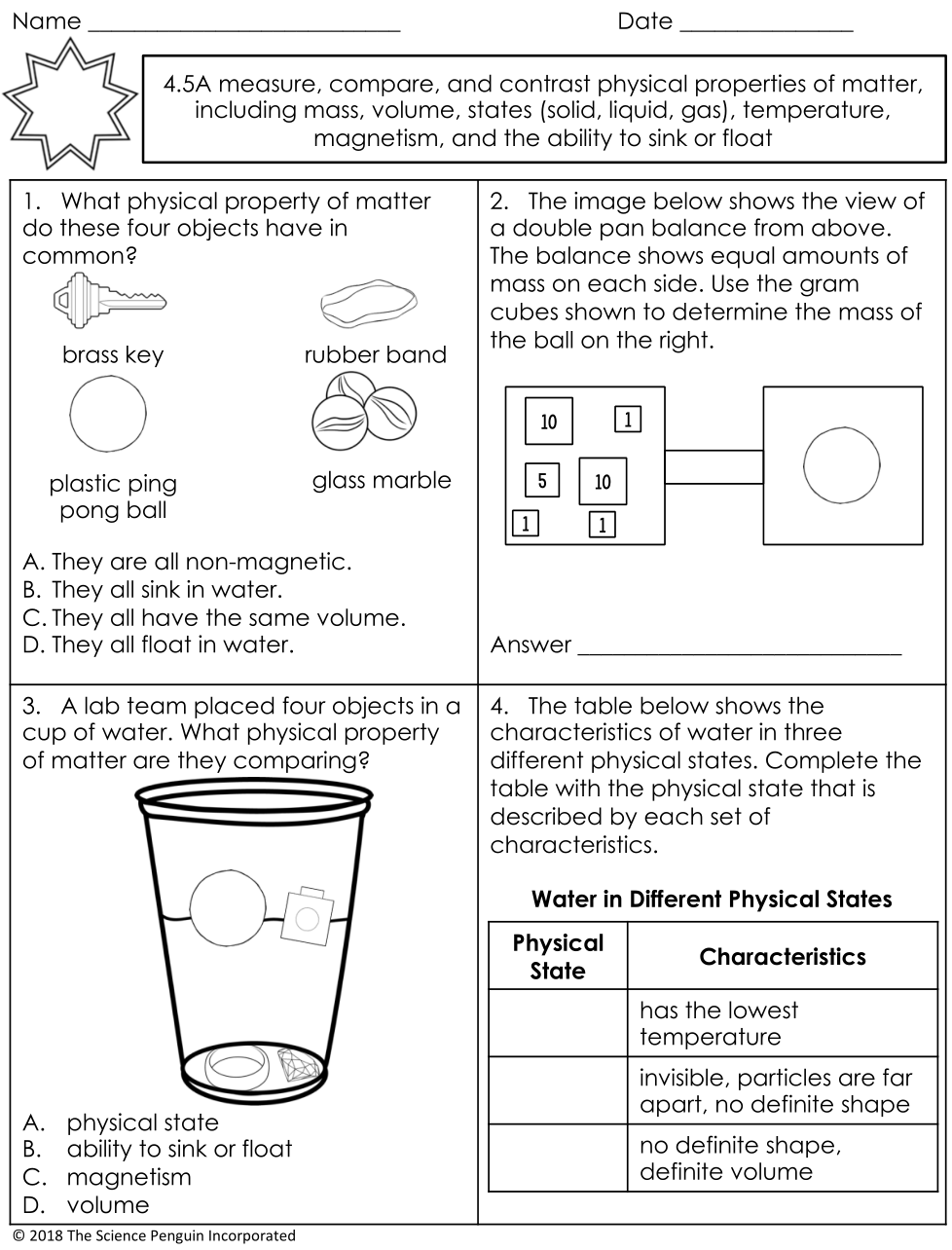
The image below shows the view of a double pan balance from above. The balance shows equal amounts of mass on each side. Use the gram cubes shown to determine the mass of the ball on the right.
1
1
1
Question 5
5.
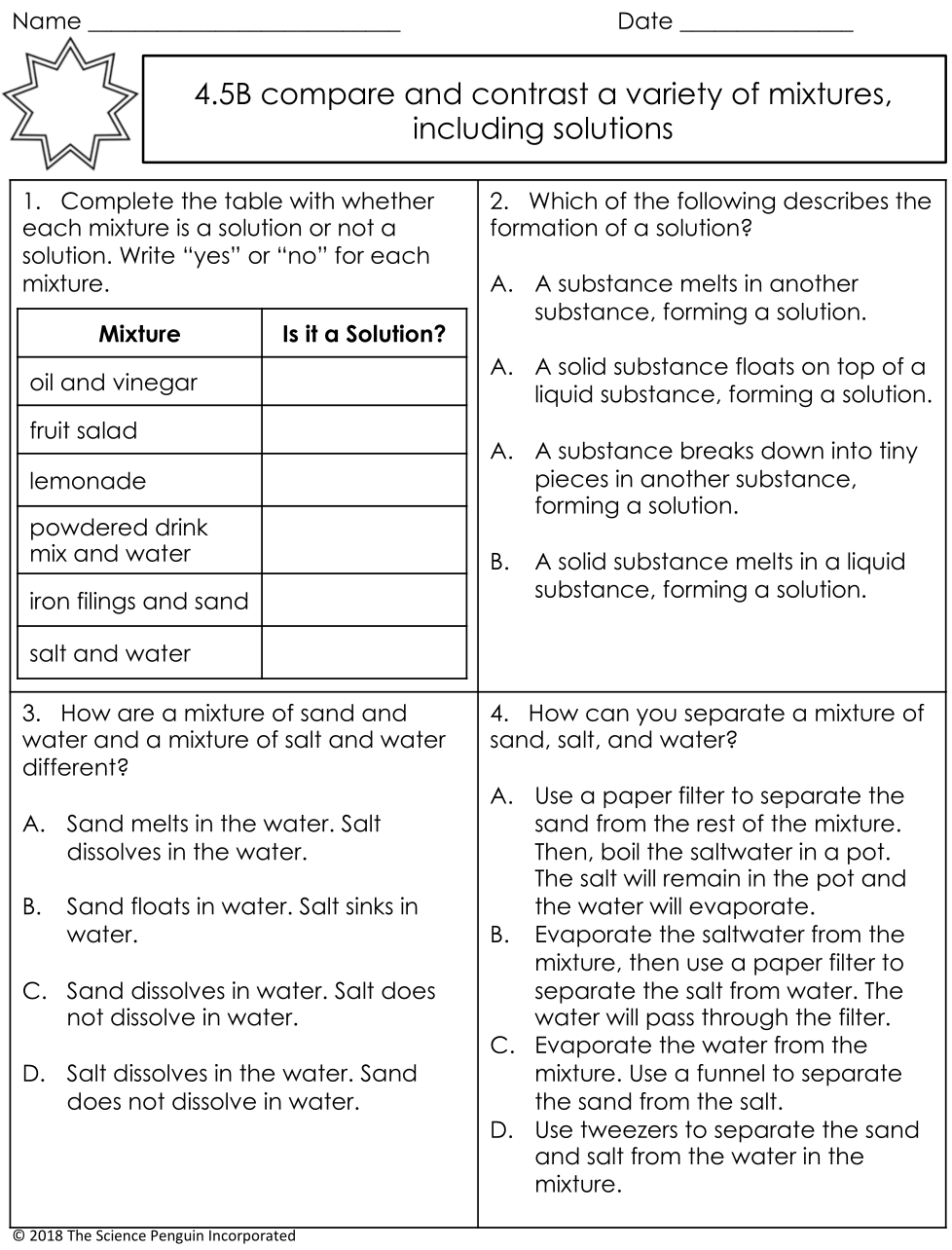
Look at the table in the question and write below whether each mixture is a solution or not a solution. Write "yes" or "no" for each mixture.
1
1
1
Question 1
1.
Question 3
3.
Question 4
4.
Question 6
6.
Question 7
7.
Question 8
8.
What physical property of matter do these four objects have in common?
A. They are all non-magnetic.
B. They all sink in water.
C. They all have the same volume.
D. They all float in water.
A lab team placed four objects in a cup of water. What physical property of matter are they comparing?
A. physical state
B. ability t sink or float
C. magnetism
D. volume
Which of the following describes the formation of a solution?
A. A substance melts in another substance, forming a solution.
B. A solid substance floats on top of a liquid substance, forming a solution.
C. A substance breaks down into tiny pieces in another substance, forming a solution.
D. A solid substance melts in a liquid substance, forming a solution.
How are a mixture of sand and water and a mixture of salt and water different?
A. Sand melts in the water. Salt dissolves in the water.
B. Sand floats in water. Salt sinks in water.
C. Sand dissolves in water. Salt does not dissolve in water.
D. Salt dissolves in the water. Sand does not dissolve in water.
How can you seperate a mixture of sand, salt, and water?
A. Use a paper filter to seperate the sand from the rest of the mixture. Then, boil the saltwater in a pot. The salt will remain in the pot and the water will evaporate.
B. Evaporate the saltwater from the mixture, then use a proper filter to separate the salt from water. The water will pass through the filter.
C. Evaporate the water from the mixtue. Use a funnel to separate the sand from the salt.
D. Use tweezers to separate the sand and salt from the water in the mixture.