The circle below is called the Unit Circle, because it has radius=1 unit and center (0,0).
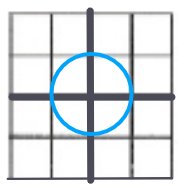
In this investigation, you will learn how to transform the Unit Circle, both graphically and symbolically.
Consider a circle with radius=10 units and center C(0,0). Point A(6, 8) and Point Q(-8, -6) exist on the circle.
Draw the radius to Point A.
Draw the vertical line segment
Draw the horizontal line segment
You have just created right triangle
Use the Pythagorean Theorem to relate the three side lengths of the right triangles.
The coordinates from A(6,8) satisfy the Pythagorean Theorem:
The coordinates from Q(-8,-6), although they are negative, also satisfy the Pythagorean Theorem:
With this information in mind, what Standard Equation can you write to represent the equation of a circle with center (0,0) and radius
Given the equation:
conjecture if the points L(4,-2), M(0, -8), and N(8, -7) exist INSIDE the circle, ON the circle, or OUTSIDE the circle.
(You may graph within the Show Your Work space if you would find it helpful!)
| Draggable item | arrow_right_alt | Corresponding Item |
|---|---|---|
M(0, -8) | arrow_right_alt | INSIDE the circle |
N(8, -7) | arrow_right_alt | ON the circle |
L(4, -2) | arrow_right_alt | OUTSIDE the circle |
What is the radius of the circle in each equation?
| Draggable item | arrow_right_alt | Corresponding Item |
|---|---|---|
| arrow_right_alt | ||
| arrow_right_alt | ||
| arrow_right_alt |
The circle below is called the Unit Circle, because it has radius=1 unit and center (0,0).
In this investigation, you will learn how to transform the Unit Circle, both graphically and symbolically.
Unit Circle Equation:
Since ALL circles are similar, EVERY circle is a transformation of the Unit Circle. Both equations below represent a "scaled up" version of the Unit Circle (scale factor of 5). Notice the Standard Form is set equal to
Standard Form:
Transformation Form:
Draw the circle that is represented by this equation in Transformation Form:
A circle can also be transformed by translation. Both equations below represent a "scaled up" version of the Unit Circle (scale factor of 4) that has also been translated 3 units left and 5 units up.
Standard Form:
Transformation Form:
IMPORTANT: The operations exist INSIDE the ( ), so we perform the INVERSE transformation of what may seem to make sense! The new center is NOT (+3, -5) as you may suspect! The new center is actually (-3, +5).
Transform the Unit Circle according to the given equation. Graph the circle on the coordinate plane.
Equation:
Transform the Unit Circle according to the given equation. Graph the circle on the coordinate plane.
Equation:
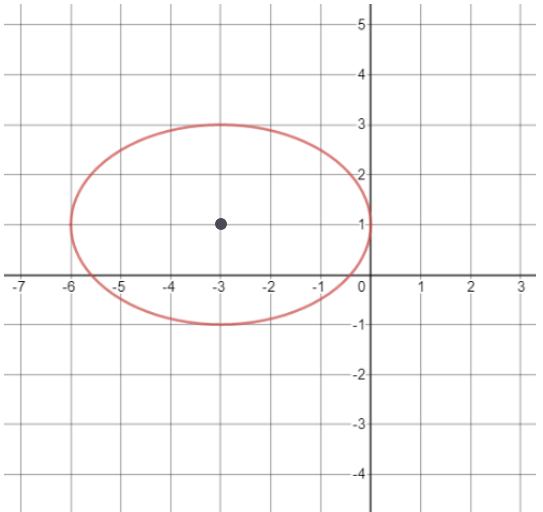
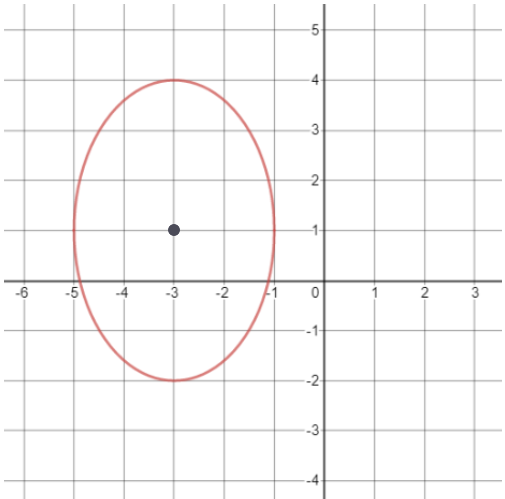
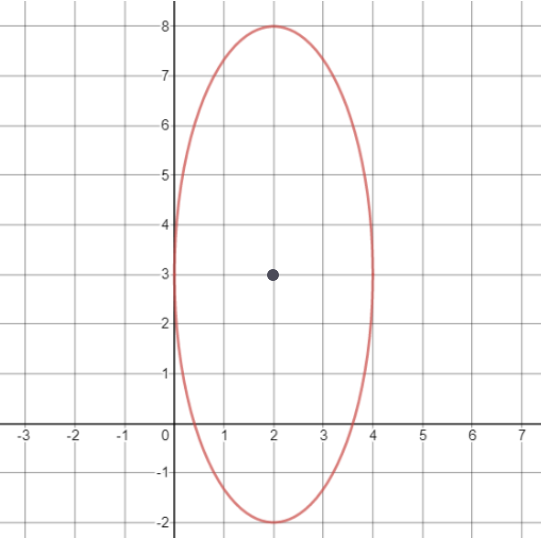
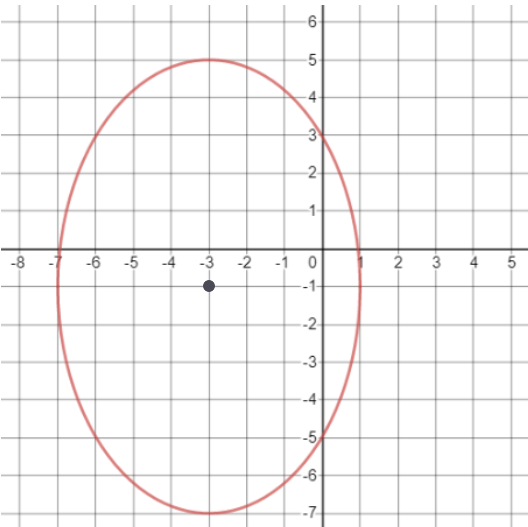
Match the equation of each ELLIPSE to its graph.
| Draggable item | arrow_right_alt | Corresponding Item |
|---|---|---|
| arrow_right_alt |
| |
| arrow_right_alt |
| |
| arrow_right_alt |
| |
| arrow_right_alt |
|