AA1-6 Absolute value equations
star
star
star
star
star
Last updated almost 5 years ago
10 Nsɛmmisa
1
1
1
1
1
1
1
1
1
1
The absolute value of a number is the distance that number is away from zero on a number line. Since distance can't be a negative number, the absolute value of a number won't be negative either.
To show we are taking the absolute value of a number or expression we put vertical bars on either side of it.
For example:
The absolute value of 5 would be written like this: |5|. This is asking "How far is 5 away from zero on the number line?"
|5|=5
|-5|=5
|5|= -5
|-5|= -5
Absolute value equations can have two, one or no solutions.
Match the equations with the solutions:
| Draggable item | arrow_right_alt | Corresponding Item |
|---|---|---|
|x| = 0 | arrow_right_alt | x = 5 and x = -5 |
|x| = 5 | arrow_right_alt | no solution |
|x| = -5 | arrow_right_alt | x = 0 |
The first step in solving an absolute value equation is to isolate the absolute value.
|x| - 4 = -1
|x| = ?
3|x| + 7 = 25
|x| = ?
The second step is to solve for x
If |x| = 3, then what are the possible values of x?
*Write your answer like this x=___ and x=____
Solve for x
|x| = 8
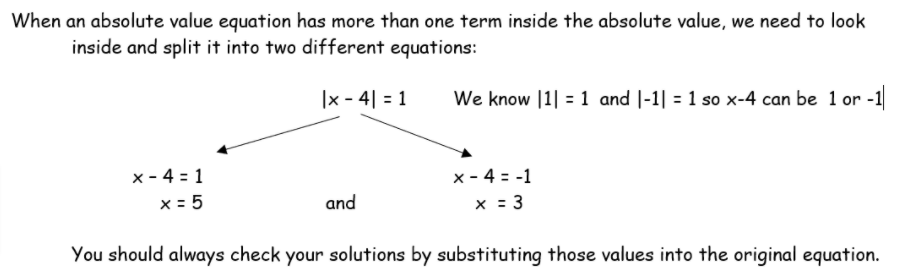
Try this one. Be careful, you cannot distribute into an absolute value
Solve for x
3|x + 6| - 4 = 5
If you are not sure how to do #10, it is shown on the intro of the AA1-8 Absolute Value Practice
Please note: Just like radical equations, if absolute value equations have x's on both sides of the equation you can end up with extraneous (false) solutions. You must always check for these extraneous solutions. Examples of these are on the AA1-8 practice as well. Check the key, or ask if you need further explanation.