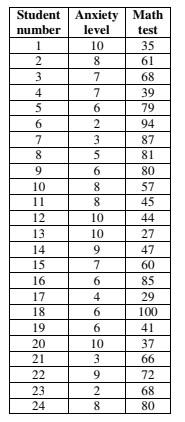
Enter the Anxiety Level and Math test score into two lists in your calculator. Do not put the "Student number" into your calculator.
From Unit 2, the skills you need are:
- Make a scatterplot (calculator and manually)
- Describe a scatterplot (strength, form, direction)
- Find and interpret correlation
- Know when correlation is an appropriate term to use
- Interpret r-squared
- Create a linear model
- Interpret slope
- Interpret y-intercept
- Interpret a residuals plot
Enter the Anxiety Level and Math test score into two lists in your calculator. Do not put the "Student number" into your calculator.
Make a scatterplot of the data (Zoom -> Stat to adjust the window to see your data). If you get an error, make sure you have the same number of data in both lists, that you only have one plot on, and that your y= screen is cleared out.
Describe the scatterplot (strength, form, direction), and be sure to include a sentence that describes the relationship in context.
Create the linear model based on your calculator output. For this part, just type in the equation using x and y. You'll define variables and talk about what needs to be added in the next problem. Round numbers to the nearest hundredth.
Define your variables from #6. What does the response variable need to have over it?
What is the value of the slope?
Interpret the slope in the context.
What is the value of the y-intercept?
Interpret the y-intercept in context.
Find the correlation.
What does the correlation coefficient indicate?
What is r-squared? (report as a %)
Interpret r-squared in context.
Create the residuals plot. What does the residuals plot indicate?