Encuentros 1
star
star
star
star
star
Last updated over 4 years ago
24 Nsɛmmisa
9

1
1
1
1
8
8
1
1
1
1
1
1
1
12
2
1
1
1
Match Spanish to English verb
| Draggable item | arrow_right_alt | Corresponding Item |
|---|---|---|
llegar | arrow_right_alt | to walk |
esperar | arrow_right_alt | to buy |
viajar | arrow_right_alt | to rest |
descansar | arrow_right_alt | to have breakfast |
desayunar | arrow_right_alt | to teach |
llevar | arrow_right_alt | to wait (for)/to hope |
enseñar | arrow_right_alt | to arrive |
caminar | arrow_right_alt | to carry |
comprar | arrow_right_alt | to travel |
Yo _______ por teléfono. (to speak)
Nosotros ______ a la Sra. Perez. (to listen)
Yo _______ a la fiesta a las ocho en punto. (arrive)
Miguel y Hector _________ para el examen de español. (to study)
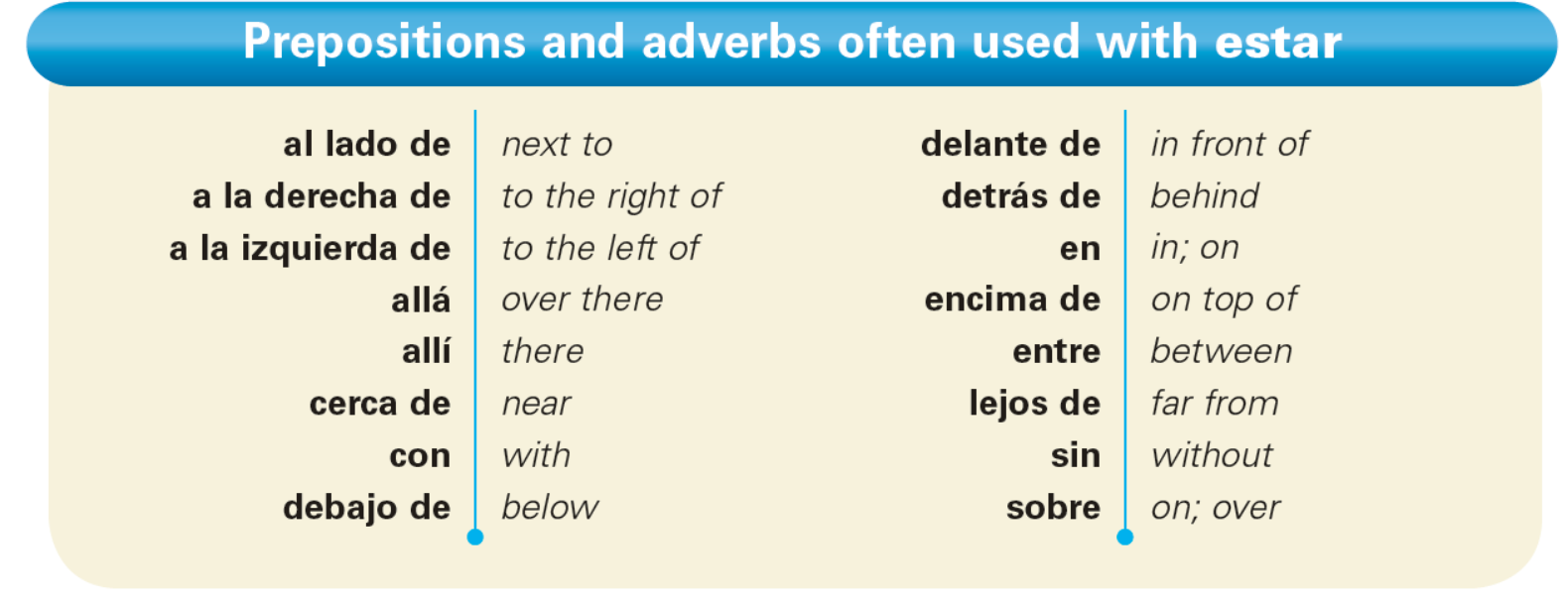
Match the prepositions.
| Draggable item | arrow_right_alt | Corresponding Item |
|---|---|---|
allí | arrow_right_alt | next to |
sin | arrow_right_alt | to the right of |
allá | arrow_right_alt | to the left of |
a la derecha de | arrow_right_alt | over there |
a la izquierda de | arrow_right_alt | there |
con | arrow_right_alt | near |
al lado de | arrow_right_alt | with |
cerca de | arrow_right_alt | without |
Match the prepositions.
| Draggable item | arrow_right_alt | Corresponding Item |
|---|---|---|
encima de | arrow_right_alt | below, underneath |
detrás de | arrow_right_alt | in front of |
debajo de | arrow_right_alt | behind |
entre | arrow_right_alt | in; on |
en | arrow_right_alt | on top of |
delante de | arrow_right_alt | over |
sobre | arrow_right_alt | far from |
lejos de | arrow_right_alt | between |
La pluma está __________ la mesa.
La ventana está __________ la puerta.
La pizarra está __________ los estudiantes.
Las sillas están __________ los escritorios.
For questions 14-16, form sentences using the words provided. Remember to use the present tense and add any other necessary words. Follow the model. Make sure you capitalize the beginning of your sentences. Make sure you add correct punctuation at the end (and beginning if it applies).
yo / viajar / Madrid / mañana Example answer:
Viajo a Madrid mañana.
or
Yo viajo a Madrid mañana.
ustedes / practicar / vocabulario
¿preparar (tú) / tarea?
clase de español / terminar / once
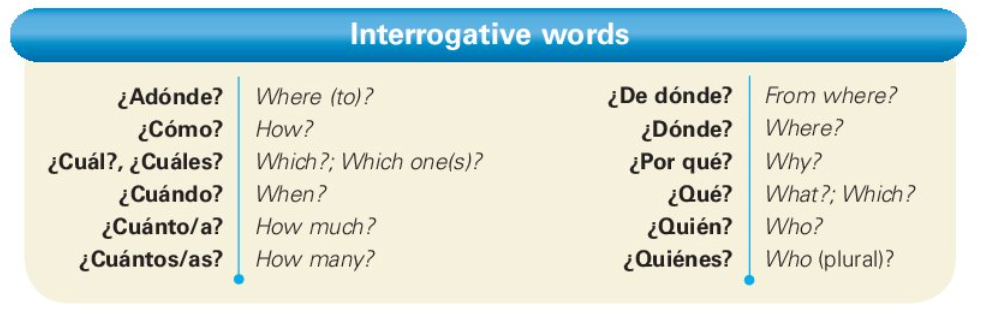
Match the Interrogative Words
| Draggable item | arrow_right_alt | Corresponding Item |
|---|---|---|
¿De dónde? | arrow_right_alt | Where (to)? |
¿Adónde? | arrow_right_alt | How? |
¿Cuántos/as? | arrow_right_alt | Which? Which one(s)? |
¿Por qué? | arrow_right_alt | When? |
¿Cuándo? | arrow_right_alt | How much? |
¿Cómo? | arrow_right_alt | How many? |
¿Quién? | arrow_right_alt | From where? |
¿Quiénes? | arrow_right_alt | Where? |
¿Cuál? ¿Cuáles? | arrow_right_alt | Why? |
¿Cuánto/a? | arrow_right_alt | What? Which? |
¿Dónde? | arrow_right_alt | Who? |
¿Qué? | arrow_right_alt | Who (plural)? |
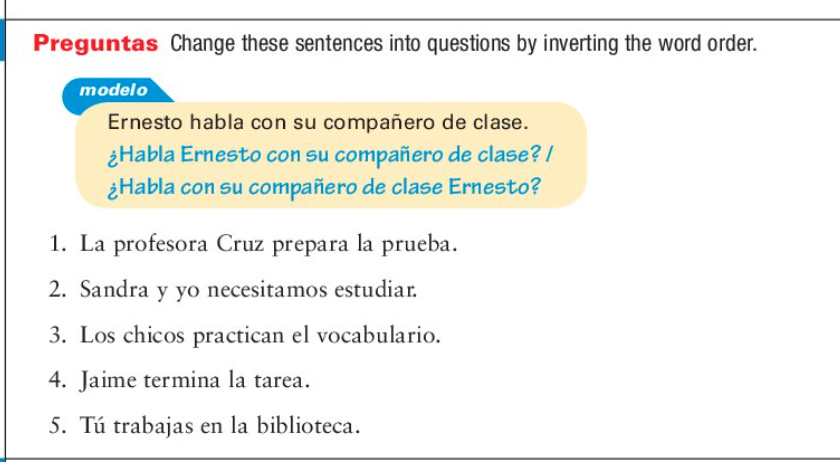
See modelo. Change sentence into question by inverting word order. Please do not replace any subjects. Use the ones given.
See modelo. Change sentence into question by inverting word order. Please do not replace any subjects. Use the ones given.
See modelo. Change sentence into question by inverting word order. Please do not replace any subjects. Use the ones given.
What are the two tags you can add at the end of a statement to make it a questions? No commas
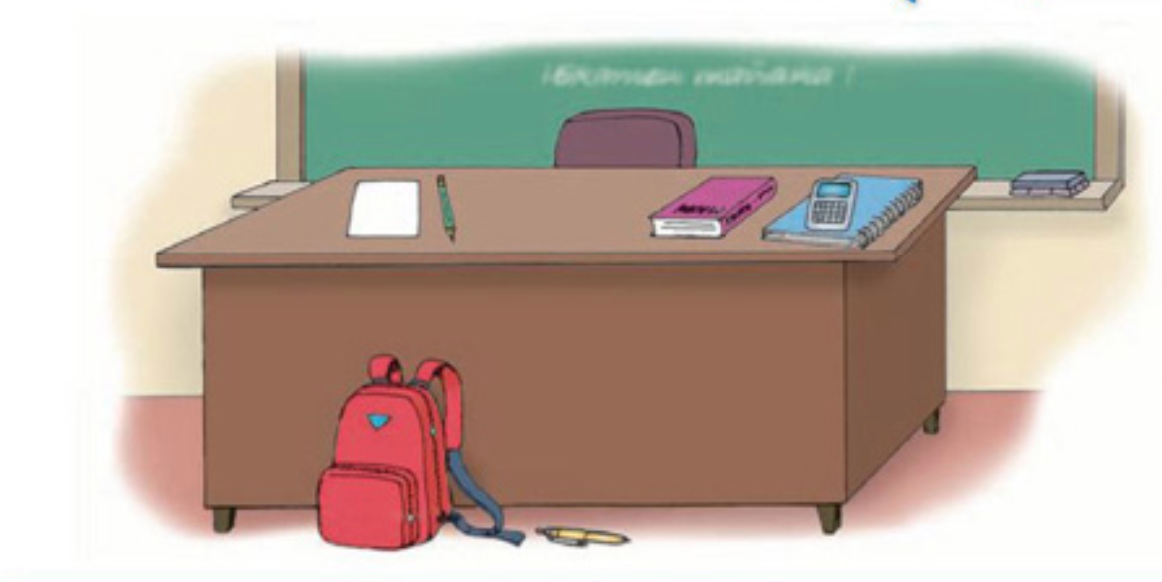
¿Dónde está la pluma? (backpack)
¿Dónde está la silla? (desk)
¿Dónde está el lápiz? (paper)
See modelo. Change sentence into question by inverting word order. Please do not replace any subjects. Use the ones given.
See modelo. Change sentence into question by inverting word order. Please do not replace any subjects. Use the ones given.