Conduction, Convection and Radiation OALH
star
star
star
star
star
Last updated over 5 years ago
37 Nsɛmmisa
1
1
1
1
1
1
1
1
1
1
1
1
1
1
1
1
1
1
1
1
1
1
1
1
1
1
1
1
1
1
1
1
1
1
1
1
1
State the equation for calculating efficiency
A lightbulb converts energy transferred via electricity into radiation (light) and thermal energy name the useful energy
Draw particle diagrams for the three states of matter
Name the equipment used to measure the size of a force
Put the following value to 2 significant figures: 2.05
Calculate the efficiency of a light bulb that uses 120J of electrical energy, with a total output of useful light energy that equals to 80J. Give your answer to 2 decimal places
Define Conduction
Define insulator
Define conductor
Define is convection
Name the states convection can occur in
How does radiation transfer thermal energy?
Name the surface that is a good absorber or emitter of infrared
Define Conduction
Define insulator
Define conductor
Define is convection
Name the states convection can occur in
How does radiation transfer thermal energy?
Name the surface that is a good absorber or emitter of infrared
The transfer of thermal energy through a substance by the vibration of particles is?
1. Convection
2. Conduction
3. Radiation
4. Insulator
A substance that does not easily transfer thermal energy e.g. rubber, is named?
1. Convection
2. Conduction
3. Radiation
4. Insulator
A substance that does allow thermal energy to pass through e.g. copper, is named?
1. Convection
2. Conductor
3. Radiation
4. Insulator
________ is the transfer of thermal energy from hot to cold places by the rise of particles in a fluid.
1. Convection
2. Conduction
3. Radiation
4. Insulation
How does the energy of the sun reach Earth?
1. Convection
2. Conduction
3. Radiation
4. Insulation
I do. Describe and explain how energy is transferred through a solid via conduction.
Conduction is the _____________________through a ___________ substance by the _________________.
When a solid is heated up, the particles near the heat source ________________ and this vibration and movement is passed on to __________________
We do. Describe the type energy transfer that takes place in solids and explain how a solid transfers energy throughout a material.
Conduction is _________________through a solid substance ____________________. When a solid is heated up, ________________this vibration and movement is _____________________________
You do. Explain how thermal energy is transferred through a heated saucepan. (2)
Describe how radiation transfers heat and explain how the shiny light coloured coating of a water bottle keeps the water cold on hot days.
Describe heat transfer via radiation and explain why the shiny light coloured coating of a water bottle keeps the water cool.
Radiation transfers heat as _____. The shiny light coloured coating of a water bottle ______ the radiation so heat ______ ____ be absorbed meaning shiny surfaces are ____ absorbers of heat radiation.
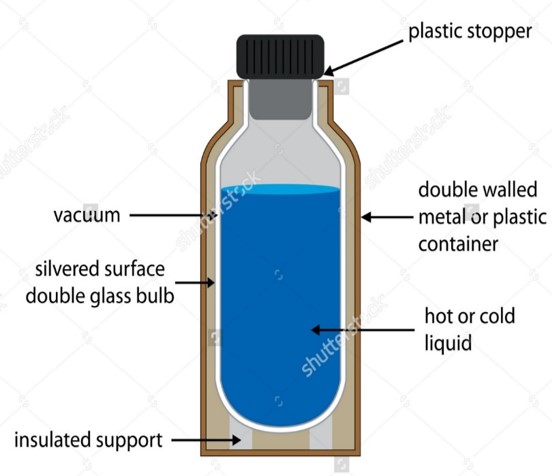
What quality of the plastic stopper makes it useful?
What quality of the plastic container makes it useful?
What quality of the Insulated Support makes it useful?
What quality of the Silver Surface makes it useful?
Why does the flask contain a vacuum inside of it?
A vacuum flask is designed to reduce the rate of energy transfer by heating processes.
Describe how the design of a vacuum flask keeps the liquid inside hot.
Include reference to convection, conduction and radiation in your answer.
1.Conduction is…
2.The best conductors of heat are usually…
3.An insulator is…
4.Convection only occurs in
5.When air particles heat up, they become
6.What can radiation do that convection and conduction cannot?