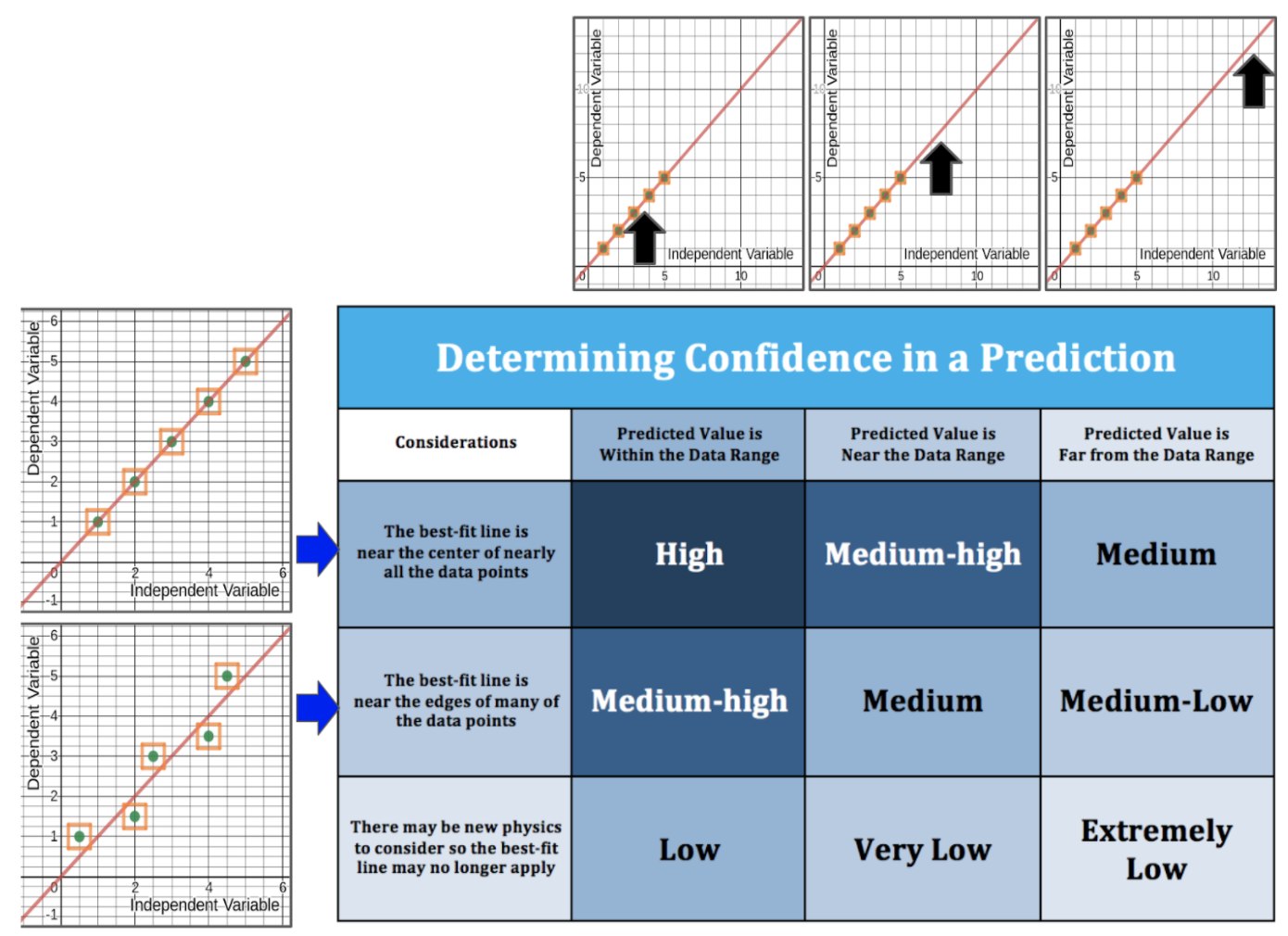
- Update your interactive notebook. Make sure you have notes for the Pendulum Lab (Horizontal Pattern), Ball on floor lab (linear pattern), coin lab (quadratic pattern) and paragraph lab (inverse pattern).
- Go back and make improvements on your labs.
- Go back and complete the Unit 1 Practice assignment and also do quiz corrections.
- Do this review.
- ASK QUESTIONS WHEN YOU GET STUCK. Thank you!
1 point
1
Question 1
1.
Explain why it is useful for us to find patterns that occur naturally (why we look for patterns in our labs).
1 point
1
Question 2
2.
Explain why we prefer a data-informed prediction over a wild-guess in science. Give more than one reason if you can. (Hint: We start each lab with a wild guess, but end with a data-informed prediction.)
1 point
1
Question 3
3.
Data-informed decisions are founded on evidence-based reasoning. Explain what evidence-based reasoning is. (Hint: you used it when we used Claim-Evidence-Reasoning, or CER.)
Be ready to compare and contrast any of the four patterns we've learned so far. Two example questions are below (#s 4 and 5).
1 point
1
Question 4
4.
Describe 2 similarities between linear and quadratic patterns.
1 point
1
Question 5
5.
Describe one difference between linear and inverse patterns.
1 point
1
Question 6
6.
Rank the four patterns from easiest to understand and explain to most difficult to understand and explain. Why did you answer the way you did?
Horizontal
Linear
Quadratic
Inverse
1 = Easiest to understand and explain
2
3
4 = Most difficult to understand and explain
1 point
1
Question 7
7.
Why?
Use the following information for questions 7 and 8.
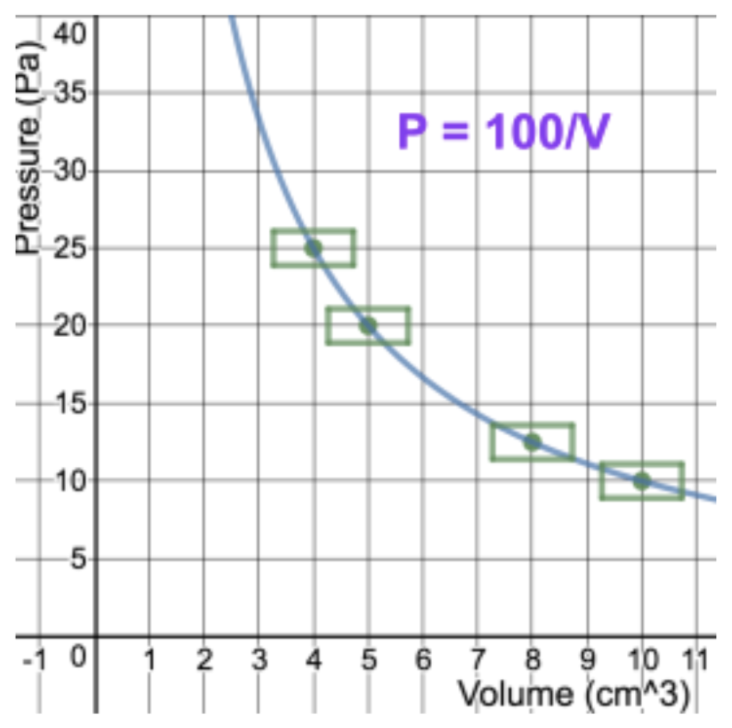
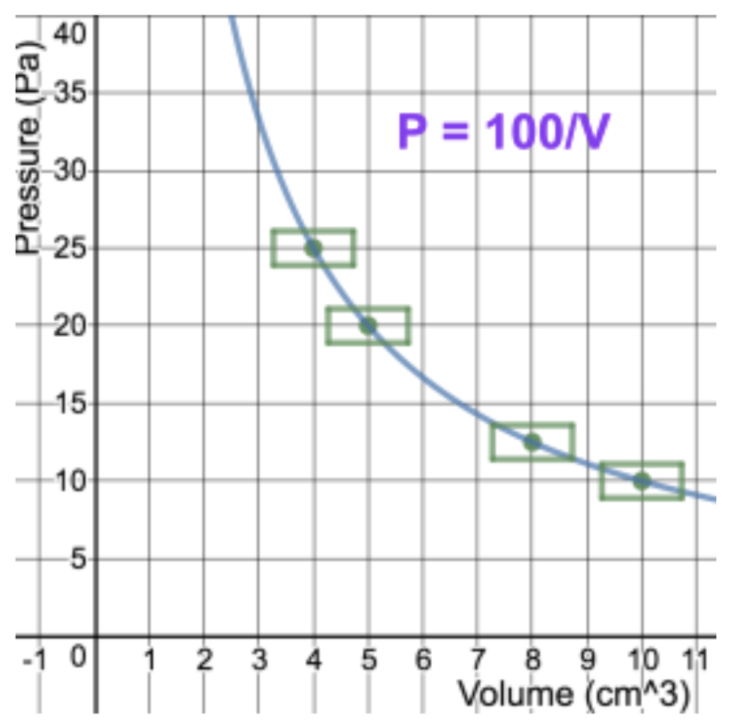
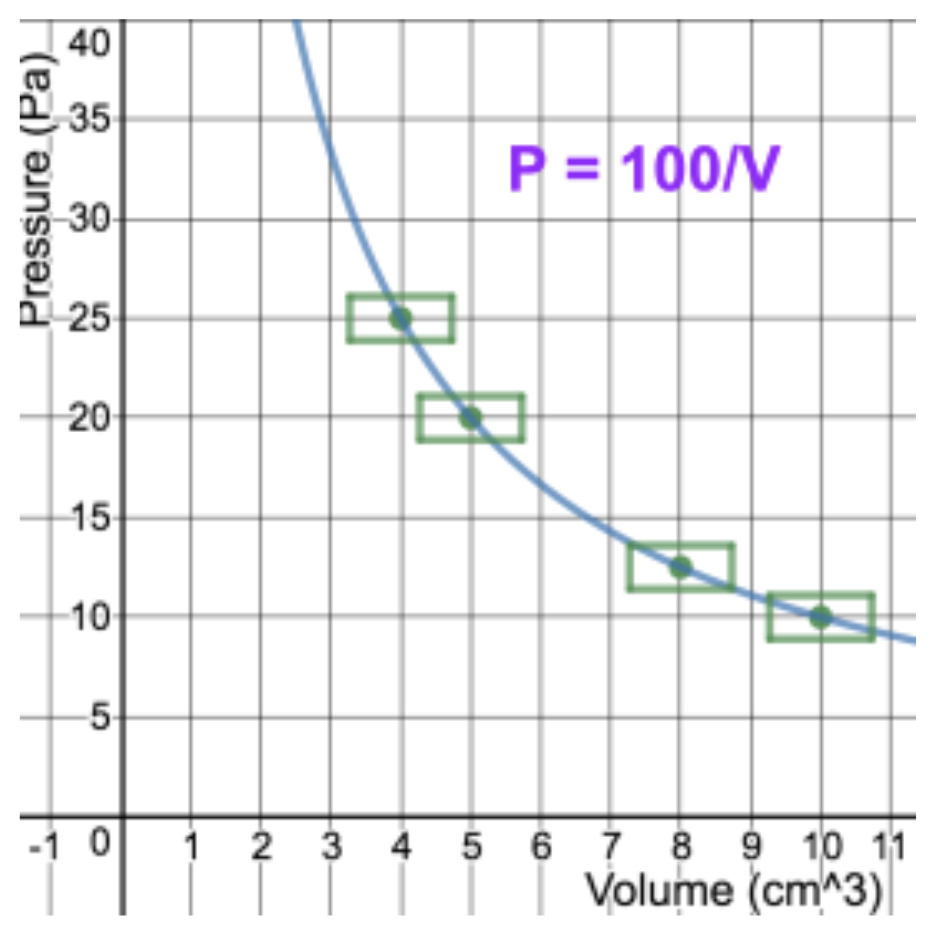
Observation – Esme squeezes a partially inflated balloon and tries to make it smaller. She notices that as she decreases the volume the balloon the air pressure inside seems to feel stronger. She asks the question “How does the volume of the balloon affect the pressure inside of the balloon?” See the Desmos graph below.
1 point
1
Question 8
8.
Using the graph, determine the pressure at 5 cm^3.
1 point
1
Question 9
9.
Use the mathematical model from the graph to calculate what the pressure would be for a volume of 20 cm^3.
Use the following information for questions 9 through 13.
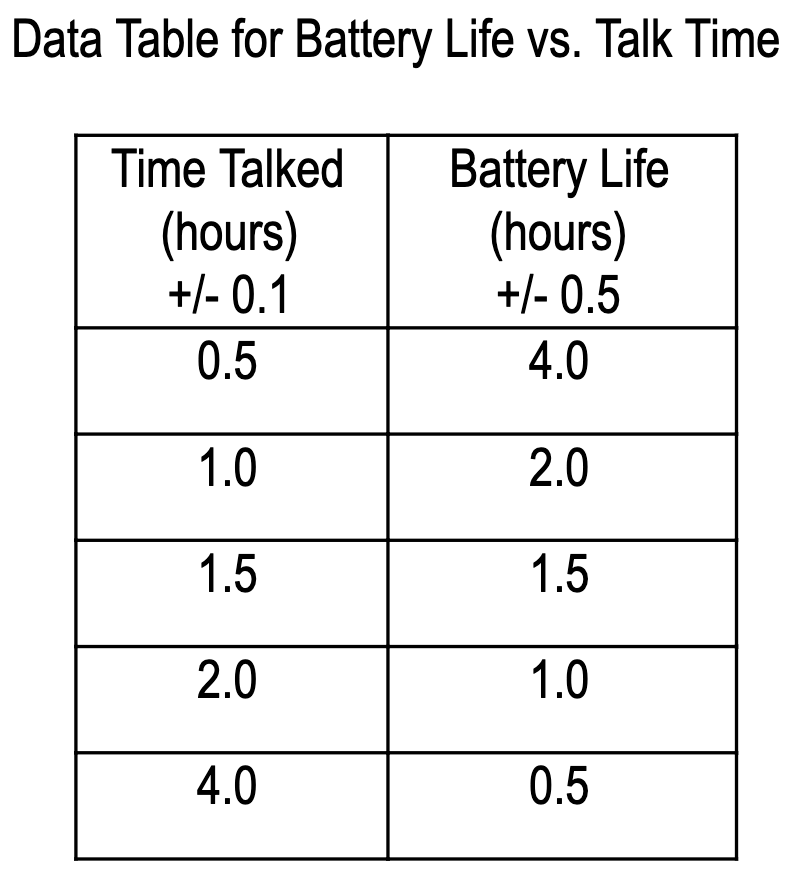
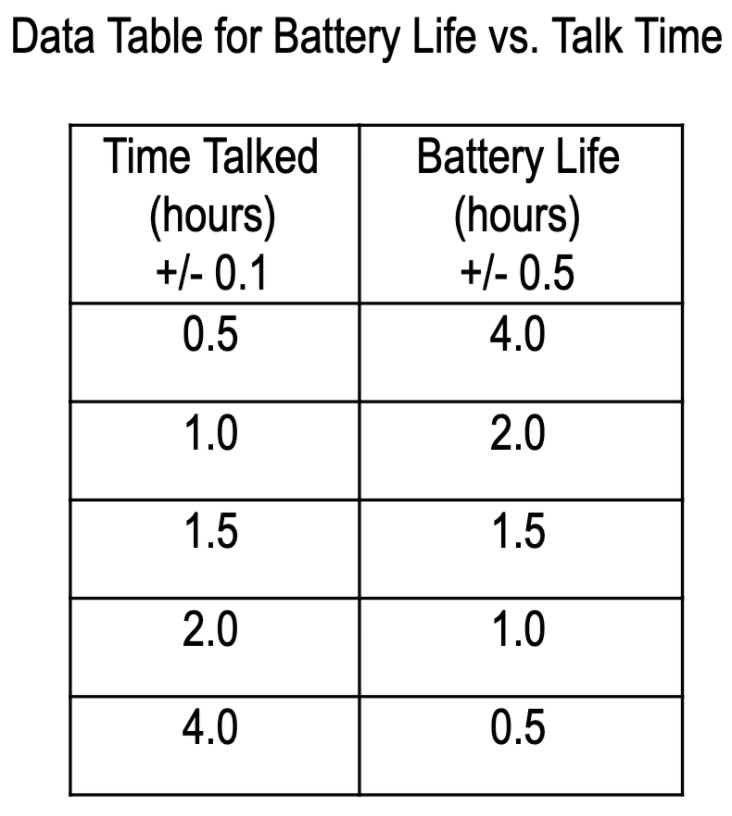
Observation -- Connor notices that that the longer he talks on his phone, the lower the battery life is, and wonders “How does the time talked affect the battery life?” Connor collects the following data about his phone.
1 point
1
Question 10
10.
Graph the data set. Use this link to graph and insert a screenshot of the graph.
1 point
1
Question 11
11.
What is the mathematical model for your best fit line?
1 point
1
Question 12
12.
What is the constant related to (hint: look at your axes on the graph)? (what does the A value represents in the real world)
1 point
1
Question 13
13.
Based on your graph or its mathematical model, predict the amount of battery life he will have if he talks for three hours.
1 point
1
Question 14
14.
What is the confidence in the prediction for number 12? Explain. (Use the confidence rubric to help you.)