8 - Inheritance and Genetic Variation
Learning Objectives: I will...
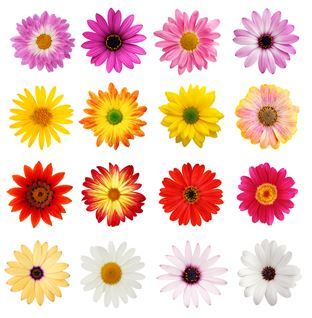
Look at the flowers shown above. Even though they all look different, they are in fact the same type of flower. These flowers are gerbera daisies, and as you can see, they come in many varieties. But how can this be? If they are all the same type of flower, why don’t they all look the same? The answer has to do with DNA, genes, and the parent plants. Yes, you can say that plants have parents. In fact, for any sexually reproducing organism, there must be two individuals involved. Each donates one half of their genetic information to their offspring. One parent gives this genetic information from a sperm cell. The other parent gives their offspring this information from an egg cell. Let us explore this a little further.
Deoxyribonucleic acid (DNA) is found in every cell of every organism. Each cell of a multicellular organism contains an exact copy of that organism’s DNA. All of the DNA within each cell is divided into chromosomes. For sexually reproducing organisms, cells contain two copies of each chromosome. One chromosome comes from the mother, and one chromosome comes from the father. Each chromosome contains segments called genes. Each chromosome carries genes for specific traits, but in slightly different versions. These different versions of the same gene are called alleles. Using our flowers as an example, the gene for the flower color trait is found in a specific gene on a specific chromosome. The location of this gene for flower color is the same for every gerbera daisy; however, there may be different alleles, or versions, of this gene. It is the different alleles that create the different colors. But how do different versions of the same gene happen?