Lower Sixth Redox test
star
star
star
star
star
Last updated over 5 years ago
31 Nsɛmmisa
1
1
1
1
1
1
1
1
2
1

1
5
2
1

1
1
1
3
1
1
1

1
1
1

1
1
1
1
1
1
1
When writing formulae, you don't need to worry about superscript or subscript numbers, just write it all on the same line, e.g. sulfate is SO42-
When writing equations, please use the following techniques:
- arrows are written as -->
- write all formulae as per the instruction above.
- leave spaces between the substances
- If balancing an acidified half equation, write the species being oxidised/reduced first, followed by any other species that are needed to balance it, followed by any electrons required to balance the charge, e.g.
MNO4- + 8H+ + 5e- --> Mn2+ + 4H2O not 5e- + MNO4- + 8H+ --> 4H2O + Mn2+
- Only include state symbols if the question asks for them
This is to help the automarking system identify the correct answers.
Which one of the following contains the metal with the lowest oxidation state?
Define the term reduction in terms of electrons
What is the oxidation state in NO3-
What is the oxidation state in NO2?
What is the oxidation state in NO?
Identify as oxidation or reduction, the formation of NO2 from NO3-
What is the half equation for the reaction in which NO is formed from NO3-
What is the half equation for the reaction in which NO2 is formed from NO3-
Deduce the overall equation for the reaction between NO3- ions, H+ ions and Cu, producing Cu2+, NO2 and water.
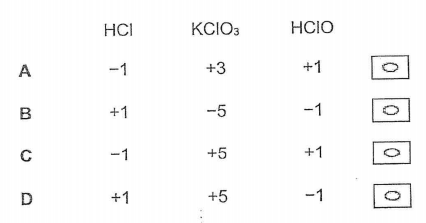
Which of the above is the correct oxidation state for chlorine in each of the compounds?
Refer to the unbalanced equation above. Which species is the reducing agent in this reaction?
A student carried out an experiment to find the mass of FeSO4.7H2O in an impure sample. The student recorded the mass of X. This sample was dissolved in water and made up to 25cm3 of solution. The student found that, after an excess of acid had been added, 25cm3 of this solution reacted with 21.3cm3 of a 0.0150 mol dm-3 solution of K2Cr2O7. What is the mass of FeSO4.7H2O in the sample?
Upload your working to get marks for it.
The student found that the calcualted mass of FeSO4.7H2O was greater than the actual mass of the sample that had been weighed out. The student realised that this could be due to the nature of the impurity.
Suggest one property of an impurity that would cause the calculated mass of FeSO4.7H2O in X to be greater than the actual mass of X. Explain your answer.
In terms of electrons, what happens to an oxidising agent during a redox reaction?
Consider the reaction above. Identify the oxidising agent. Write the formula but not the state symbol.
Consider the reaction above. Identify the reudcing agent. Write the formula but not the state symbol.
Write a half-equation to show how sulfur dioxide is converted into sulfate ions in aqueous solution
Write a half-equation for the oxidation of Fe2+ ions in this reaction.
Deduce the oxidation state of chlorine in ClO3- ions
Write a half equation for the reduction of ClO3- ions to Cl- ions in acidic conditions.
Write an overall equation for the reaction
Define oxidation in terms of electrons.
Deduce the oxidation state of nitrogen in NO.
Deduce the oxidation state of nitrogen in NH4+
Identify the species formed by oxidation in the reaction above.
Write a half equation for the formation of chloride ions from chlorine.
Write a half equation for the formation of hydrogen ions and sulfate ions from sulfur dioxide and water.
Write the overall equation for the reaction which occurs when chlorine is bubbled into aqueous sulfur dioxide.
Which one of the following is the electronic configuration of the strongest reducing agent?
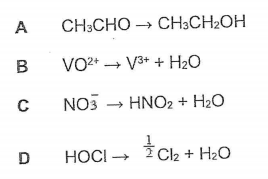
Look at the options above. In which of the reactions do two H+ ions and one electron have to be added to the self hand side in order to balance the equation?
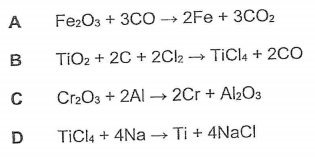
Look at the options above. Which equation does not involve the reduction of a transition metal compound?