Log in
Sign up for FREE
arrow_back
Library

Unit 5 Part 4 Cloud Lab

star
star
star
star
star
Last updated over 4 years ago
15 questions
3
2
1
1
1
1
1
1
1
1
3
1
Question 1
1.

Let's begin with a hypothesis:

Where do you think clouds come from?
Remember what we've been learning about air movement and convection cycles, now consider how moisture in the air might be connected to that process.

Question 2
2.

What are some important safety precautions to take when conducting an experiment, like the one we did together, where fire and pressurized containers are used?

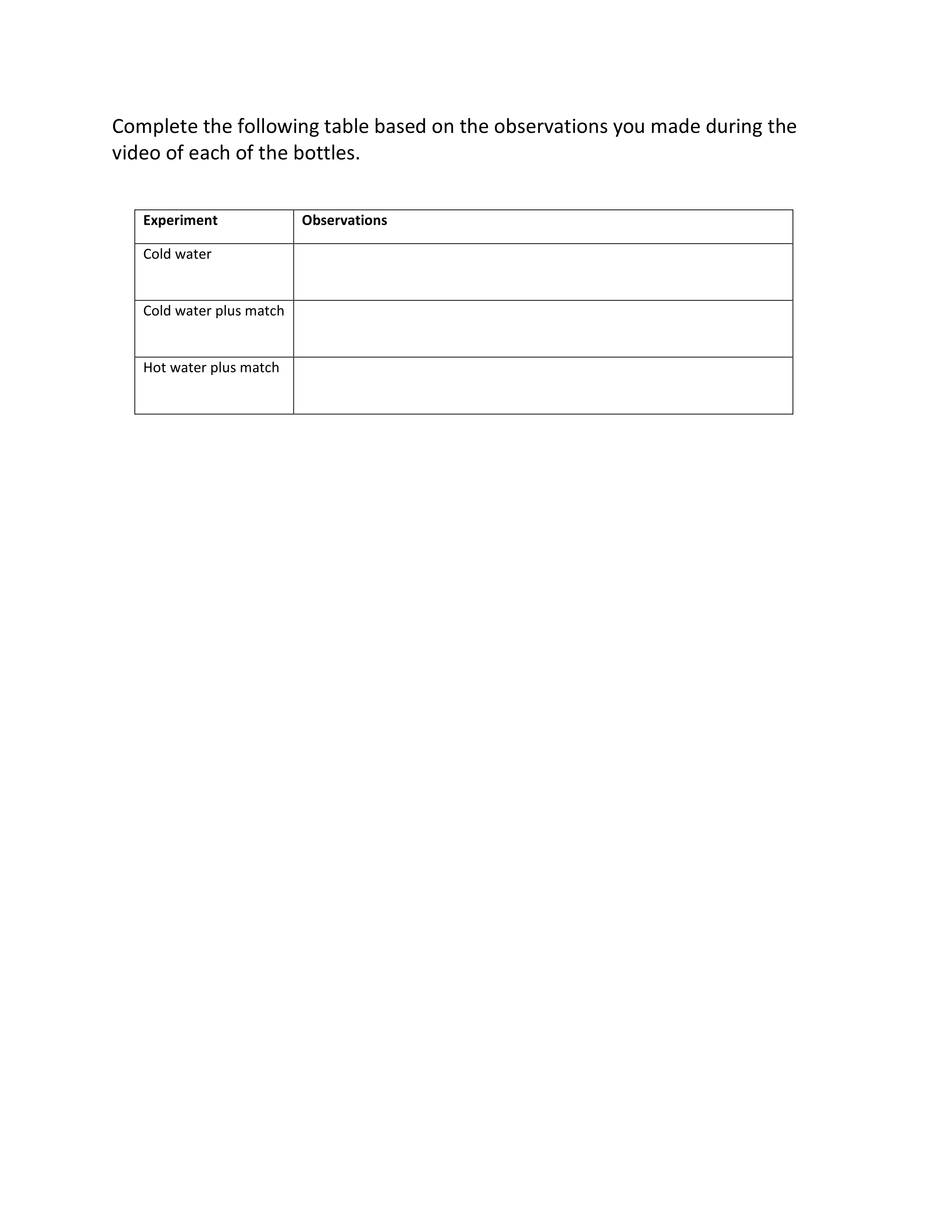
Next, watch the following video and fill out the observations below.
The results are the same as the experiment we conducted in class but it may be easier to see what happens in the bottle here. You are welcome to watch either.

Question 3
3.

What factor was manipulated in the experiment? (What is the independent variable being tested?)

Question 4
4.

Can you think of anything else we could have manipulated or changed to try and form bigger/better clouds?

1
Question 5
5.

Observations of bottle with just cold water.

1
Question 6
6.

Add your observations of the bottle with cold water plus the match.

1
Question 7
7.

Add your observations of the bottle with hot water plus the match.

Question 8
8.

Which experimental setup represented the negative control group? The one where we didn't expect a cloud to form.

Question 9
9.

Do condensation nuclei make it harder or easier for clouds to form?

Question 10
10.

Which of the following could create condensation nuclei?

Question 11
11.

In the experiment what was used as condensation nuclei?

Watch the following video to help answer questions 12 and 13.


Question 12
12.

Do clouds form in high or low atmospheric pressure systems?

Question 13
13.

Did the cloud appear in the experiment when he squeezed the bottle or released the bottle?

Question 14
14.

Conclusion:
Explain how the water vapor moved in the bottle and what happened when the temperature of the vapor changed?

Question 15
15.

Mark the places on the rubric that reflects where you are with respect to our learning targets for this lesson.