Inheritance &Variations part 1
star
star
star
star
star
Last updated over 5 years ago
25 Nsɛmmisa
Hyɛ no nsow a efi ɔkyerɛwfo no hɔ:
Genetics: Inheritance & Variations
10

1
1
1
1
1
1
1
1
1
1
1

1
1
1

1
1
1
1
1
1
1
1
1


1
Genetics: Inheritance & Variations
| Draggable item | arrow_right_alt | Corresponding Item |
|---|---|---|
VARIATION | arrow_right_alt | A version of a gene |
GENETIC VARIATION | arrow_right_alt | organized piece of DNA |
PUNNETT SQUARE | arrow_right_alt | reroductive rpocess that involves one parent and produces offbpring identical to the parent |
Item 2
CHROMOSOME | arrow_right_alt | basic physical and functional unit of heredity; made up of DNA |
ASEXUAL REPRODUCTION | arrow_right_alt | characteristic that is passed from parent to offspring |
SEXUAL REPRODUCTION | arrow_right_alt | a new organism produced by one or more parents |
Item 1
ALLELE | arrow_right_alt | tool used to analyze the possible allele combinations of the offspring between two individuals |
INHERITED | arrow_right_alt | The variety of gene combinations that exist within a population |
OFFSPRING | arrow_right_alt | The occurrence of an organism, trati or gene in more than one form |
GENE | arrow_right_alt | The reproductive process involving two parents whose genetic material is combined to produce a new organism |
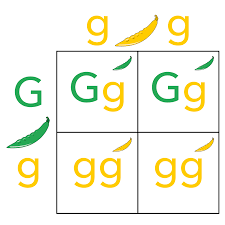
Does the uppercase letter (G )represent the dominant or recessive trait?
Does the lowercase letter (g) represent the dominant or recessive trait?
If the combination of letters has an uppercase G, will we see the dominant or recessive trait?
Based on your Punnett Square outcome, how many offspring with the dominant trait might show up?
How many DD combinations show up?
What color hair will the children with DD have?
How many Dd combinations are shown?
What color hair will the children with Dd combination have?
Is there any possible way Tark and Julia (who both have dark hair) can have children with light hair? EXPLAIN:
Use the spinner to figure out what traits will be passed on to each elf child.
http://shodor.org/interactivate/activities/BasicSpinner/
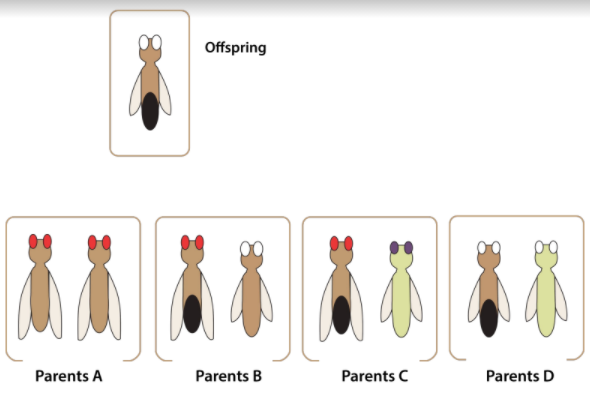
Based on the images of fruit flies above, which set of fruit flies is moste likely the offspring's parents?
What characteristics did you use to answer #14?
Read through each group of 3 or 4 clue words and guess the mystery word that is being described.
| Draggable item | arrow_right_alt | Corresponding Item |
|---|---|---|
baby seedling child parent | arrow_right_alt | variation |
smallest heredity DNA | arrow_right_alt | inherited |
distinct individuals different | arrow_right_alt | asexual |
reproduction parent one | arrow_right_alt | chromosome |
structure DNA genetic cells | arrow_right_alt | genes |
parent offspring trait | arrow_right_alt | offspring |
Who is the Austrian monk who studied peas and pea plants?
When Mendel bred a plant with yellow peas with a plant with green peas, in the next generation all the plants had yellow peas. This is due to the fact that...
The "hidden trait" that caused the plant with green peas is called a:
An allele is a:
Homozygous pairs result when the alleles are:
The heterozygous organism has:
The genotype is the set of alleles (ie. YY, Yy, or yy). The phenotype is...
What is the name of the model we have been using to predict the genotype and phenotype probabilities of offspring?