Log in
Sign up for FREE
arrow_back
Library

Cellular Respiration Article

star
star
star
star
star
Last updated about 5 years ago
4 questions
1
1
1
1
Question 1
1.

Question 2
2.

Question 3
3.

Question 4
4.

When do large amounts of ATP get created? How do you know?
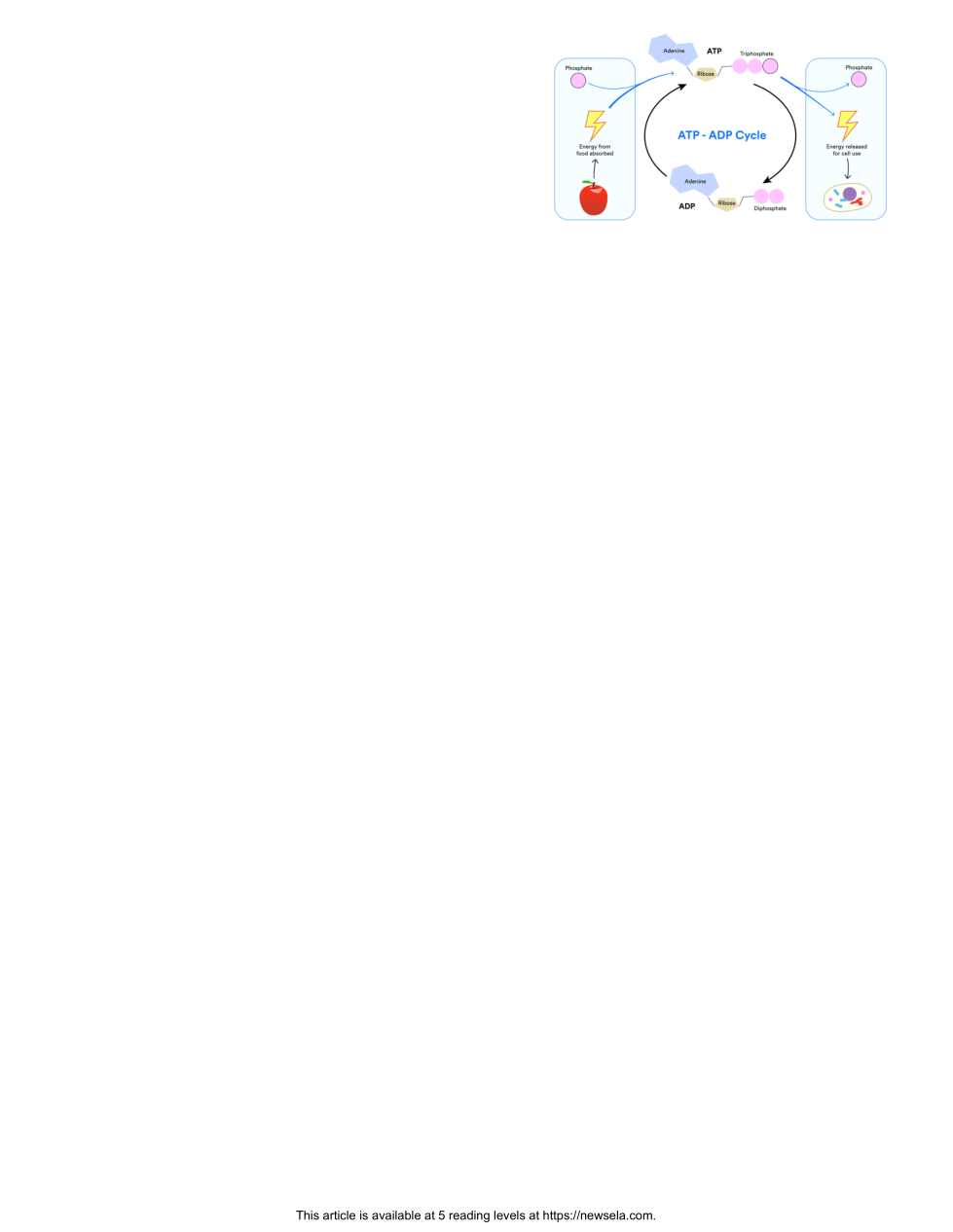
(A) Large amounts of ATP get created during the Krebs cycle. "It then converts it into adenosine triphosphate, or ATP. ATP is a high-energy molecule. It helps your muscles move. It also lets your body's nerve cells communicate with each other."
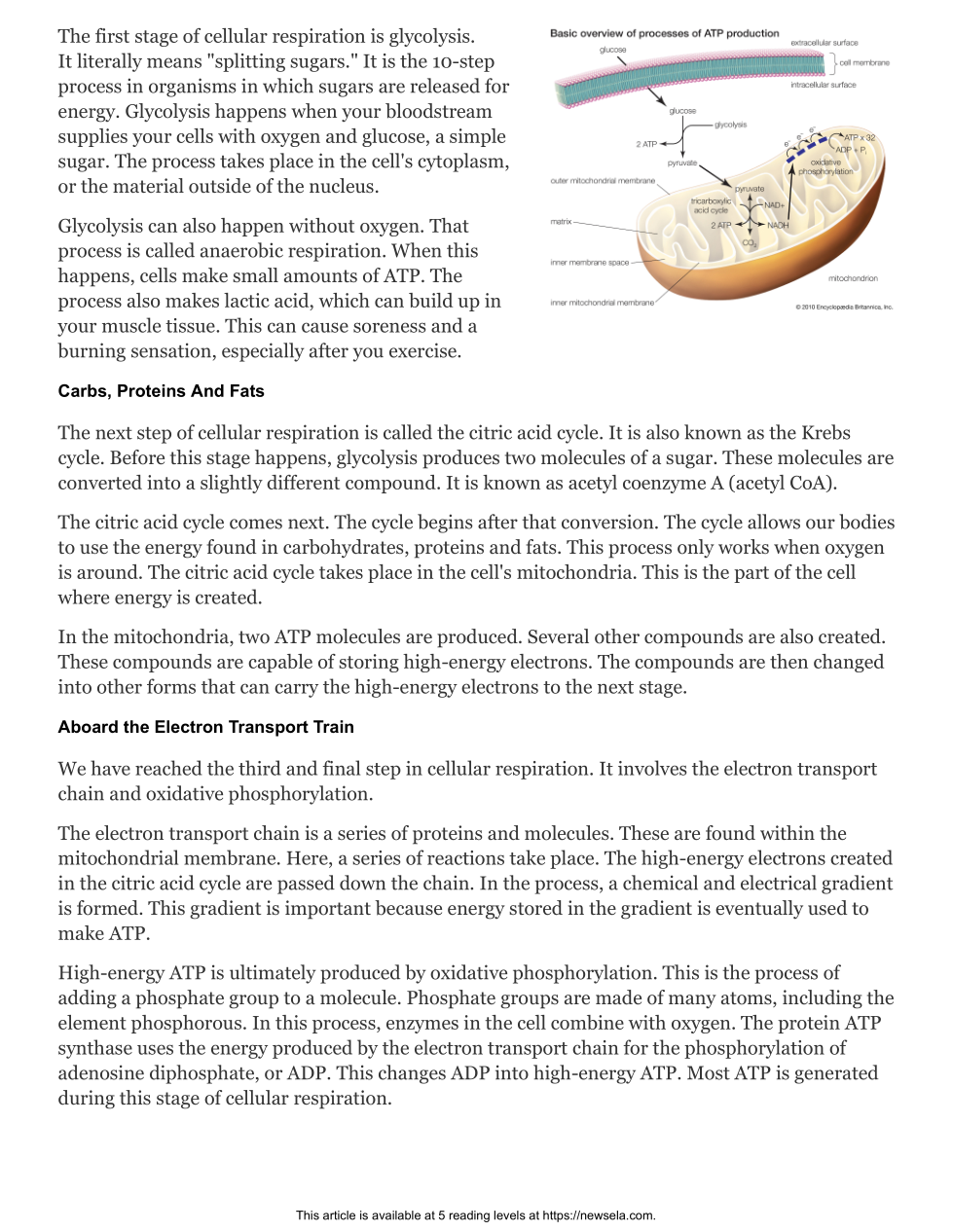
(B) Large amounts of ATP get created during glycolysis. "Glycolysis can also happen without oxygen. That process is called anaerobic respiration. When this happens, cells make small amounts of ATP. "
(C) Large amounts of ATP get created during the citric acid cycle. "In the mitochondria, two ATP molecules are produced. Several other compounds are also created. These compounds are capable of storing high-energy electrons."
(D) Large amounts of ATP get created during the electron transport and oxidative phosphorylation phase: "This changes ADP into high-energy ATP. Most ATP is generated during this stage of cellular respiration."
Read the introduction [paragraphs 1-4].
Select the detail from the section that shows what the goal of cellular respiration is.
(A) Our cells are able to pull nutrients from our foods. Then, cells convert the nutrients into usable forms of energy.
(B) Cellular respiration happens in both eukaryotic and prokaryotic cells. Eukaryotic cells are cells with a nucleus, which is the control center of the cell.
(C) These cells are found in many life forms, including animals. Prokaryotic cells don't have a nucleus. These are found in bacteria.
(D) There are three main stages of cellular respiration: glycolysis, the citric acid cycle and electron transport and oxidative phosphorylation.
Read the paragraph below from the section "Carbs, Proteins And Fats."

In the mitochondria, two ATP molecules are produced. Several other compounds are also created. These compounds are capable of storing high-energy electrons. The compounds are then changed into other forms that can carry the high-energy electrons to the next stage.

Which word from the paragraph helps the reader to understand the meaning of "produced"?
(A) compounds
(B) created
(C) storing
(D) changed
The word "glycolysis" is essential to understanding cellular respiration.

Which sentence from the article explains what "glycolysis" means?
(A) It is the 10-step process in organisms in which sugars are released for energy.
(B) The process takes place in the cell's cytoplasm, or the material outside of the nucleus.
(C) Glycolysis can also happen without oxygen.
(D) This can cause soreness and a burning sensation, especially after you exercise.