Log in
Sign up for FREE
arrow_back
Library
APUSH Period 5.1 (Ch. 16 & 18) Quiz - SY2021
By Haiyen Truong
star
star
star
star
star
Share
share
Last updated over 1 year ago
11 questions
Add this activity
1
IIUR.01
KC 4.3.II
POL 1.0
1
CUL 4.0
IICI.01
KC 5.2.I
1
KC 4.1.II
NAT 4.0
1
KC 5.2.I
NAT 4.0
1
IICI.01
KC 5.2.I
WXT 1.0
1
CUL 4.0
IIUR.01
KC 5.2.I
1
IIUR.01
KC 5.2.II
NAT 2.0
1
KC 5.1.II
POL 1.0
1
CUL 4.0
IIRC.02
KC 5.2.I
1
IIUR.01
KC 5.2.I
NAT 2.0
0
Question 1
1.
Review:
What was the result of the Missouri Compromise?
There were more slave states than free states in the Union.
Slavery was banned north of 36°30’ in the Louisiana Purchase territory, except in Missouri.
Missourians were required to free their slaves when they reached full adulthood.
The balance of power in the Senate tipped toward the free states.
Chapter 16:
The South and the Slavery Controversy (1793-1860)
Question 2
2.
The plantation system of the Cotton South before the Civil War
resembled an aristocracy in which wealth and power was concentrated at the top in a small group of people.
became more democratic and open to newcomers.
included no expectation that planter aristocrats had any obligation to serve the public as politicians or statesmen.
was very financially stable over many years.
Question 3
3.
Enslaved Blacks fought the system of slavery by
conducting periodic slave rebellions,
slowing down the pace of their labor.
All answer choices are correct.
running away from their masters.
Question 4
4.
Blacks living in the North experienced
widespread voting rights.
discrimination concerning employment, suffrage, and a public education.
high quality education that opened the door to economic opportunity.
living conditions that were nearly equal to those for whites.
Question 5
5.
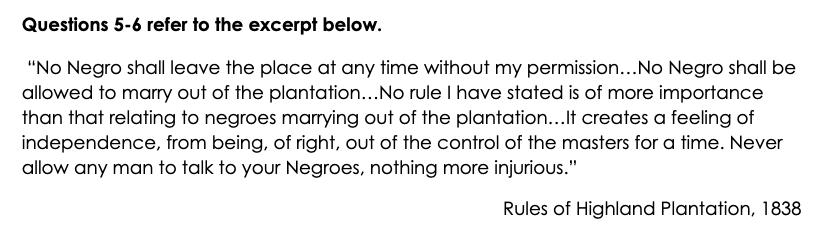
Which of the following best supports the excerpt?
Many slaves were able to buy their freedom.
Slave owners had a special status of privilege.
Slavery was the sole cause for a single crop agricultural system.
Many slave revolts resulted in freedom for thousands of slaves before the Civil War.
Question 6
6.
In the decades before the Civil War, slave owners
formed a union to prevent the abolitionists from gaining power.
provided separate villages for the slaves to come together for worship and marriage.
empowered by the slave revolts became less harsh toward their slaves.
created a set of proslavery arguments justifying slavery as a positive good.
Chapter 18:
Renewing the Sectional Struggle (1848-1854)
Question 7
7.
After the Mexico cession, the South grew increasingly worried about the future of slavery because
popular sovereignty would almost certainly prevent the spread of slavery.
the plantation system was unsuited to life on the Western frontier.
the Supreme Court might issue rulings against slavery.
the admission of California might permanently tip the political balance against them.
Question 8
8.
Stephen A. Douglas’ plans for deciding the slavery question in the Kansas-Nebraska scheme required repeal of the
three-fifths provision of the Constitution.
Wilmot Proviso.
Missouri Compromise.
Northwest Ordinance.
Question 9
9.
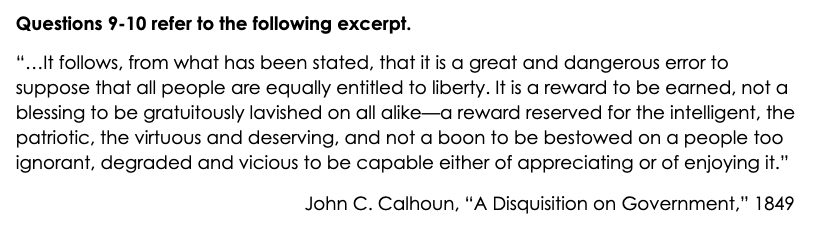
John C. Calhoun reveals here that many Southerners’ based their arguments in favor of slavery on
the economic necessity of the institution.
the Constitution’s protections of states’ rights.
support for the Northern labor market.
theories about racial superiority.
Question 10
10.
One of the most significant effects of rhetoric like that used here was
widespread opposition to the Civil War.
the demise of the two-party system.
increased sectional divisions between the North and South.
increased support for westward expansion.
Question 11
11.
Halfway through Period 5 (1844-1877)! How are you feeling? Any feedback, questions or concerns about this unit?
visibility
View drawing
