Log in
Sign up for FREE
arrow_back
Library

Chem Unit 6 Homework 1

star
star
star
star
star
Last updated 2 days ago
10 questions
Note from the author:
3
3
2
3
1
3
2
1
1
1
Review of the organization of the Periodic Table, scientists who developed the table, and characteristics of groups of elements
Question 1
1.

Match the work to the scientist who was the first to propose the concept or to conduct the work.

Draggable itemarrow_right_altCorresponding Item
Recognized that the middle element in a group of 3 similar elements is the mathematical average of the other two in weight and density.
arrow_right_alt
John Newlands
arrow_right_alt
arrow_right_alt
arrow_right_alt
arrow_right_alt
Question 2
2.

Draggable itemarrow_right_altCorresponding Item
Alkali Metals
arrow_right_alt
arrow_right_alt
arrow_right_alt
arrow_right_alt
arrow_right_alt
arrow_right_alt
Question 3
3.
Identify the sets of elements by the type of ion formed.
Other Answer Choices:
Elements that form ions with -1 charge
Elements that form ions with +2 charge
Elements that form ions with +1 charge
Elements that do not form ions
Question 4
4.

Distinguish between columns and rows on the Periodic Table.

  • Elements have the same number of valence electrons
  • Families
  • Elements have similar chemical and physical properties
  • Elements have the same number of energy levels
  • Groups
Question 5
5.

Which trait is the first characteristic considered in organizing elements in the modern Periodic Law?

Question 6
6.

Identify the type of ion formed.

  • The atom has 5, 6, or 7 valence electrons
  • The atom is a nonmetal, such as O, P, or Br
  • The atom gains 2 electrons
  • The atom is a metal, such as Na, Ca, or Al
  • The atom has 1, 2, or 3 valence electrons
Question 7
7.

Match the element family with its members' traits.

Draggable itemarrow_right_altCorresponding Item
Form ions with a charge of -1; nonmetals that are very reactive; each element has a distinct color; used as disinfectants
arrow_right_alt
Alkali Metals
Metals that are found in items that we touch such as jewelry, coins, and utensils
arrow_right_alt
Transition Metals
Nonmetals that are nonreactive; elements that have color when electrified in a light tube
arrow_right_alt
arrow_right_alt
Question 8
8.

Why do neon and argon have similar chemical and physical properties?

Question 9
9.

What rule states that atoms tend to lose, gain, or share electrons in order to get a full set of valence electrons?

Question 10
10.

Match the family of elements with its characteristics.

Draggable itemarrow_right_altCorresponding Item
Gases that have few known chemical reactions
arrow_right_alt
Noble Gases
Highly reactive, dangerous metals
arrow_right_alt
Alkali Metals
Highly reactive, colorful nonmetals
arrow_right_alt
Halogens
Organized elements by mass and properties and predicted properties for elements that seemed to be missing from his arrangement.
Johann Dobereiner
Assigned an atomic number to each element which was later recognized as the number of protons.
Henry Moseley
Law of Octaves devised after arranging elements by atomic weight.
Dmitri Mendeleev
Involved in the creation of the first transuranium elements, atoms produced in a laboratory.
Glenn Seaborg
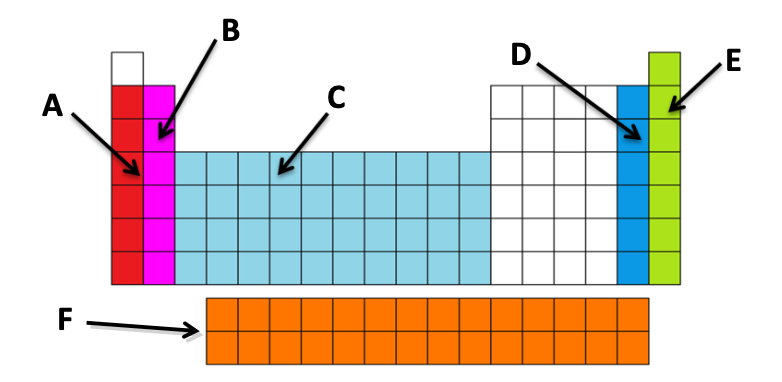
Identify the sets of elements by name.
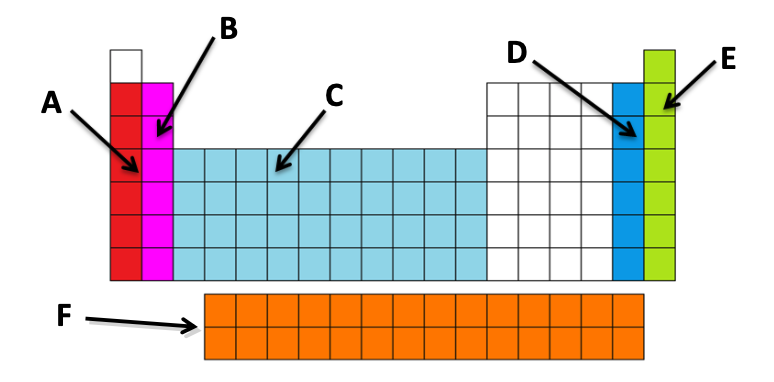
A
Noble Gases
B
Alkaline Earth Metals
C
Transition Metals
D
Inner Transition Metals
E
Halogens
F
Periods
Columns of Elements
Rows of Elements
The atom loses 3 electrons
+ an ion with a positive charge
- an ion with a negative charge
Halogens
Have 1 valence electron; metals that should not touch bare skin because they react quickly with water
Noble Gases