What Are Systems?
star
star
star
star
star
Last updated over 5 years ago
13 Nsɛmmisa
Hyɛ no nsow a efi ɔkyerɛwfo no hɔ:
A look into systems, and how they are important.

1

1
1
1
1
1
1
1
1
1
1
1
1
A look into systems, and how they are important.
(adapted from PBS & WGBH Educational Foundation, 2021. https://lsintspl3.wgbh.org/en-us/lesson/syslit-il-pdsystems/1)
So, what exactly is a system?
Write a definition of what you think a system is below
Look back at what you wrote in , and update it with any new insights.
Now, pick one of the examples of systems you listed on the previous page. Then use the simple questions to determine if the example you selected is actually a system--and not just a heap, collection, or group of things.
What's your example?
Are there parts?
Do the parts effect each other?
Does it matter how the parts are arranged?
Does the behavior of the system change if a key part is taken away?
Does the interaction of the parts produce an effect that is different from that of any of the parts on its own?
Over time, we humans have come up with ways to organize and make sense of [complex things].
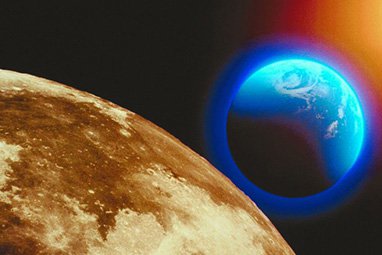
We see an object like the Sun that provides light and warmth, and give that object a name. Then we observe that the Sun appears over the horizon in one direction [in the morning] and disappears in the opposite direction as it gets dark. We have now identified a behavior of that object, and we name that behavior, sunrise and sunset ... We now recognize that a cycle is taking place and that it repeats each day, although this behavior changes over the course of the year: daylength varies, as does the location of sunrise and sunset.
To understand why this changes requires a shift in perspective. Eventually, we come to understand that the behavior of the Sun and the behavior of Earth are [related], and that these two objects, the Sun and Earth, are part of a system, together with other objects such as the Moon that each have their own behaviors and interactions. These interrelationships cause a lot of the phenomena we experience, including day and night, seasons, tides, [and] eclipses...!
...Studying systems can help us understand the whole set of interrelationships rather than just the parts, and to analyze how changing [just] one [thing], or changing the pattern of the parts, can have ...unexpected consequences in other parts of the system.
(Audio recording below)
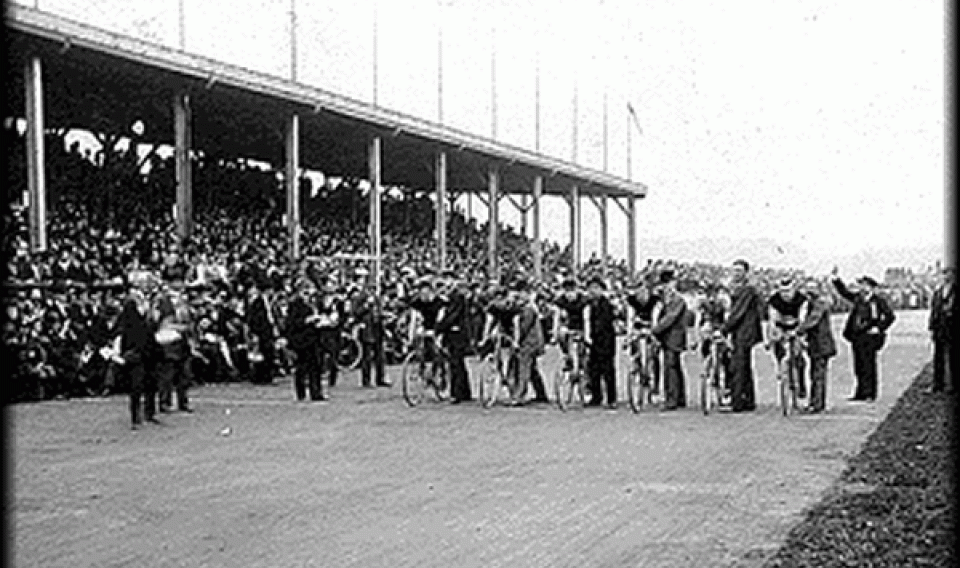
No inventor or country can single-handedly claim to have invented the bicycle; it was invented and reinvented in many places over a period of many years.
In 1817, Germany's Baron von Drais de Saverbrun invented the Draisienne, (also "draisine" or "hobby horse") a steerable bicycle. It was almost completely made of wood, and had no pedals. Riders propelled it by pushing their feet against the ground. In 1860, a model called the Michaux Velocipede became the world's first mass-produced riding machine. Designed by France's Pierre Michaux, he came up with his design when a customer brought a Draisienne in for repairs. After his son tried riding it and had difficulties with his feet on downhill roads, Michaux came up with the idea of connecting crank arms and pedals directly to the front wheel as a means of propelling the bike. In 1865 in Connecticut, Pierre Lallement rode a distance of several miles and performed the very first "header" (flipping over the handlebars) on his bicycle. He was granted the first bicycle-related U.S. patent in 1866.
It seems that people have always held a special place in their hearts for sports stars of the day; history has seen an ongoing cycle of esteemed athletes.
Since the automobile didn't catch on until the beginning of the 20th century, it is easy to understand how and why the bicycle became so popular. Throughout the late 1800s, new models and materials were constantly being designed and tested. Bicycles provided people with a means of travel, recreation, sport, and newfound freedom. The League of American Wheelmen, or L.A.W., was established in 1880 as a national chapter of bicyclists. Known then as "wheelmen," cyclists were challenged by gravel and dirt roads, and sometimes given problems by horsemen, wagon drivers, and pedestrians. In order to improve conditions for themselves, the early leaders of bicycling came together and lobbied the government for more paved roads and assistance in ending the antagonistic acts of other road-users. Formally united in 1880, the League's mission has continued for more than a century. Today, the L.A.W. is called the League of American Bicyclists.
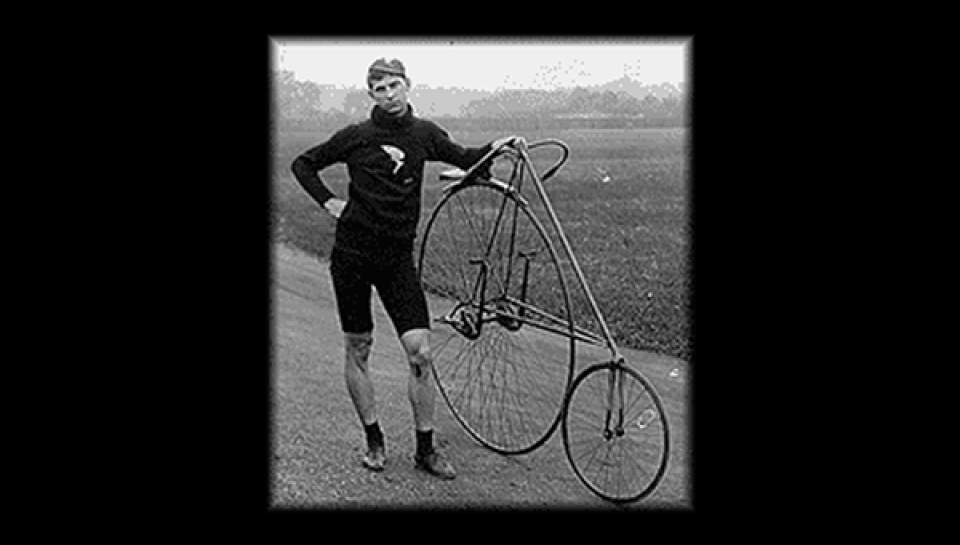
Bicycle clubs sprang up everywhere, and gave cyclists a chance to gather and socialize, share their interest in the sport, and even race competitively. Members proudly wore the badges, buttons, and pins of their clubs at meets and races. Before baseball cards came about, racing cards were sold in cigarette packs and featured the latest popular wheelman. Here are just a few of those heroes:
Charlie Miller was a German immigrant who lived in Chicago. Miller was considered the king of the "single six," a race in which a single rider sometimes pedaled as much as twenty hours in one day. Many people considered this a grueling test of racing ability, but he excelled at it. The single six was eventually outlawed.
Englishman Thomas Stevens took a bike trip around the world in the 1880s. The feat took two years and eight months to accomplish, and Stevens published installments of his colorful adventures along the way, gaining fame and the nickname, "The King of the Cycling World" for his incredible journey.
Two more "stars" of bicycle racing were George M. Hendee and W.A. Rowe. Hendee was graceful and handsome, and quickly became very popular. He was well known both in the society of cyclists and among racing fans. When W.A. Rowe, another rising star, upstaged him in a Massachusetts race in 1887, it was said that the people in the grandstands wept to see Hendee's champion status taken from him.
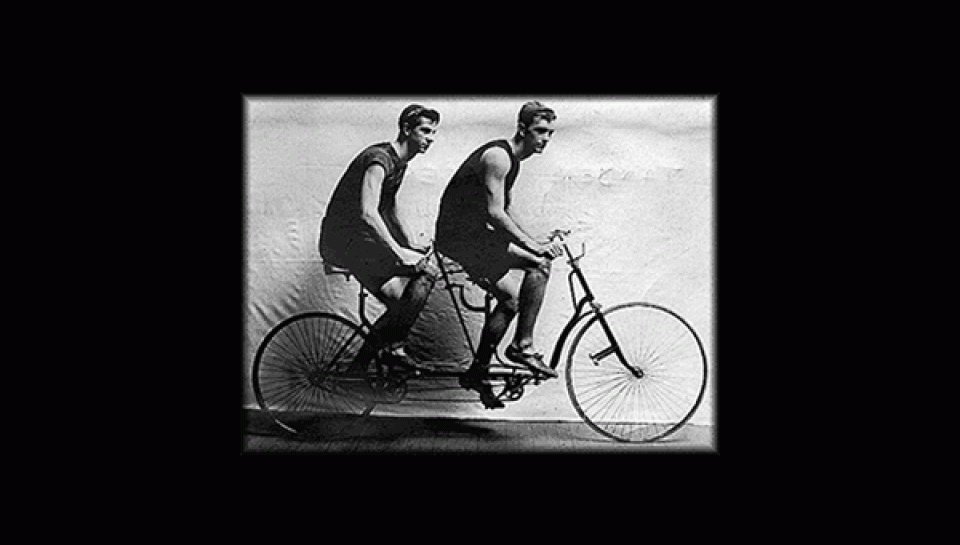
In the 1890s, A.A. "Zimmy" Zimmerman was America's first international athletic star. He was a fun-loving, agreeable character from New Jersey who could get three hours of sleep the night before a race and then go out and break a time record. Zimmerman changed amateur racing from a sport for the wealthy to a sport with universal appeal. He appeared in advertisements for bicycle companies, and people were fascinated with his effortless victories. Zimmy was known for his short bursts of incredible speed, holding back until the last lap when he would surge forward to defeat his competitors.
Marshall "Major" Taylor was an African-American who became one of America's first world champion athletes. Taylor was discovered at age 13 in Indiana, and won a racing medal at the same age. He faced extensive racial prejudice, and was even banned from racing in various American cities because of his color. In 1901, Taylor began a European tour of fifty-seven races, of which he won forty-two. Marshall Taylor was the first African-American world champion in any major sport.*
*[From The American Bicycle. Pridmore and Hurd, 1995.]
Note: The objects pictured above are part of The Franklin Institute's protected collection of objects. The images are © The Franklin Institute. All rights are reserved.
How do the early bicycles differ from bicycles made today?
Why were bicycles so popular when they were first invented in the late 1800s?
Why do you think bicycles are so popular TODAY?
Identify the various parts of a bicycle.
List 3 parts of a bicycle and what they do:
What is the purpose of a "bicycle system"?