TE 3.2

Last updated almost 3 years ago
15 questions

TE 3.2 Thermal Energy and Temperature Change

Objective: KWBAT demonstrate how things made of different numbers of molecules transfer energy and reach equilibrium by closely rereading key ideas from an article and building a model.

Part 1: Warm Up
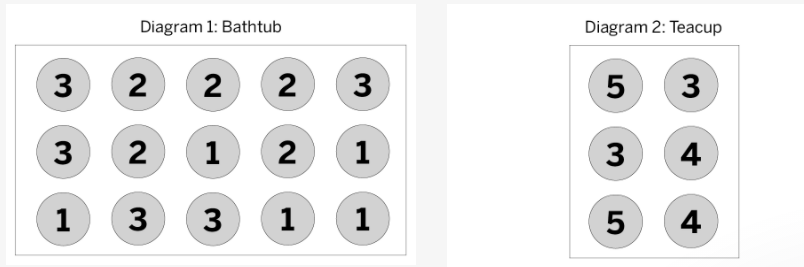
In a previous lesson, you compared a small teacup full of very hot water (80°C) to a large bathtub full of warm water (40°C). Below are two diagrams that use circles to represent molecules and numbers to represent how much kinetic energy each molecule has.
  • Diagram 1 represents the bathtub full of warm water, and
  • Diagram 2 represents the teacup full of hot water.
Examine the diagrams and use them to answer the questions below
1

What is the total kinetic energy of the molecules in Diagram 1?

1

What is the average kinetic energy of the molecules in Diagram 1?

1

What is the total kinetic energy of the molecules in Diagram 2?

1

What is the average kinetic energy of the molecules in Diagram 2?

1

Which object has a greater total kinetic energy?

1

Which object has a greater average kinetic energy?


Part 2: Close read of "Thermal Energy is NOT Temperature"

Reread paragraph 3 below from yesterday’s article. Then, answer the guiding questions. It will help us decide what determines how much thermal energy something has!
Paragraph 3:
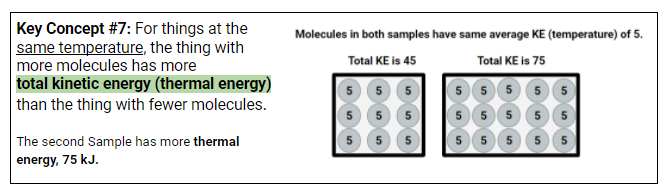
“Since the two containers of soup began at the same temperature, the molecules in the bowl of soup and the mug of soup started off with the same average kinetic energy. However, that doesn’t mean they had the same thermal energy. Thermal energy is the total kinetic energy of the molecules of an object or material, and not the average kinetic energy. Each molecule in an object or sample adds its kinetic energy to the total kinetic energy. The bowl contains a lot more soup than the mug, and because soup is made of molecules, more soup means more molecules. Each additional molecule contributes the kinetic energy of its movement to the total kinetic energy. As a result, your bowl of soup has much higher total kinetic energy (thermal energy) than your brother’s mug because it has more molecules to contribute to the total.”
1

Thermal energy =

0

What determines how much total kinetic energy (thermal energy) something has?

(how do I know something has more thermal energy?)

1

Why did your soup have a higher total kinetic energy?


Part 3: Energy Cube Models

Average Kinetic Energy = TEMPERATURE
Total Kinetic Energy = THERMAL ENERGY

Low average kinetic energy = low temperature
High average kinetic energy = high temperature
Same average kinetic energy = same temperature

Energy Cube: Trial 1

Use the Energy Cube system to complete the chart. The average KE (temperature) for each molecule is filled in.
  • Record the total KE for Objects 1 and 2.
  • Then, answer the review question.
1

Record the total KE for Objects 1 and 2.
(Add up the total amount of energy cubes for each object.)

1

True or False: Object B has more total kinetic energy than Object A.

1

Based on Energy Cube Trial 1, Which of these choices is correct?

Hint: Compare the total kinetic energy and average kinetic energy (Temperature) of both Objects.

Energy Cube: Trial 2

Use the Energy Cube system to complete the chart below.
  • Record the average kinetic energy of molecules for Objects A and B. (Count the cubes in each molecule to help you.)
  • Calculate individual total KE for Objects A and B.
1

  • Record the average kinetic energy of molecules for Objects A and B. (Count the cubes to help you.)
  • Calculate individual total KE for Objects A and B.

1

Based on Energy Cube Trial 2, Which of these choices is correct?

Hint: Compare the total kinetic energy and average kinetic energy (Temperature) of both Objects.

0

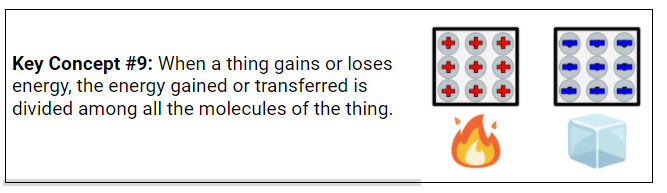
How could you change this system to make it stable?

Hint: Read key concept #9 to get an idea of how to make a system stable.

Sentence Starter:
I can make this system stable by.....