The major goal (that means WHY are we going through this process, not just what happens in this process) of cellular respiration is …
Which of the following are reactants (starting molecules) in cellular respiration (select all that apply)?
Which of the following are products (what is produced) in cellular respiration (select all that apply)?
How many hydrogens are in one glucose molecule?
ATP is … (select all that apply)
Where does glycolysis occur?
Where does acetyl CoA formation and the CAC occur?
Where does the electron transport chain occur?
What is the most useful part of glucose for cellular respiration (it's what we use in the Electron Transport Chain)?
What does ATP Synthase do in Cellular Respiration (select all that apply)?
What are the major things that occur in glycolysis/acetyl CoA formation/CAC (select all that apply)?
What are the major things that occur in the Electron Transport Chain (select all that apply)?
What does glucose become once you remove the hydrogens (this is a waste product)?
What does oxygen do in this process (select all that apply)?
What do electron carriers carry to the electron transport chain (select all that apply)?
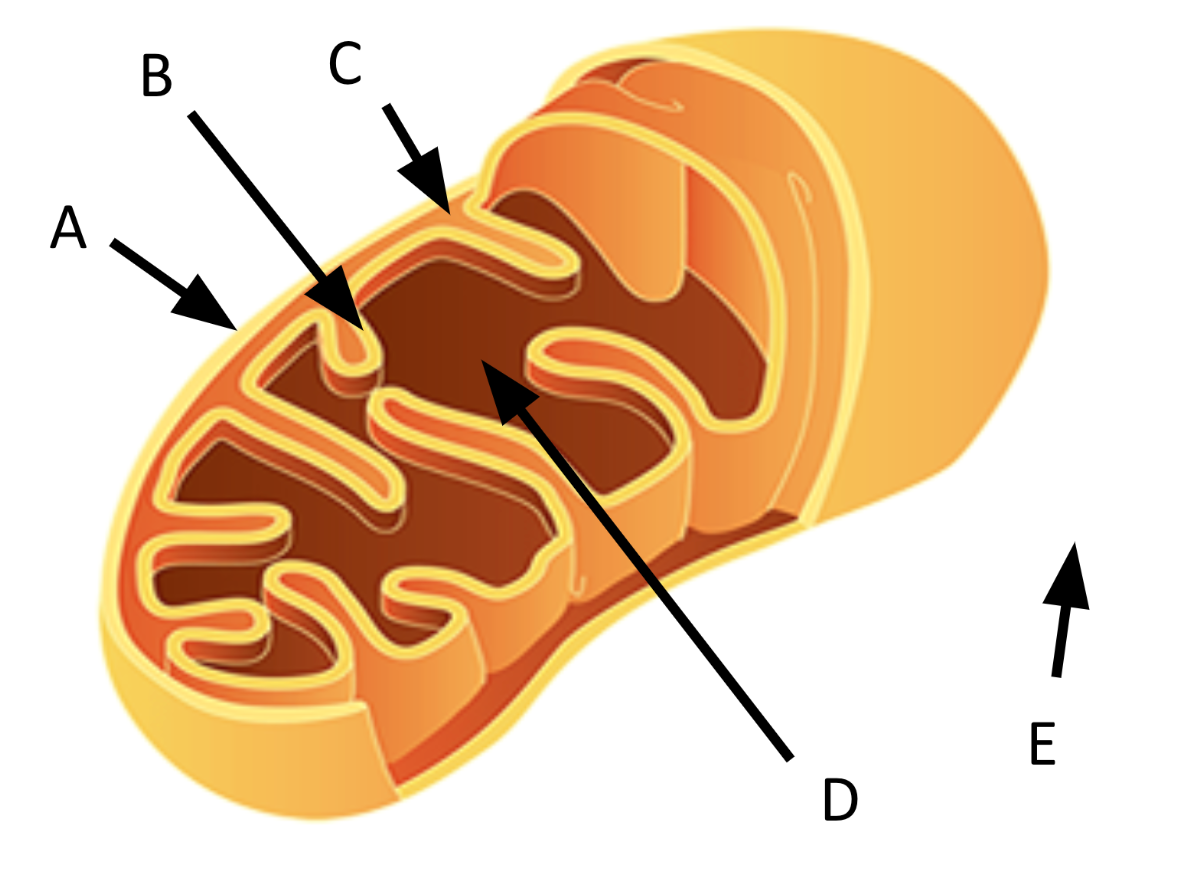
What is A pointing to?
What is B pointing to?
What is C pointing to?
What is D pointing to?
What is E pointing to?
Looking at the diagram, when you are forming the concentration gradient in the mitochondria using the hydrogen ions and electrons, where is there a high concentration of hydrogen ions?
Sort the following into the steps of cellular respiration:
Produces carbon dioxide as the waste from breaking down glucose
Combines the majority of ADP and phosphate groups in the process of cellular respiration
Makes a concentration gradient using electrons
Involves ATP synthase spinning
Pulls electrons off of glucose
Makes a concentration gradient using hydrogen ions
Pulls hydrogen ions off of glucose
Breaks down glucose
Creates the majority of ATP in the process of cellular respiration
Glycolysis, Acetyl CoA Formation, and Citric Acid Cycle
Electron Transport Chain
Sort the following into one of the reactants of cellular respiration
Is converted into water when combines with hydrogen ions and electrons
Has the hydrogen ions to use in the electron transport chain
Has the electrons to use in the electron transport chain
Is broken down in glycolysis/acetyl CoA formation/the citric acid cycle
Is converted into carbon dioxide when the hydrogen ions and electrons are removed
Contains 12 hydrogens
Is involved in the opening of the ATP synthase when it is combined with hydrogen ions and electrons
Glucose
Oxygen