1
1
1
1
1
1
1
1
The Central Nervous System (CNS) is composed of
Nerves carry impulses toward the brain are
An automatic response to a stimulus that often does not pass through the brain is called
Which membrane protein is responsible for restoring the original concentration of ions during the action potential?
Which protein hormone is produced by the pancreas to promote the increase in the sugar content of the blood by breaking down glycogen in the liver?
An endocrine gland that stores and releases two hormones produced by the hypothallumus is called
Visual condition in which the eye focuses an image behind the retina. Vision is better for a distance than for close up
The difference between a rod and a cone is
What structure regulates the amount of light passing to the visual receptors of the eye?
Light passes through the following structures in which order?
The ____ is an insulating lipid coat of cell membrane from Schwann cells that is interrupted by the Nodes of Ranvier
The lobe of the cerebrum responsible for sensory reception from many areas of the body is the
The most posterior lobe of the brain is the
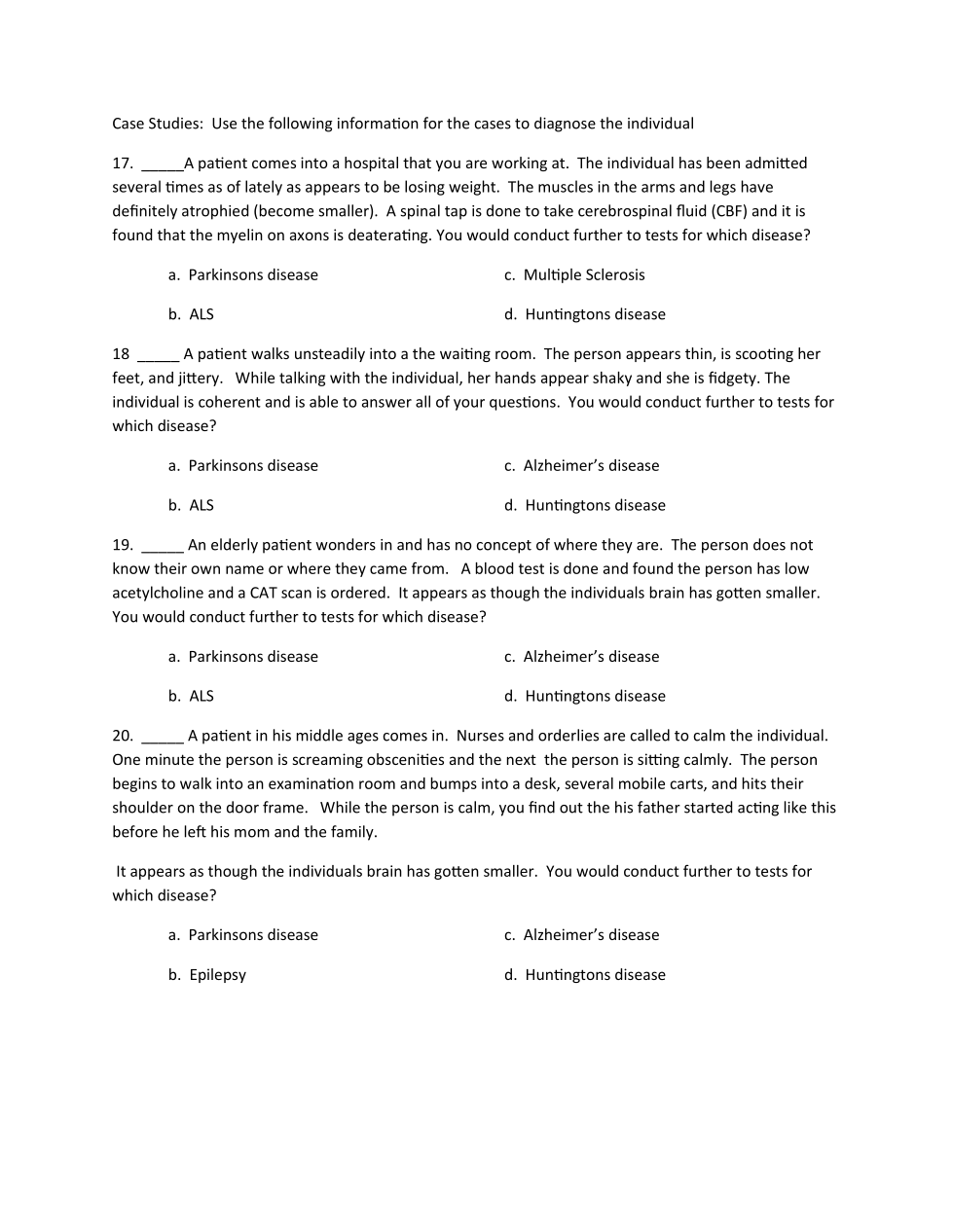
Use the following diagram and the choices to answer question 14
Use the following diagram and the choices to answer question 15
Use the following diagram and the choices to answer question 16
A patient comes into a hospital that you are working at. The individual has been admitted several times as of lately as appears to be losing weight. The muscles in the arms and legs have definitely atrophied (become smaller). A spinal tap is done to take cerebrospinal fluid (CBF) and it is found that the myelin on axons is deteriorating. You would conduct further to tests for which disease?
A patient walks unsteadily into a the waiting room. The person appears thin, is scooting her feet, and jittery. While talking with the individual, her hands appear shaky and she is fidgety. The individual is coherent and is able to answer all of your questions. You would conduct further to tests for which disease?
An elderly patient wonders in and has no concept of where they are. The person does not know their own name or where they came from. A blood test is done and found the person has low acetylcholine and a CAT scan is ordered. It appears as though the individuals brain has gotten smaller. You would conduct further to tests for which disease?
A patient in his middle ages comes in. Nurses and orderlies are called to calm the individual. One minute the person is screaming obscenities and the next, the person is sitting calmly. The person begins to walk into an examination room and bumps into a desk, several mobile carts, and hits their shoulder on the door frame. While the person is calm, you find out that his father started acting like this before he left his mom and the family.
It appears as though the individuals brain has gotten smaller. You would conduct further to tests for which disease?
Cardiac center, blood pressure
Hunger, thirst
Coordination of movement, posture, balance
Primary auditory area (hearing)
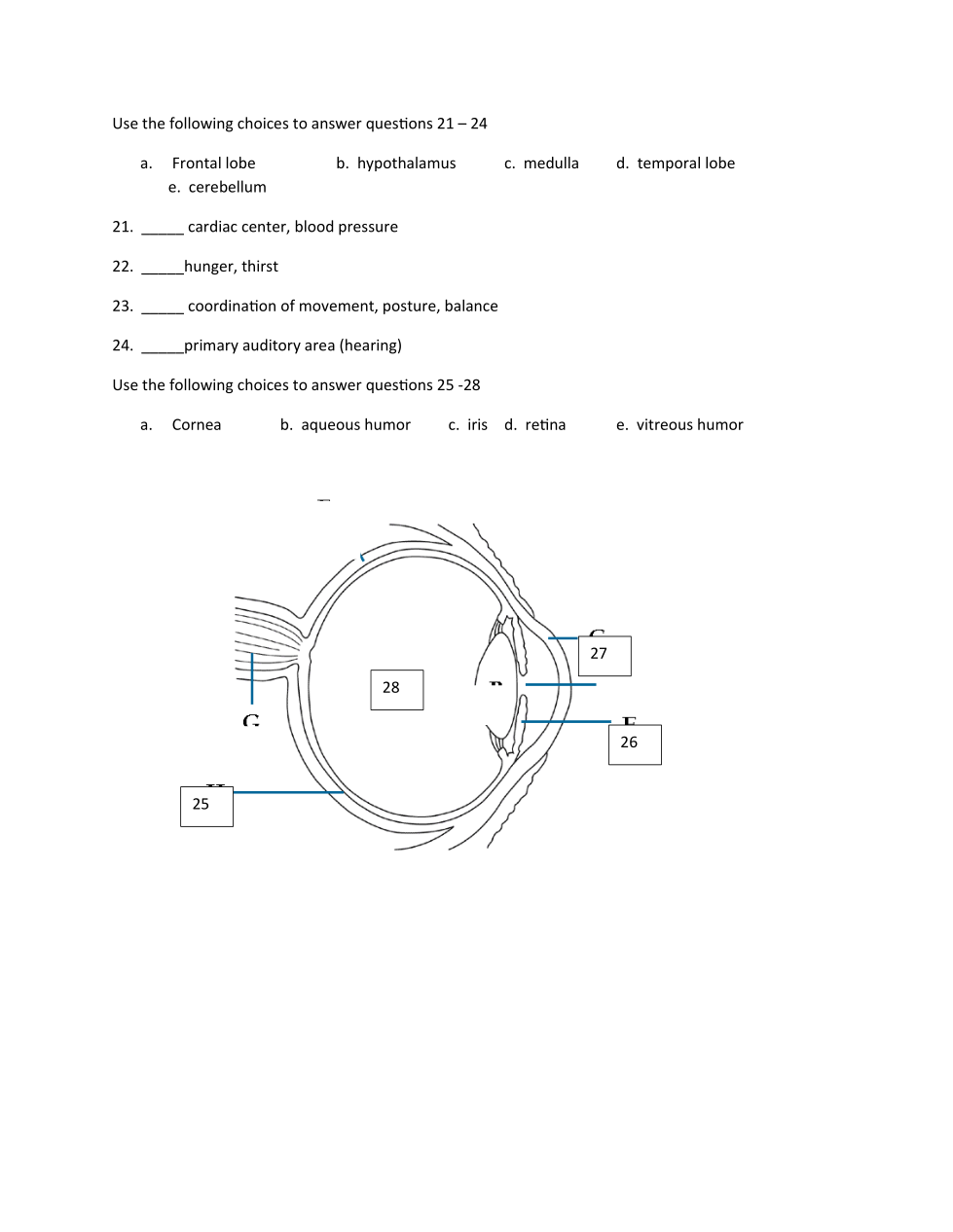
Use the following choices to answer question 25
Use the following choices to answer question 26
Use the following choices to answer question 27
Use the following choices to answer question28
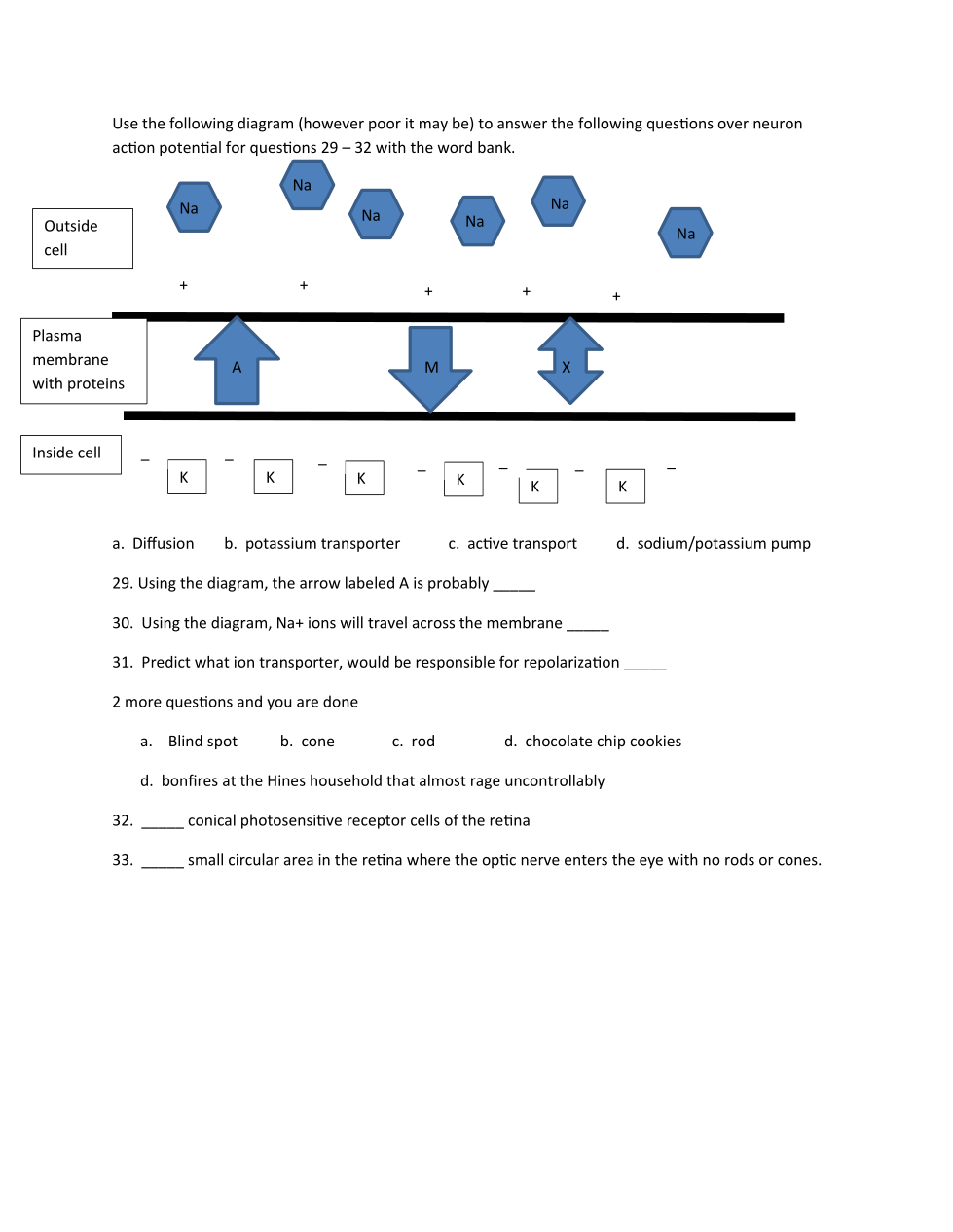
Using the diagram, the arrow labeled A is probably
Using the diagram, Na+ ions will travel across the membrane
Predict what ion transporter, would be responsible for repolarization
conical photosensitive receptors cells of the retina
Small circular area in the retina where the optic nerve enters the eye with no rods or cones