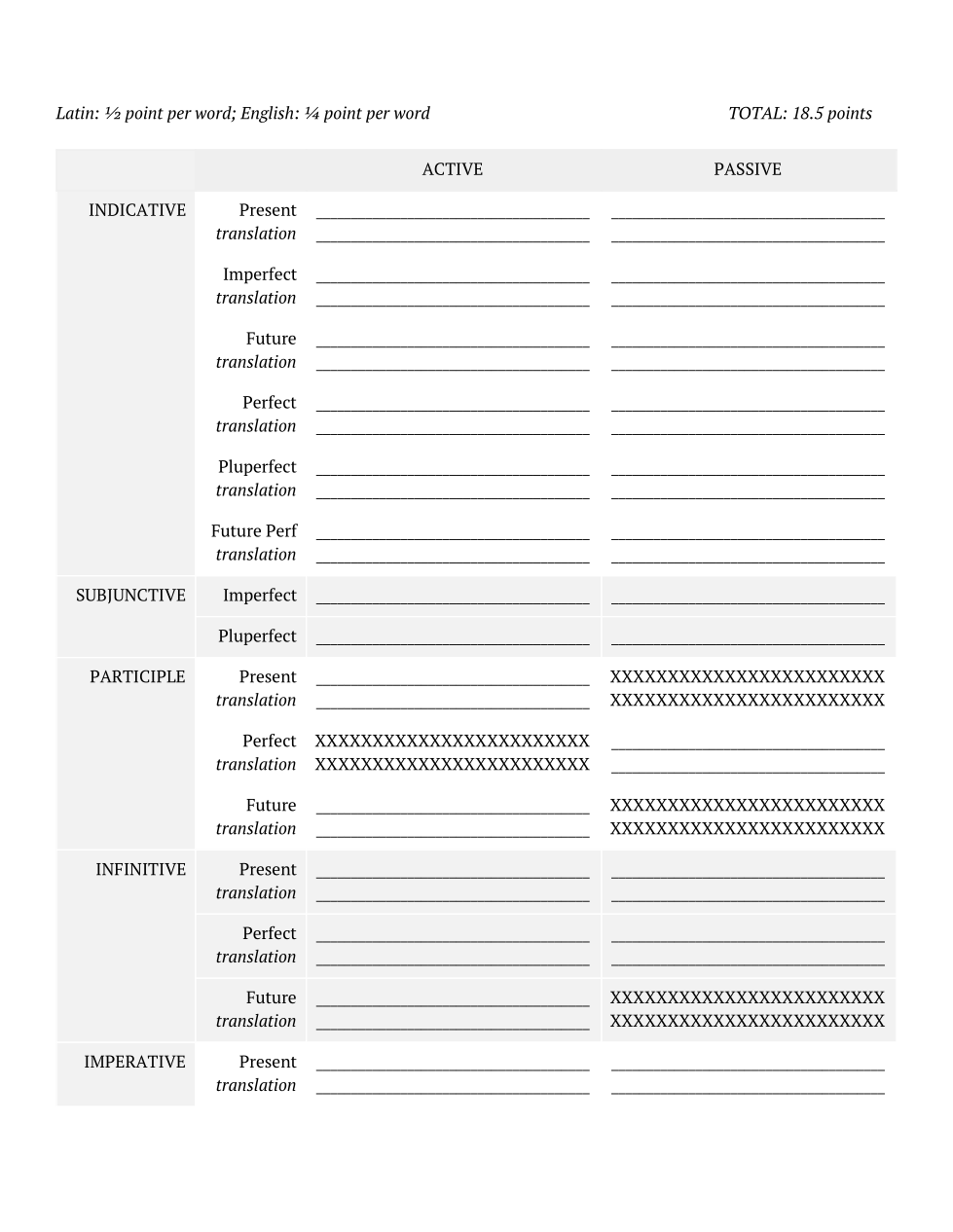
0.5
0.5
0.5
0.5
0.5
0.5
0.5
0.5
0.5
0.5
0.5
0.5
0.5
0.5
0.5
0.5
0.5
0.5
0.5
0.5
0.5
0.5
0.5
0.5
0.5
0.5
Change the indicative verb [in brackets] to subjunctive, keeping the TENSE and PERSON/NUMBER the same. Note that principal parts have been provided in the vocabulary help beneath the sentence.
Cum fūr vestīmenta ______________________________ [surripiēbat], Sextus in apodytērium ambulāvit.
vocabulary help:
surripiō, surripere, surripuī, surreptus: to steal
Change the indicative verb [in brackets] to subjunctive, keeping the TENSE and PERSON/NUMBER the same. Note that principal parts have been provided in the vocabulary help beneath the sentence.
Nesciēbam quid tū ______________________________ [vīderās].
vocabulary help:
videō, vidēre, vīdī, vīsus
Change the indicative verb [in brackets] to subjunctive, keeping the TENSE and PERSON/NUMBER the same. Note that principal parts have been provided in the vocabulary help beneath the sentence.
Nesciēbam quid ab illō senātōre ______________________________ [dictum erat].
vocabulary help:
nesciō, nescīre, nescīvī, nescītus: to not know
dīcō, dīcere, dīxī, dictus: to say
Translate this sentence into English.
Cum puerī in urbem cum Eucleidē ēgressī essent, domus Cornēliōrum tranquilla erat.
vocabulary help:
ēgredior, ēgredī, ēgressus sum: to go out
domus, domī / domūs, f.: home
tranquillus, -a, -um: peaceful
What type of subjunctive clause does this sentence contain?
Cum puerī in urbem cum Eucleidē ēgressī essent, domus Cornēliōrum tranquilla erat.
Translate this sentence into English.
Cornēlia et māter prōcēdēbant ad illam partem domūs ubi balneum fuit. Dum eō ambulant, Cornēlia mātrem rogāvit cūr in thermīs pūblicīs nōn lavārentur.
vocabulary help:
prōcēdō, prōcēdere, prōcessī, prōcessūrus: to proceed
pars, partis, f.: part
domus, domī / domūs, f.: home
balneum, balneī, n.: bath
dum (conj.): while
eō (adv.): there, to that place
rogō, rogāre, rogāvī, rogātus: to ask
thermae pūblicae, thermārum pūblicārum, f. pl.: public baths
lavor, lavārī, lautus sum: to bathe
What type of subjunctive clause does this sentence contain?
Dum eō ambulant, Cornēlia mātrem rogāvit cūr in thermīs pūblicīs nōn lavārentur.
Translate this sentence into English.
Cum māter "In thermīs lavārī mulierēs praeclārās nōn decet" dīxisset, Cornēlia identidem cogitābat cur virīs sed nōn mulieribus multa facere licēret.
vocabulary help:
thermae, thermārum, f. pl.: public baths
lavor, lavārī, lautus sum: to bathe
mulier, mulieris, f.: woman
praeclārus, -a, -um: distinguished, important
decet, decēre, decuit: it is proper
identidem (adv.): again and again
cogitō, -āre, -āvī, -ātus: to think about, ponder
licet, licēre, licuit: it is allowed
What type of subjunctive clause is the underlined verb a part of?
Cum māter "In thermīs lavārī mulierēs praeclārās nōn decet" dīxisset, Cornēlia identidem cogitābat cur virīs sed nōn mulieribus multa facere licēret.
Translate this sentence into English.
Cornēlia, cum cuperet cognōscere ubi esset Valerius et num ad urbem regressus esset, rogāvit, "Dīc mihi dē Valeriō, māter."
vocabulary help:
cupiō, cupere, cupīvī, cupītus: to desire
cognōscō, cognōscere, cognōvī, cognōtus: to find out, learn
num (conj.): whether
regredior, regredī, regressus sum: to return, go back
rogō, -āre, -āvī, -ātus: to ask
dē (+ abl.): about
Valerius, Valeriī, m.: Valerius
What type of subjunctive clause is the underlined verb part of?
Cornēlia, cum cuperet cognōscere ubi esset Valerius et num ad urbem regressus esset, rogāvit, "Dīc mihi dē Valeriō, māter."
sciō, scīre, scīvī, scītus ("know"): 2nd person pl. f.
INDICATIVE: Present Active (Latin)
sciō, scīre, scīvī, scītus ("know"): 2nd person pl. f.
INDICATIVE: Present Passive (Latin)
sciō, scīre, scīvī, scītus ("know"): 2nd person pl. f.
INDICATIVE: Imperfect Active (Latin)
sciō, scīre, scīvī, scītus ("know"): 2nd person pl. f.
INDICATIVE: Imperfect Passive (Latin)
sciō, scīre, scīvī, scītus ("know"): 2nd person pl. f.
INDICATIVE: Future Active (Latin)
sciō, scīre, scīvī, scītus ("know"): 2nd person pl. f.
INDICATIVE: Future Passive (Latin)
sciō, scīre, scīvī, scītus ("know"): 2nd person pl. f.
INDICATIVE: Perfect Active (Latin)
sciō, scīre, scīvī, scītus ("know"): 2nd person pl. f.
INDICATIVE: Perfect Passive (Latin)
sciō, scīre, scīvī, scītus ("know"): 2nd person pl. f.
INDICATIVE: Pluperfect Active (Latin)
sciō, scīre, scīvī, scītus ("know"): 2nd person pl. f.
INDICATIVE: Pluperfect Passive (Latin)
sciō, scīre, scīvī, scītus ("know"): 2nd person pl. f.
INDICATIVE: Future Perfect Active (Latin)
sciō, scīre, scīvī, scītus ("know"): 2nd person pl. f.
INDICATIVE: Future Perfect Passive (Latin)
sciō, scīre, scīvī, scītus ("know"): 2nd person pl. f.
SUBJUNCTIVE: Imperfect Active (Latin)
sciō, scīre, scīvī, scītus ("know"): 2nd person pl. f.
SUBJUNCTIVE: Imperfect Passive (Latin)
sciō, scīre, scīvī, scītus ("know"): 2nd person pl. f.
SUBJUNCTIVE: Pluperfect Active (Latin)
sciō, scīre, scīvī, scītus ("know"): 2nd person pl. f.
SUBJUNCTIVE: Pluperfect Passive (Latin)
sciō, scīre, scīvī, scītus ("know"): 2nd person pl. f.
PARTICIPLE: Present Active (Latin)
sciō, scīre, scīvī, scītus ("know"): 2nd person pl. f.
PARTICIPLE: Perfect Passive (Latin)
sciō, scīre, scīvī, scītus ("know"): 2nd person pl. f.
PARTICIPLE: Future Active (Latin)
sciō, scīre, scīvī, scītus ("know"): 2nd person pl. f.
INFINITIVE: Present Active (Latin)
sciō, scīre, scīvī, scītus ("know"): 2nd person pl. f.
INFINITIVE: Present Passive (Latin)
sciō, scīre, scīvī, scītus ("know"): 2nd person pl. f.
INFINITIVE: Perfect Active (Latin)
sciō, scīre, scīvī, scītus ("know"): 2nd person pl. f.
INFINITIVE: Perfect Passive (Latin)
sciō, scīre, scīvī, scītus ("know"): 2nd person pl. f.
INFINITIVE: Future Active (Latin)
sciō, scīre, scīvī, scītus ("know"): 2nd person pl. f.
IMPERATIVE: Present Active (Latin)
sciō, scīre, scīvī, scītus ("know"): 2nd person pl. f.
IMPERATIVE: Present Passive (Latin)