TES 2.5
star
star
star
star
star
Last updated about 1 month ago
12 Nsɛmmisa


1
1
1
1
1

3
6
0
1
1
1
0
New water forms on Earth every few years.
Dinosaurs may have drunk the same water you bathe in.
If all the water vapor in the atmosphere condensed, it would cover the whole Earth.
Air is always dry.
Your body is made of water.
Match each of the groups of molecules as a solid, liquid, or gas.
| Draggable item | arrow_right_alt | Corresponding Item |
|---|---|---|
| arrow_right_alt | Liquid |
| arrow_right_alt | Gas |
| arrow_right_alt | Solid |
THE WATER CYCLE! From National Geographic Kids

Pour yourself a glass of water and take a sip. Did you know that the water you’ve just swallowed is the same water that wooly mammoths, King Tutankhamun and the first humans drank? That’s because Earth has been recycling water for over 4 billion years!
The world’s water moves between lakes, rivers, oceans, the atmosphere and the land in an ongoing cycle called – you guessed it! – the water cycle. As it goes through this continuous system, it can be a liquid (water), a gas (water vapor) or a solid (ice).
Evaporation
Energy from the sun heats up the surface of the Earth, causing the temperature of the water in our rivers, lakes and oceans to rise (increase/get hotter). When this happens, some of the water “evaporates” into the air, turning into a gas called “vapor“. Plants and trees also lose water to the atmosphere through their leaves. This process is known as “transpiration“.
Condensation
As water vapor rises up high into the sky, it cools and turns back into a liquid, forming clouds. This process is called “condensation“. Wind high up in the air moves these clouds around the globe.
Precipitation
When too much water has condensed, the water droplets in the clouds become too big and heavy for the air to hold them. And so they fall back down to Earth as rain, snow, hail or sleet, a process known as “precipitation“.

Collection
The fallen precipitation is then “collected” in bodies of water – such as rivers, lakes and oceans – from where it will eventually evaporate back into the air, beginning the cycle all over again. How it is collected, depends on where it lands…
Some will fall directly into lakes, rivers or the sea, from where it will evaporate and begin the cycle all over again. In cold climates, the precipitation may build up on land as snow, ice or glaciers. If temperatures rise, the ice will melt to liquid water and then soak into the ground, or flow into rivers or the ocean.
Water that reaches land directly may flow across the ground and collect in the oceans, rivers or lakes. This water is called “surface run-off“. Some of the precipitation will instead soak (or “infiltrate”) into the soil, from where it will slowly move through the ground until eventually reaching a river or the ocean.
And there you have it – the ongoing water cycle!
Match each of the following vocabulary words with its definition.
| Draggable item | arrow_right_alt | Corresponding Item |
|---|---|---|
Water Vapor | arrow_right_alt | When a liquid water turns into water vapor. |
Precipitation | arrow_right_alt | When water vapor turns into liquid water. |
Groundwater | arrow_right_alt | Liquid or solid water that falls to earth’s surface. |
Evaporation | arrow_right_alt | Water that is found in soil and rock underground. |
Runoff | arrow_right_alt | Water in the form of invisible gas. |
Condensation | arrow_right_alt | The downward movement of surface water. |
In the water cycle, what causes evaporation to occur?
Sentence starter: Evaporation happens when ____________
Imagine you’re looking at a water molecule in the atmosphere. What phase (state) of matter is it in - is it a solid, liquid or gas?
Which image below could show water molecules before they evaporate?
Which image below could show water molecules before they condense?
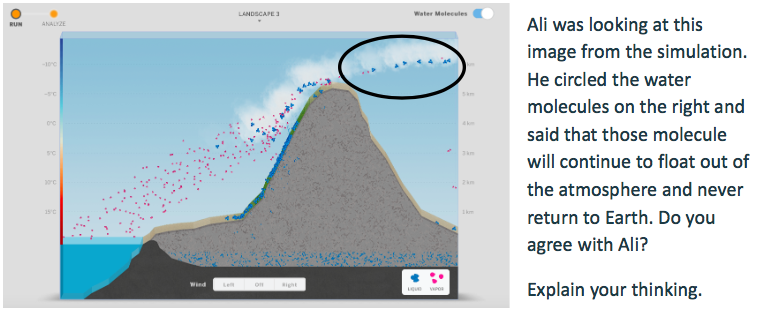
Sentence starters (choose one):
I agree with Ali, because ______________
OR
I disagree with Ali, because ______________


