Log in
Sign up for FREE
arrow_back
Library

Cells Review

star
star
star
star
star
Last updated about 5 years ago
16 questions
Note from the author:
1
1
10
1
1
6
4
6
6
10
4
4
1
1
1
2
Covers cell basics, photosynthesis and cellular respiration basics, and characteristics of living things.

Directions:

Use your Human Body Digital Notebook to answer the questions.

Question 1
1.

Question 2
2.

Question 3
3.

Question 4
4.

Question 5
5.

Question 6
6.

Draggable itemarrow_right_altCorresponding Item
arrow_right_alt
arrow_right_alt
arrow_right_alt
arrow_right_alt
arrow_right_alt
arrow_right_alt
Question 7
7.

Question 8
8.

Question 9
9.

Question 10
10.

Question 11
11.

Choose ONE living thing from Question 10. Tell how you KNOW that it is a living thing.
(*See Notebook SLIDE 6)

Question 12
12.

Choose ONE nonliving thing from Question 10. Tell how you KNOW that it is NOT a living thing.
(*See Notebook SLIDE 6)

Question 13
13.

Question 14
14.

Question 15
15.

Question 16
16.

Which of the following BEST defines "structure"?
(*See Notebook SLIDE 4)
Giving or receiving information
Something's job or purpose
Working together
How something is built or arranged
A building
Which of the following BEST defines "function"?
(*See Notebook SLIDE 4)
Working together
Something's job or purpose
Giving or receiving information
A building
How something is built or arranged
Sort the items into their correct category.
(*See Notebook SLIDE 4)
Getting liquid to your mouth
Making and receiving calls and messages
Cell phone
Arctic foxes have thick fur
Flying through the air
Large wings on an eagle
Tear apart food
A drinking straw's hollow, cylindrical shape
A shark's sharp teeth
Insulation (warmth) in cold climates

Structure

Function

Which of the following BEST defines "cell"?
(*See Notebook SLIDE 5)
The structures that make up all living things
The structure that make up plants and animals
A nonliving part of an organism
The one thing that all living things have in common
Which of the following BEST defines "organelle"?
(*See Notebook SLIDE 5)
A part of the cell that helps the cell survive
The basic building block of all living things
A structure that makes something an organism
The one thing that all cells have in common
Match each job (function) to the cell organelle (structure) that is responsible.
(*See Notebook SLIDE 9)
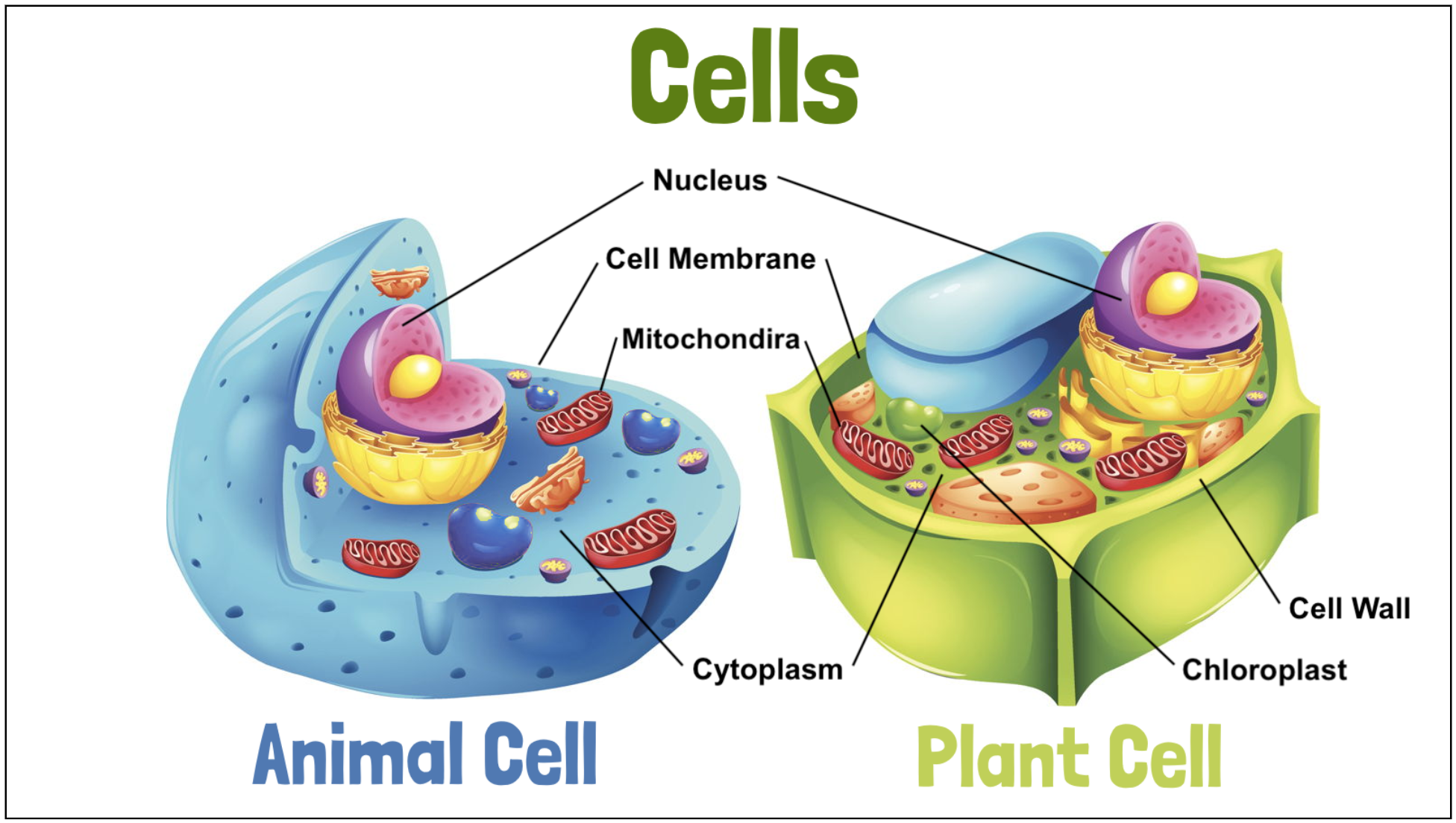
The jelly-like fluid that fills the cell and keeps the organelles in place
Cell membrane
Turns oxygen & food into ENERGY through cellular respiration
Nucleus
A sturdy outer layer that gives the cell its shape and structure
Mitochondria
Uses DNA instructions to tell the parts of the cell what to do and when
Chloroplast
Holds the cells together and protects it from its environment
Cell wall
Uses carbon dioxide & water to make FOOD (glucose) through photosynthesis
Cytoplasm
Which of the following cell organelles are found in ANIMAL cells. (Check all that apply.)
(*See Notebook SLIDE 9)
Cell membrane
Cell wall
Chloroplast
Cytoplasm
Mitochondria
Nucleus
Which of the following cell organelles are found in PLANT cells. (Check all that apply.)
(*See Notebook SLIDE 9)
Cell membrane
Cell wall
Chloroplast
Cytoplasm
Mitochondria
Nucleus
Which of the following are NOT among the 5 characteristics of living things?
(*See Notebook SLIDE 6)
Respond to stimuli
Reproduce
Grow
Move
Need sunlight
Made up of cells
Heal
Breathe
Absorb nutrients
Swim
Talk
Sort the following items into their correct category.
(*See Notebook SLIDE 6)
Dirt
Seaweed
Bacteria
Chloroplast
Ant
Seagull
Mold
Influenza (flu virus)
Sunlight
Amazon Alexa

Living

Nonliving

Which of the following BEST defines "cellular respiration"?
(*See Notebook SLIDE 7)
The process of making ENERGY for the cell using oxygen and good particles
Calculating a solution to a problem
The process of making FOOD for the plant cell using sunlight, carbon dioxide, and water
Breathing in oxygen and exhaling carbon dioxide
Which of the following BEST defines "photosynthesis"?
(*See Notebook SLIDE 7)
The process of releasing ENERGY for the cell using oxygen and good particles
The process of making FOOD for the plant cell using sunlight, carbon dioxide, and water
Breathing in oxygen and exhaling carbon dioxide
Calculating a solution to a problem
Why do PLANT cells need photosynthesis?
(*See Notebook SLIDE 7)
To use carbon dioxide
To release energy
To make food
To release oxygen
How do OUR cells benefit from photosynthesis? (Check all that apply.)
(*See Notebook SLIDE 7)
Uses sunlight that would otherwise be wasted
Removes carbon dioxide from the air
Provides oxygen for us to breathe in for cellular respiration
Provides food that we can eat, digest, and break down for energy