Log in
Sign up for FREE
arrow_back
Library

QB3 - Population Ecology

star
star
star
star
star
Last updated about 5 years ago
4 questions
1
1
1
1
Question 1
1.

Question 2
2.

Question 3
3.

Question 4
4.

The graph below shows information about the growth of a population.
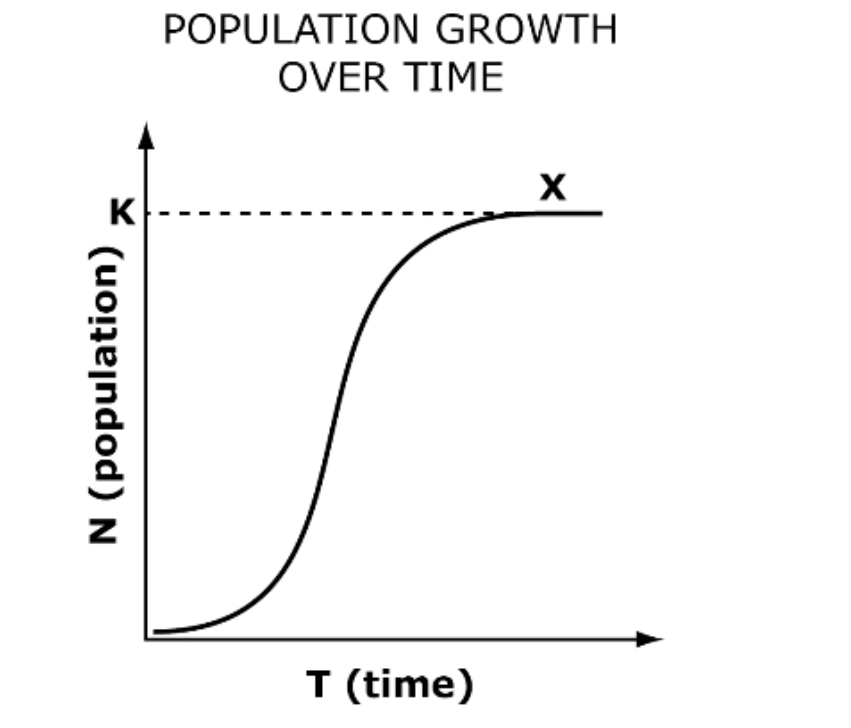
Which best explains what occurred at point X on the curve?
The birth rate was equal to the death rate.
The death rate was greater than the birth rate.
The rate of emigration was equal to the birth rate.
The rate of immigration was greater than the death rate.
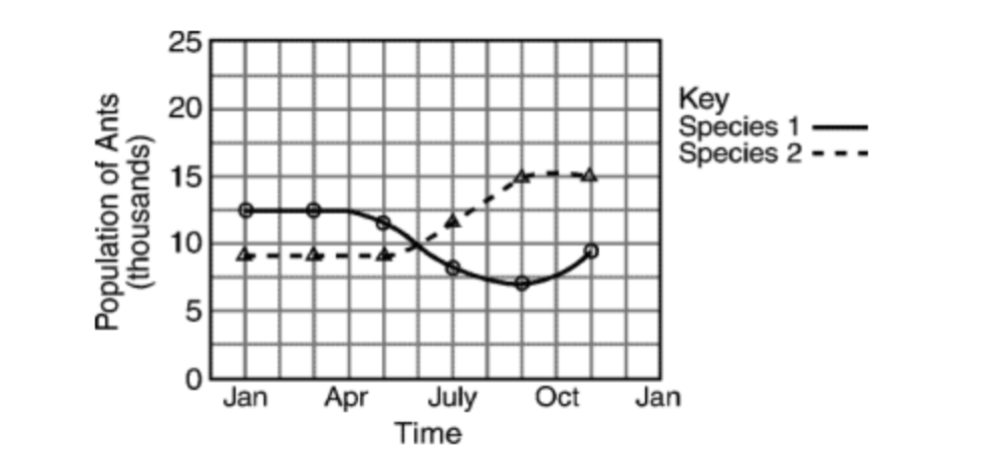
The graph shows the populations of two species of ants. Ants of species 2 have a thicker outer covering that helps prevent excessive evaporation of water and keeps them cool and hydrated.


Which statement would best explain the population changes in the graph?
Disease killed off species 1 beginning in May
the food sources for species 1 increased while the food sources for species 2 decreased from January through November.
Mutations occurred from April through September in both species, resulting in both species becoming better adapted to the environment.
The weather was hotter and dryer than normal from April through September.
In the 1930s, the Red Imported Fire Ant was accidentally introduced into the United States. This species is native to South America, but has thrived in the United States because of a lack of natural enemies here. Which of the following best explains how the Red Imported Fire Ant has affected native ant species in the U.S. that do have predators?
Native ant species preyed on the Red Imported Fire Ant and increased in population.
Native ant species interbred with the Red Imported Fire Ant, creating new ant species.
The Red Imported Fire Ant caused native ant species to become more susceptible to predators.
The Red Imported Fire Ant caused a decline in native ant species by competing for their resources.
Scientists that study the effects of global warming predict that a change in Earth's average temperature of even a few degrees will have dramatic effects. One consequence of global warming is the melting of the polar ice caps, which will in turn affect polar bears that use sea ice as a platform for hunting seals. What will most likely happen to the population of polar bears as a result of global warming?
It will increase as polar bears adapt to other habitats.
It will increase because polar bears will have fewer predators.
It will decrease as the habitat suitable for polar bears decreases.
It will decrease because polar bears will become easier to hunt.