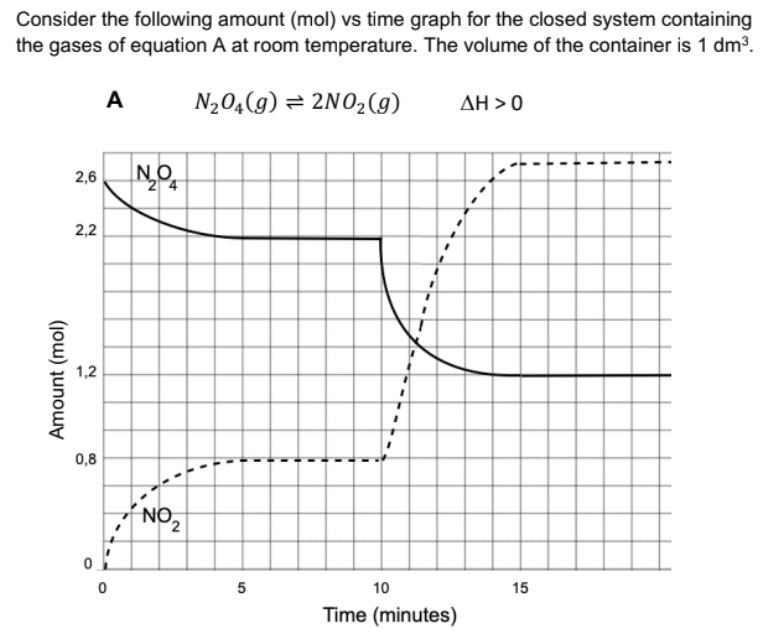
For the following system at equilibrium, which statement is INCORRECT?

For the following system at equilibrium, which statement is INCORRECT?
Hydrogen gas and iodine gas are introduced into a flask, which is then sealed and allowed to reach dynamic chemical equilibrium.
The balanced equation is:
H2(g) + I2(g) ⇌ 2HI(g).
Which one of the graphs shows how the rates of the forward and reverse reactions change with time?
Which of the following is true regarding the concentration of products, for a chemical system at equilibrium?
For the following system at equilibrium, which statement is INCORRECT?
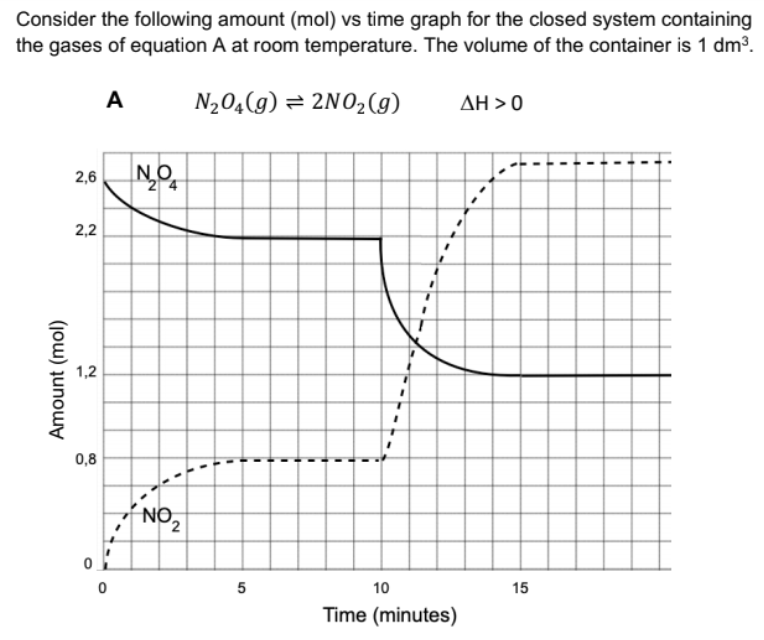
Consider the amount (mol) vs. time graph for the closed system containing the gases of equation A at room temperature. The volume of the container is 1 dm3.
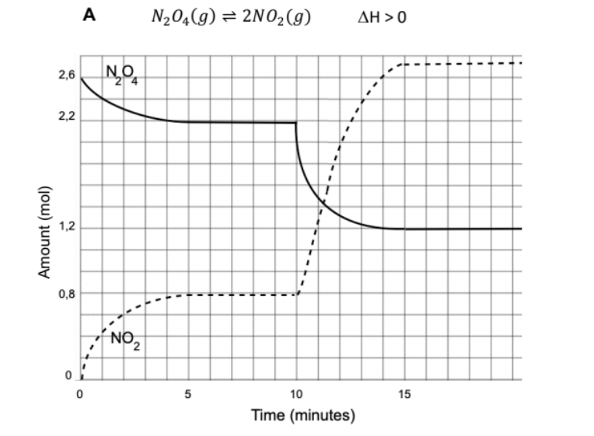
At which of the following time(s) is the the system NOT in equilibrium?
A disturbance to temperature was made at 10 minutes. Which reaction was favoured?
Therefore, considering your answer above, what temperature change was made at 10 minutes?