Characteristics of High and Low Pressure
star
star
star
star
star
Last updated over 5 years ago
17 Nsɛmmisa
1
1
1
1
1
1
1
1
1
1
1
1
1
1
1
1
1
Is the pressure inside the balloon HIGH or LOW when the balloon IS inflated?
When the balloon is released does the air flow out of the balloon or into the balloon?
Knowing this, what is the correct direction that air flows
If the balloon was inflated to MAXIMUM capacity how would the air flow be affected?
When a balloon is blown up to MAXIMUM capacity the pressure inside the balloon is __________ compared to the outside air
Based on the two previous question, when there is a BIG difference in pressure between to locations you would expect:
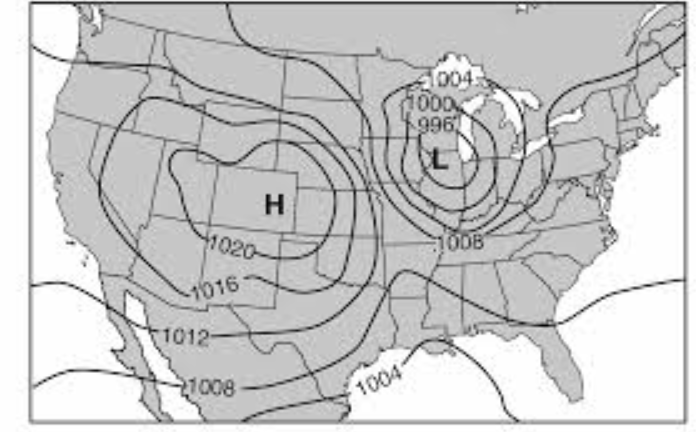
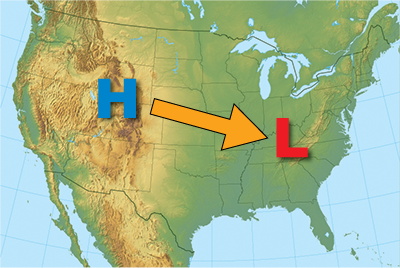
Pressure differences are shown on a weather map using ISOBARS. ISOBARS represent lines of EQUAL PRESSURE. On this map you can see where the (H) highest pressure and (L) lowest pressure on the map are located. Wind will travel from the H to the L. The CLOSER that the ISOBARS are together the BIGGER the pressure difference. Where would the FASTEST winds be blowing on this day?
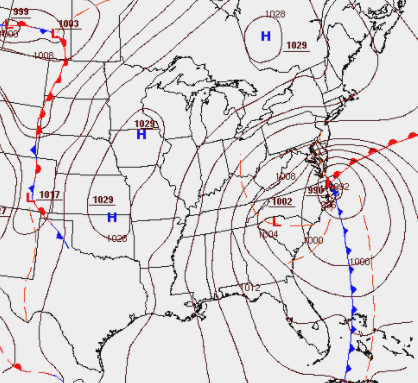
You are on a BOAT travelling off of the coast of North Carolina during this storm. Based on the weather map above the safest route around this storm would be:
In this video clip what is the correct movement of the ball?
Why would LOCATION A represent an area of HIGH PRESSURE?
Why did the ball curve to the right as it was traveling AWAY from Location A?
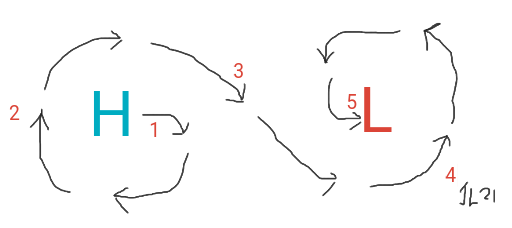
IMAGE ABOVE IS LOOKING DOWN AS IF IT WERE A MAP
List below describes the air flow at labelled locations on the diagram above
1. Wind flows FROM High pressure TOWARDS Low pressure and veers to the RIGHT as Earth rotates beneath it.
2. Winds flows CLOCKWISE around HIGH pressure
3. Wind flows AWAY from High pressure towards Low pressure in order to create equilibrium.
4. Winds gets sucked INTO LOW pressure just like pet hair into a vacuum.
5. Winds travel COUNTERCLOCKWISE and up the center of Low pressure just like a tornado.
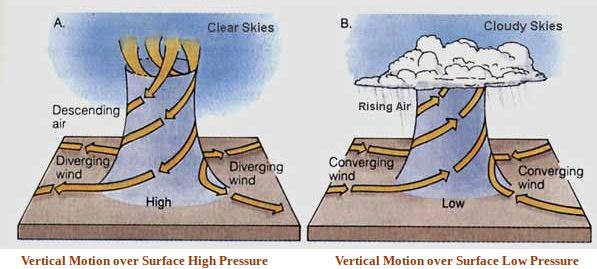
Above is a sideview that shows the CONSTANT VERTICAL air motion as well as the wind direction.
What direction does wind flow around a HIGH pressure system?
What direction does wind flow around a tornado which is also an intense LOW pressure system?
Which statement is correct?
A LOW pressure system would be be compared to:
Using thick black arrows, draw the correct pattern that the wind traveled from the center of High pressure towards the center of Hurricane Sandy on October 29, 2012 as it approached the Jersey Shore.
Draw arrowheads on the lines below showing proper vertical and horizontal wind direction.