TES 3.1-3.2
star
star
star
star
star
Last updated about 1 month ago
24 Nsɛmmisa


1

1
1
1
1


1
1

1
1
1
1
1
1
1

1
1
1
1

1
1
1
1
1
1
Based on what we know so far, why is more rain forming over West Ferris than East Ferris?
What do you notice about the temperatures of East Ferris and West Ferris?
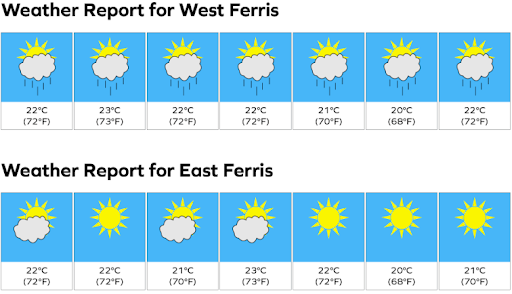
Sentence starter: The temperatures of East Ferris and West Ferris are _______________
Directions: Read the page to the right from Water Encyclopedia to find information about temperatures in the atmosphere!
Important thing to know, just ONE kilometer is about 3,280 feet or the length of about 11 football fields!
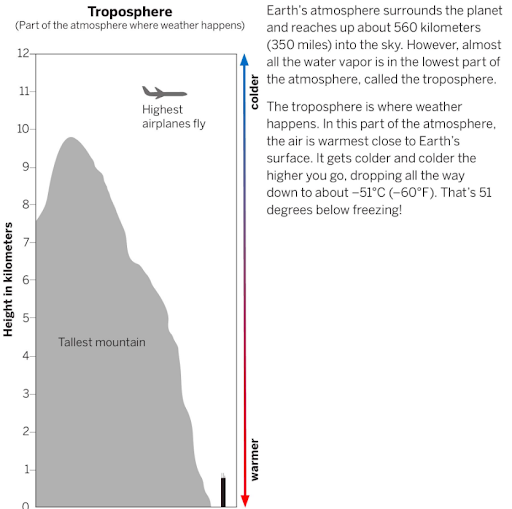
What happens to the temperature as it gets higher into the atmosphere?
What evidence in the text supports this claim/answer?
Sentence starter: In the text it says ________________
What evidence in the diagram/model supports this claim/answer?
Sentence starter: In the diagram it says ________________
Read Page 12 and answer where and why water vapor condensed.
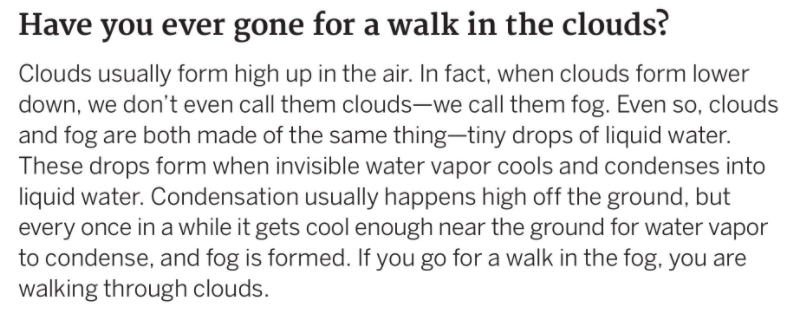
Example of water vapor condensing: Fog
Where did the water vapor condense?
Sentece starter: The water vapor condensed _________________________
Example of water vapor condensing: Fog
Why did the water vapor condense?
Sentece starter: The water vapor condensed because _________________________
Read Page 13 and answer where and why water vapor condensed.
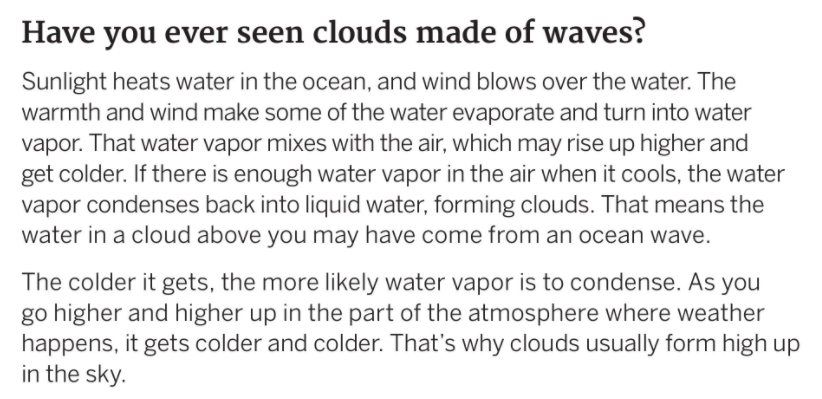
Example of water vapor condensing: Clouds
Where did the water vapor condense?
Sentece starter: The water vapor condensed _________________________
Example of water vapor condensing: Clouds
Why did the water vapor condense?
Sentece starter: The water vapor condensed because _________________________
Condensation mostly happens higher in the atmosphere or lower in the atmosphere?
Why do you think so?
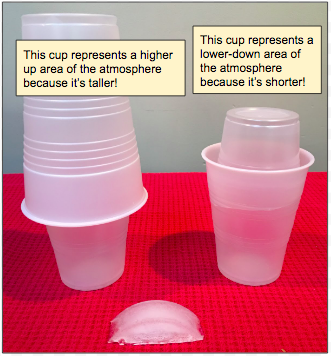
Make a prediction! What do you think will happen in the models and why?
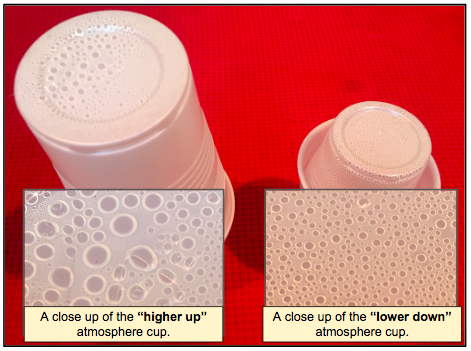
What do you notice is different between the two models afterwards?
Condensation happens higher in the atmosphere. Why?
Sentence starter: Condensation happens higher in the atmosphere because ___________________
Scientists and engineers collect and analyze data, which are observations or measurements recorded in an investigation. Today, we’ll use our simulation to investigate where water vapor condenses and record data as we go!
Before you start the sim, watch the video below to understand key features of it.
How does temperature change as you get higher in the atmosphere?
How do the amounts of molecules in water vapor and liquid water change as you move from 3.0 to 4.0 kilometers in the atmosphere?
Where does water vapor condense most?
Why do you think more condensation is happening there than in other areas of the atmosphere?
Sentence starter: More condensation happens there because _________________
Based on our key point, where is condensation most likely to happen?
Two students were trying to graph their data from the sim. However, one of them got confused when and messed up when making their graph!
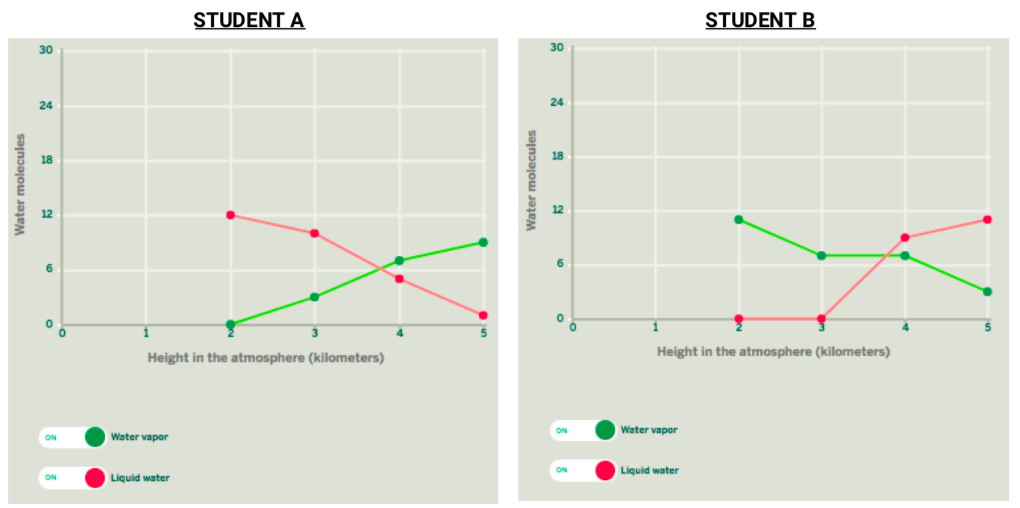
Based on your investigations in the sim, and our key point we learned together, who’s data is correct and who got confused? Explain how you know.
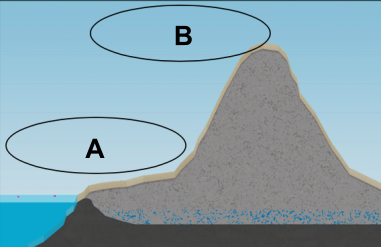
Would more water vapor molecules or liquid water molecules be found at location A?
Explain why (you chose your answer for the last question):
Sentence starter: Location A would have more ________________________ molecules because __________________
Would more water vapor molecules or liquid water molecules be found at location B?
Explain why (you chose your answer for the last question):
Sentence starter: Location B would have more ________________________ molecules because __________________