0.25
0.25
0.25
0.25
0.25
0.25
0.25
0.25
0.25
0.25
0.25
0.25
0.25
0.25
0.25
0.25
0.25
0.25
0.25
0.25
0.25
0.25
0.25
0.25
Translate the sentence. In the following question, identify the underlined word(s) as DATIVE or ABLATIVE, and pick the correct usage.
Puella puerō multa dē urbe explicāvit.
vocabulary help:
dē (+ abl.): about
explicō, explicāre, explicāvī, explicātus: to explain
Choose the correct CASE and USAGE for the underlined word.
Puella puerō multa dē urbe explicāvit.
vocabulary help:
dē (+ abl.): about
explicō, explicāre, explicāvī, explicātus: to explain
Choose the correct CASE and USAGE for the underlined word.
Puella puerō multa dē urbe explicāvit.
vocabulary help:
dē (+ abl.): about
explicō, explicāre, explicāvī, explicātus: to explain
Translate the sentence. In the following question, identify the underlined word(s) as DATIVE or ABLATIVE, and pick the correct usage.
Caupō scelestus corpus mortuum stercore cēlāvit.
vocabulary help:
caupō, caupōnis, m.: innkeeper
scelestus, scelesta, scelestum: wicked
corpus, corporis, n.: body
mortuus, mortua, mortuum: dead
stercus, stercoris, n.: manure
cēlō, cēlāre, cēlāvī, cēlātus: to hide, conceal
Choose the correct CASE and USAGE for the underlined word.
Caupō scelestus corpus mortuum stercore cēlāvit.
vocabulary help:
caupō, caupōnis, m.: innkeeper
scelestus, scelesta, scelestum: wicked
corpus, corporis, n.: body
mortuus, mortua, mortuum: dead
stercus, stercoris, n.: manure
cēlō, cēlāre, cēlāvī, cēlātus: to hide, conceal
Translate the sentence. In the following question, identify the underlined word(s) as DATIVE or ABLATIVE, and pick the correct usage.
Nocte Rōmānīs licuit plaustra intrā urbem agere.
vocabulary help:
nox, noctis, f.: night
licet, licēre, licuit: it is permitted, it is allowed
plaustrum, plaustrī, n.: cart
intrā (+acc.): inside, within
agō, agere, ēgī, āctus: to do, drive
Choose the correct CASE and USAGE for the underlined word.
Nocte Rōmānīs licuit plaustra intrā urbem agere
vocabulary help:
nox, noctis, f.: night
licet, licēre, licuit: it is permitted, it is allowed
intrā (+acc.): inside, within
agō, agere, ēgī, āctus: to do, drive
Choose the correct CASE and USAGE for the underlined word.
Nocte Rōmānīs licuit plaustra intrā urbem agere
vocabulary help:
nox, noctis, f.: night
licet, licēre, licuit: it is permitted, it is allowed
intrā (+acc.): inside, within
agō, agere, ēgī, āctus: to do, drive
Translate the sentence. In the following question, identify the underlined word(s) as DATIVE or ABLATIVE, and pick the correct usage.
Appropinquāvistīne ingentī sepulcrō?
vocabulary help:
appropinquō, appropinquāre, appropinquāvī, appropinquātus (+dat.): to approach
ingēns, gen. sing. ingentis: huge
sepulcrum, sepulcrī, n.: tomb
Choose the correct CASE and USAGE for the underlined word.
Appropinquāvistīne ingentī sepulcrō?
vocabulary help:
appropinquō, appropinquāre, appropinquāvī, appropinquātus (+dat.): to approach
ingēns, gen. sing. ingentis: huge
sepulcrum, sepulcrī, n.: tomb
Translate the sentence. In the following question, identify the underlined word(s) as DATIVE or ABLATIVE, and pick the correct usage.
Cornēlius ad forum ambulāre cum Titō voluit.
vocabulary help:
forum, forī, n.: the forum, city center
Titus, -ī, m.: Titus (brother of Cornelius)
Choose the correct CASE and USAGE for the underlined word.
Cornēlius ad forum ambulāre cum Titō voluit.
vocabulary help:
forum, forī, n.: the forum, city center
Titus, -ī, m.: Titus (brother of Cornelius)
Translate the sentence. In the following question, identify the underlined word(s) as DATIVE or ABLATIVE, and pick the correct usage.
Mīles fēminās et līberōs magnā cum virtūte dēfendere temptābat.
vocabulary help:
mīles, mīlitis, m.: soldier
fēmina, -ae, f.: woman
līberī, līberōrum, m. pl.: children
virtūs, virtūtis, f.: courage
dēfendō, dēfendere, dēfendī, dēfēnsus: to defend
temptō, temptāre, temptāvī, temptātus: to try, attempt
Choose the correct CASE and USAGE for the underlined word.
Mīles fēminās et līberōs magnā cum virtūte dēfendere temptābat.
vocabulary help:
mīles, mīlitis, m.: soldier
fēmina, -ae, f.: woman
līberī, līberōrum, m. pl.: children
virtūs, virtūtis, f.: courage
dēfendō, dēfendere, dēfendī, dēfēnsus: to defent
temptō, temptāre, temptāvī, temptātus: to try, attempt
Translate the sentence. In the following question, identify the underlined word(s) as DATIVE or ABLATIVE, and pick the correct usage.
Sepulcrum pater puerīs mōnstrābat.
vocabulary help:
sepulchrum, -ī, n.: tomb
mōnstrō, mōnstrāre, mōnstrāvī, mōnstrātus: to show
Choose the correct CASE and USAGE for the underlined word.
Sepulcrum pater puerīs mōnstrābat.
vocabulary help:
sepulchrum, -ī, n.: tomb
mōnstrō, mōnstrāre, mōnstrāvī, mōnstrātus: to show
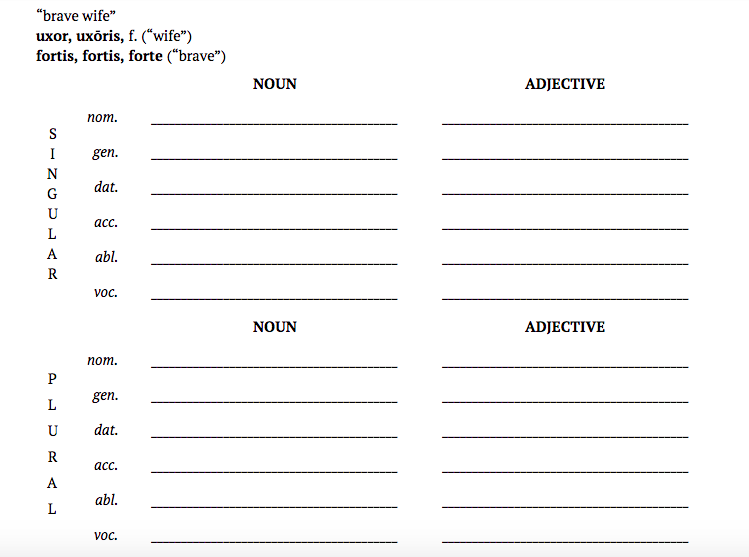
NOUN: nom. sing.
NOUN: gen. sing.
NOUN: dat. sing.
NOUN: acc. sing.
NOUN: abl. sing.
NOUN: voc. sing.
NOUN: nom. pl.
NOUN: gen. pl.
NOUN: dat. pl.
NOUN: acc. pl.
NOUN: abl. pl.
NOUN: voc. pl.
ADJ: nom. sing.
ADJ: gen. sing.
ADJ: dat. sing.
ADJ: acc. sing.
ADJ: abl. sing.
ADJ: voc. sing.
ADJ: nom. pl.
ADJ: gen. pl.
ADJ: dat. pl.
ADJ: acc. pl.
ADJ: abl. pl.
ADJ: voc. pl.
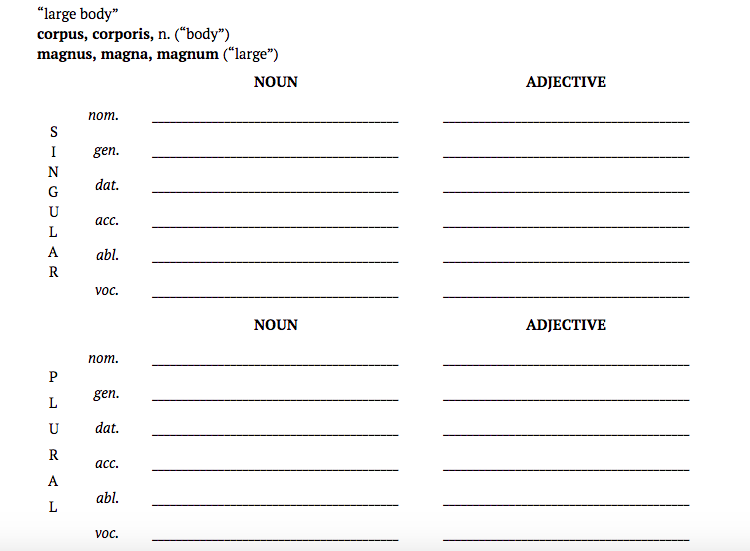
NOUN: nom. sing.
NOUN: gen. sing.
NOUN: dat. sing.
NOUN: acc. sing.
NOUN: abl. sing.
NOUN: voc. sing.
NOUN: nom. pl.
NOUN: gen. pl.
NOUN: dat. pl.
NOUN: acc. pl.
NOUN: abl. pl.
NOUN: voc. pl.
ADJ: nom. sing.
ADJ: gen. sing.
ADJ: dat. sing.
ADJ: acc. sing.
ADJ: abl. sing.
ADJ: voc. sing.
ADJ: nom. pl.
ADJ: gen. pl.
ADJ: dat. pl.
ADJ: acc. pl.
ADJ: abl. pl.
ADJ: voc. pl.