Hooke's Law & Elastic Potential Energy Investigation
star
star
star
star
star
Last updated over 4 years ago
19 questions
Note from the author:
In-class investigation of Hooke's Law, a derivation of Elastic Potential Energy, and graphical interpretation of Force vs. Stretch graph.
** Please copy and re-link data tables for your class to this assignment.
1
Please use this link to graph Weight (force of gravity)(N) vs. Displacement from equilibrium (m) in Desmos.Please upload a screenshot of your graph in the space below. Please also include the science equation for the line of best fit near the graph, and which spring your group used.
Please use this link to graph Weight (force of gravity)(N) vs. Displacement from equilibrium (m) in Desmos.
Please upload a screenshot of your graph in the space below. Please also include the science equation for the line of best fit near the graph, and which spring your group used.
1
What does the slope of your line represent? (When you get to this point, ask Ms. McVay to present the class graphs).
1
Find the area under the Weight vs displacement graph. (Hint: how do you find the area of a triangle?)
1
What two quantities did you have to multiply together to get your answer?
1
What does the area under the line represent? (Look back to our notes at the very beginning of this unit to see what F and d have to do with energy.)Check your answer with Ms. McVay
What does the area under the line represent? (Look back to our notes at the very beginning of this unit to see what F and d have to do with energy.)
Check your answer with Ms. McVay
1
What is the name of the law that we just found?
1
- We graphed the the force that the mass exerts on the spring.
- HOWEVER, Hooke's Law is intended to represent the force the SPRING exerts on the MASS.
- Because springs (or elastic cords) exert a restoring force on an object as the spring or cord stretches (or compresses), the force is negative, opposing the applied force.
The equation for this law is written as:
- We graphed the the force that the mass exerts on the spring.
- HOWEVER, Hooke's Law is intended to represent the force the SPRING exerts on the MASS.
- Because springs (or elastic cords) exert a restoring force on an object as the spring or cord stretches (or compresses), the force is negative, opposing the applied force.
The equation for this law is written as:
1
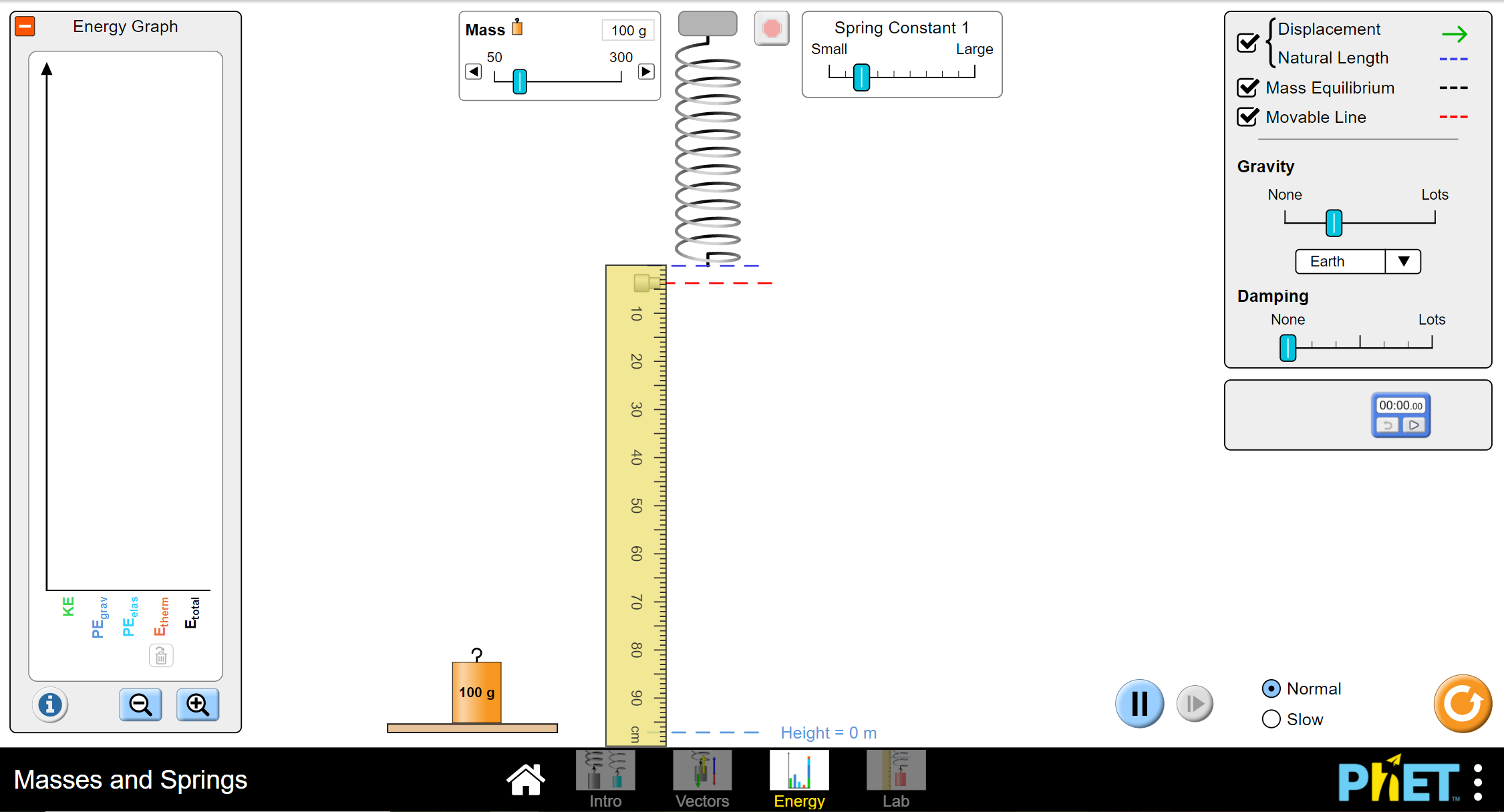
Measure the displacement (in meters) through which the mass stretched the spring while it was falling.
1
Calculate the change in potential energy (potential energy lost) by the mass as it fell. ∆GPE = mg∆h
1
While the mass was falling, what did the GPE turn in to? (Look at the energy bar charts to the left on the simulation. Compare the types of energy just before release, and the energy types just as the mass reaches the bottom of it's bounce.)
1
At the instant that the mass stops at its lowest point, how do you know it will turn around and spring back up? So, what type of energy must all of the GPE have turned into?
1
On the x-axis of your Weight vs. displacement graph, locate the point on the line of the graph which corresponds to the value of your displacement (answer to question 8). On the y-axis of your graph find the force that corresponds to this point.
1
Using these values for displacement and force, find the area under the line on your Weight vs. displacemnt graph, up to this point:
1
The area under a force vs displacement curve represents the work that was done on the mass. Does the value that you calculated match any other value from this lab?
1
Please use this link to graph Elastic Potential Energy vs. Displacement from equilibrium (m) in Desmos.Please upload a screenshot of your graph in the space below. Please also include the science equation for the line of best fit near the graph, and which spring your group used.
Please use this link to graph Elastic Potential Energy vs. Displacement from equilibrium (m) in Desmos.
Please upload a screenshot of your graph in the space below. Please also include the science equation for the line of best fit near the graph, and which spring your group used.
1
How does the constant in your EPE vs. Displacement graph compare to the constant in your Weight vs. Displacement graph?
1
So... what do you think is the meaning of the constant in the EPE vs. Diplacement graph?
1
Then, what must be the general equation relating EPE and displacement?
1
Write a brief summary of the investigation telling how it demonstrates the Law of Conservation of Energy.