https://pbslm-contrib.s3.amazonaws.com/WGBH/arct15/SimBucket/Simulations/chemthink-ionicbonding/content/index.html
1
1
1
1
1
1
1
1
1
1
1
What types of atoms form cations? Where are they located on the Periodic Table?
What types of atoms form anions? Where are they located on the Periodic Table?
Why do chlorine atoms have a strong attraction for electrons? What other are other examples of atoms that behave similarly to chlorine atoms?
What is a chlorine ion called?
How do ionic bonds form?
What is a diatomic molecule?
Describe how ionic crystals form.
In a sodium chloride salt crystal, what is the ratio of sodium ions to chloride ions?
What is the formula for sodium chloride?
In a calcium floride crystal, what is the ratio of calcium ions to fluoride ions?
What is the formula for calcium fluoride?
Describe how the electrons are moving:
When the atoms are apart:
Describe how the electrons are moving:
b. When the atoms are close together:
Do the atoms stick together?
What happens if you try to move the two atoms very close together?
Why do electrons spend most of their time between the two nuclei of the atoms?
Draw a picture of what it looks like when both hydrogen atoms are attracting their own electron as well as the other atom’s electron. Label the electrons and the protons:
What happens to the electrons during covalent bonding?
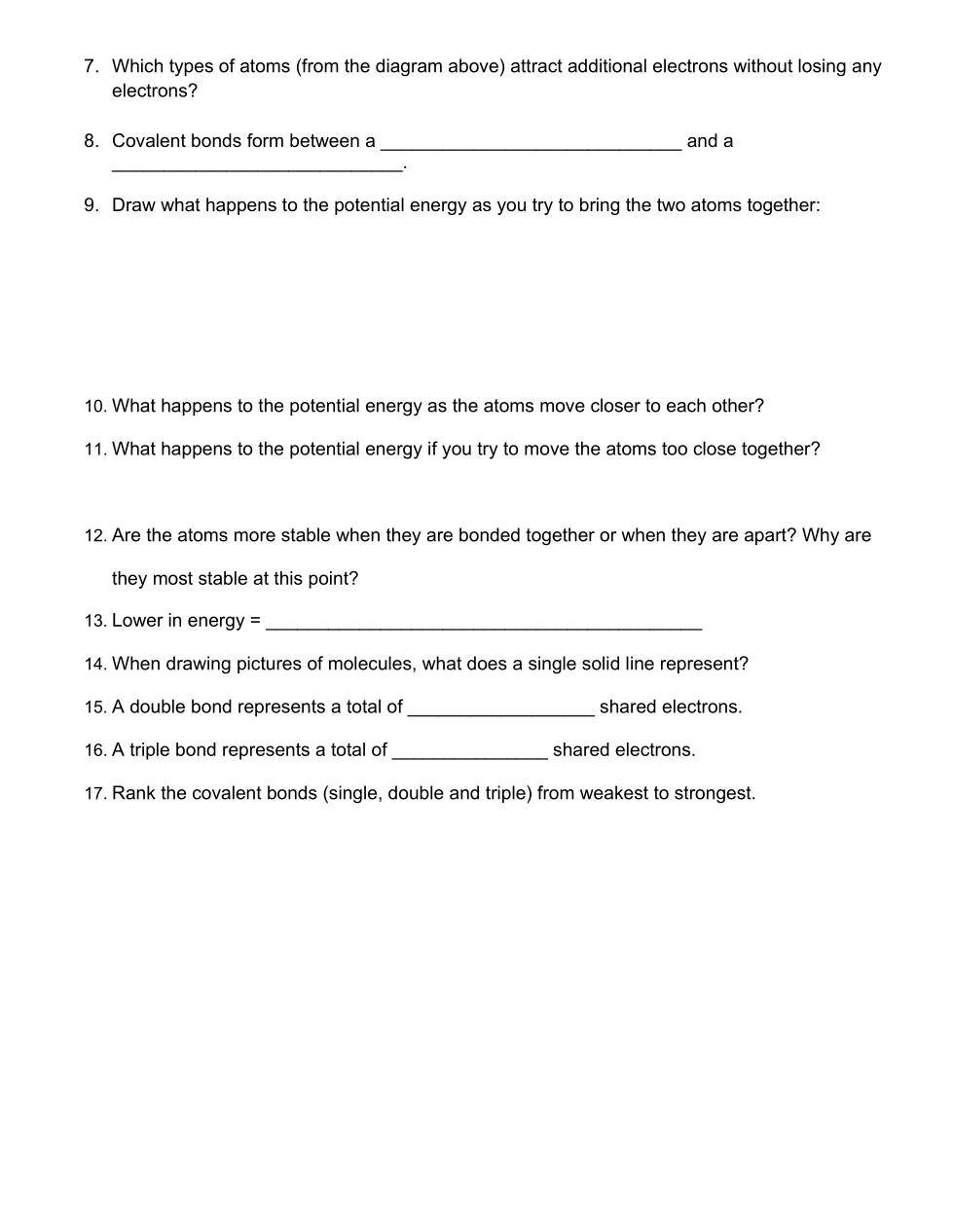
On the diagram of a Periodic Table below, identify the metals, non-metals, and Noble Gases.
Which types of atoms (from the diagram above) attract additional electrons without losing any electrons?
Covalent bonds form between a _____________________________ and a ____________________________.
Draw what happens to the potential energy as you try to bring the two atoms together:
What happens to the potential energy as the atoms move closer to each other?
What happens to the potential energy if you try to move the atoms too close together?
Are the atoms more stable when they are bonded together or when they are apart? Why are they most stable at this point?
Lower in energy =
When drawing pictures of molecules, what does a single solid line represent?
A double bond represents a total of __________________ shared electrons.
A triple bond represents a total of _______________ shared electrons.
Rank the covalent bonds (single, double, and triple) from weakest to strongest.
In light of our current atomic model, which metaphor would best describe how the two atoms “share” the electrons between them?
(highlight your choice)
Taking turns
Tug of war
Explain your choice: