NS: 2.3 (1/18) Version B
star
star
star
star
star
Last updated about 3 years ago
7 Nsɛmmisa

0
0

0
0
0
0
2
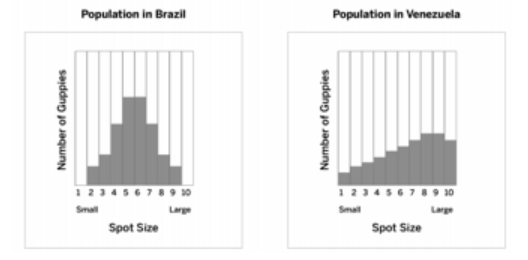
What in the environment do you think causes spot sizes vary from Brazil and Venezuela?
If surrounding rock sizes decrease in the Venezuelan population, what shift in spot size would you expect to see?
(think: the fish will want to blend in, what size spots are most likely to live longer and reproduce?)
In 1979, friends dared a 29-year-old man in Oregon to swallow a living rough-skinned newt. The man didn’t realize how poisonous roughskinned newts are. A lethal, fast-acting poison called tetrodotoxin (TTX) oozes from their skin. The man swallowed the newt whole and started feeling weak a few minutes later. He described a numb feeling all over his body. His friends tried to take him to a hospital, but he refused. Just 20 minutes later, the man was dead. Of course, the newt the man swallowed died, too. In that particular case, being poisonous didn’t help that individual newt survive. If newts have to be eaten in order to defend themselves, being poisonous doesn’t sound like a very good defense! How is being poisonous—having a high level of TTX poison— an adaptive trait for a rough-skinned newt?
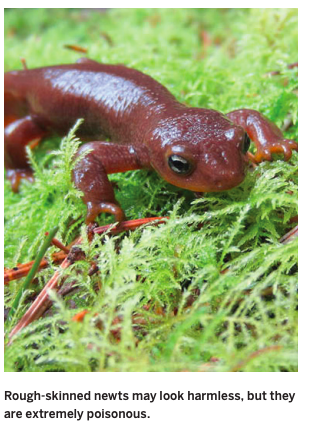
Explain the title of the article. What was the, “deadly dare?”
CFS:
accurately identifies the central idea from the primary source of evidence
accurately describes the relationship between title and the source of evidence
What type of poison does the newt have and how does it deliver the poison?
CFS:
accurately identifies the central idea from the primary source of evidence
accurately describes the natural phenomena using evidence from the text
Why Poison Is Adaptive
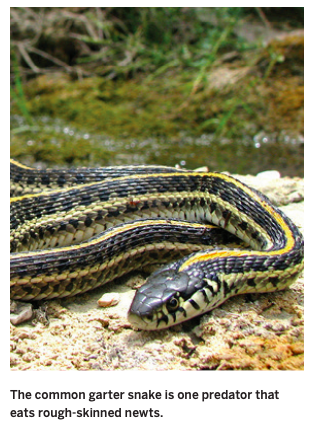
One reason TTX is adaptive is that it acts quickly. A predator that tries to eat a poisonous newt may become sick before it’s able to kill the newt, allowing the newt to escape. In fact, TTX acts so quickly that sometimes predators die before finishing their meals. Scientists have observed rough-skinned newts crawling out of dead or paralyzed predators. Even more important, predators can smell and taste TTX poison. The main predator of roughskinned newts is the garter snake. Scientists have found evidence that garter snakes use their senses of smell and taste to tell whether a rough-skinned newt is too poisonous to eat. They have even observed garter snakes doing quick “taste tests”—licking rough-skinned newts before deciding whether to eat them.
Scientists have studied whether garter snakes are able to detect TTX poison in newts. Biologists have placed one newt and one garter snake together in a cage to see whether the snake would eat the newt. They have tried this test over and over again, using different snakes and different newts. Even though the newts are placed directly in front of the snakes, not every newt gets eaten! Biologists are able to consider the cause-and-effect relationship between high poison levels and survival in newts by examining a population of newts with high variation. The newts in the test range from having no poison to having very high levels of TTX in their bodies. In these tests, the snakes consistently eat the newts with the lowest levels of TTX, and do not eat the newts with high levels of TTX. These results are evidence that garter snakes can detect TTX and that they prefer to eat roughskinned newts with lower levels of TTX. The more poisonous a rough-skinned newt is, the less likely it is to be eaten by a garter snake. That means high levels of TTX are an adaptive trait in roughskinned newts that live near garter snakes.
Is the newt poison lethal to humans? Give an example.
What is the newt’s adaptive trait and how does it help them surive?
CFS:
accurately identifies the central idea from the primary source of evidence
accurately describes the natural phenomena using evidence from the text
"I think that the newts adaptive trait is ... "
(Think: what trait helps the newt surive?)
How Adaptive Traits Spread
If snakes are in its environment, a poisonous newt is less likely to die from being eaten than a newt that isn’t poisonous. The newts that don’t get eaten have a better chance of living longer, and that’s important because it means more chances to reproduce. Organisms have to reproduce in order to pass on their genes, which are the instructions for making the protein molecules that determine traits: if they don’t reproduce, their traits die with them. In the newt population, more poisonous newts are more likely to survive long enough to reproduce and pass down their genes, and therefore the trait of being poisonous, to the next generation. As a result, there will be more and more highly poisonous rough-skinned newts in each generation. This will cause the distribution of traits in the population to change over many generations. Scientists call this process natural selection. This process does not only happen in rough-skinned newts. It has been observed in populations of different species all over the world.
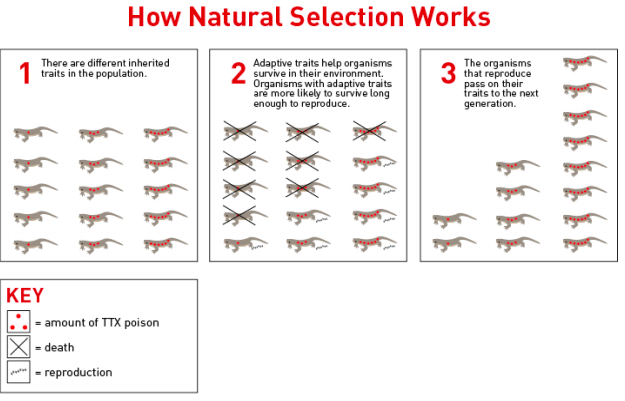
Explain how adaptive traits spread in a population?
CFS:
accurately identifies factors that impact trait distribution and variation
accurately describes how adaptive traits spread in a population
"I know that adaptive traits spread because ... "