Energy and Heat and Test

Last updated over 4 years ago
14 questions
1

Two metals of equal mass but different specific heat capacities are subjected to the same amount of heat. Which will undergo the smallest change in temperature?

2

Which of the following is true for temperature?

4

Which of the following is NOT TRUE when a sample of liquid water becomes ice?

2

A 112 gram sample of an unknown metal was heated from 0.0C to 20.0C. The sample absorbed 1004 J of energy. What was the specific heat capacity of this metal? Show/submit your work.

2

How much energy does a 2.01 gram sample of mercury (specific heat capacity is 0.14 J/g°C) gain if the temperature changes from 10.0°C to 40.0°C? Show/submit your work.

2

A hot metal sinker of mass 68.2 grams at 99.8°C is dropped into a cup containing 125 mL of water at 22.4°C. The final temperature in the cup is 31.0°C. What is the specific heat capacity of the metal? Submit/show your work.

2

A 45.9 gram sample of a metal is heated to 95.2°C and then placed in a cup of 120.0 gram room temperature (21.6°C). The final temperature of the water is 24.5°C. Which metal was used? Submit/show your work.

3

What is the energy change when 82 grams of water is boiled into steam at 100.0°C? Is this endothermic or exothermic? Show/submit your work.

2

What is the final temperature of a system where a 65.5 gram copper sinker at 97.4°C is dropped into 225 grams of water at 22.4°C? The specific heat capacity of copper is 0.3845 J/g°C. Show/submit your work.

3

How much energy is involved with 398 grams of steam is condensed into liquid water? Is this process endothermic or exothermic? Submit/show your work.

2

A 45.2 gram sample of iron (c= 0.4494 J/g°C) is exposed to 1350 J of energy. If the starting temperature is 19.4°C what is the final temperature? Show/submit your work.

7

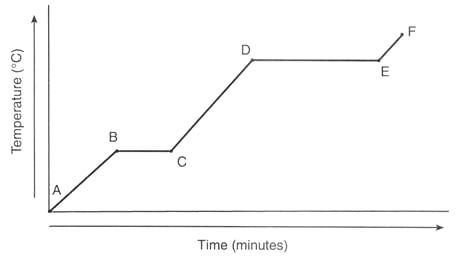
Consider the following heating curve for water and answer the following questions:
a. Describe as fully as you can what is happening for each section of the curve (for example, what is going on between A and B, B and C, etc.
b. What is the temperature at point B?
c. What is the temperature at point E?
2

Which of the following statements are false?

2

A “normal” small bottle of water is 500mL in volume. Which involves more energy, freezing a bottle of water or boiling a cup of water (250mL) on the stove? Show/submit your work.