Washington State History: Chapter 4 Assessment
star
star
star
star
star
Last updated about 4 years ago
6 questions
Note from the author:
This is for Washington State History and follows the information from the textbook "The Washington Journey".
5
Mark all the cultural conflicts recognized between indiginous tribes and white populations
8
Match the event/name/term to the description
| Draggable item | arrow_right_alt | Corresponding Item |
|---|---|---|
Stevens Treaties | arrow_right_alt | Isaac Stevens, the first governor of Washington Territory and Superintendent of Indian Affairs, negotiated and signed 10 treaties with indigineous tribes to give up their land and live on reservations in Washington Territory. |
Assimilation | arrow_right_alt | The act of a dominant culture forcing another smaller culture to change and become the same as the dominate culture |
Tribal Soverignty | arrow_right_alt | The right of tribes to self-govern, and the idea that they are their own nation. |
Dawes Act | arrow_right_alt | When gold seekers tresspassed on native reservation land, violence ensued with a band of Yakama killing the white settlers who intruded upon their land. Chief Kamiakin and follwers were captured by the US Army. They were forced to sign a peace treaty. |
Yakama War | arrow_right_alt | White settlers killed Nez Perce tribesmen when they entered upon the Nez Perce land. A few sons of the killed tribesmen retailated and killed the white settlers. Chief Joseph knew there would be consequences of this action and took his poeple to the Bear Paw Mountains, where bloody battles raged until Chief Joseph reconigzed he could not win and too much had been lost, and he surrendered to the US Army. They were eventually returned to the Colville Reservation. |
Washington Statehood | arrow_right_alt | In an effort to encourage ownership of land while also protecting native rights, Congressed passed this act. It gave natives a piece of land to own, but because of the difference of cultural values, this was not successful. This was especially true when land given to the natives to own was taken back and given to white settlers through coersion or fruad. Natives did not have a way to defend themselves in court. |
Indian Homestead Act | arrow_right_alt | Also known as the "General Allotment Act", this law divided reservation land into individual allotments and encouraged natives to become farmers. However, lands given to the natives were not good for farming. Also, natives could apply to become citizens once they got the land, but only if they gave up all of their rights and tribal ties. This led to encouragement of assimilation and the idea of bording schools where young native children learned the white ways. |
Nez Perce War | arrow_right_alt | Washington became a state in 1889 after multiple years of applying to the federal government. Washington drafted constitutions, met the required citizenship number, and established a school system. |
3
Explain the basic principles and values of the Washington State Constitution. Provide at least two examples to support your answer.
4
Explain the purpose of the treaty-making period and its impact on both indigineous peoples and the white population/Washington. Provide two examples to support your answer.

2
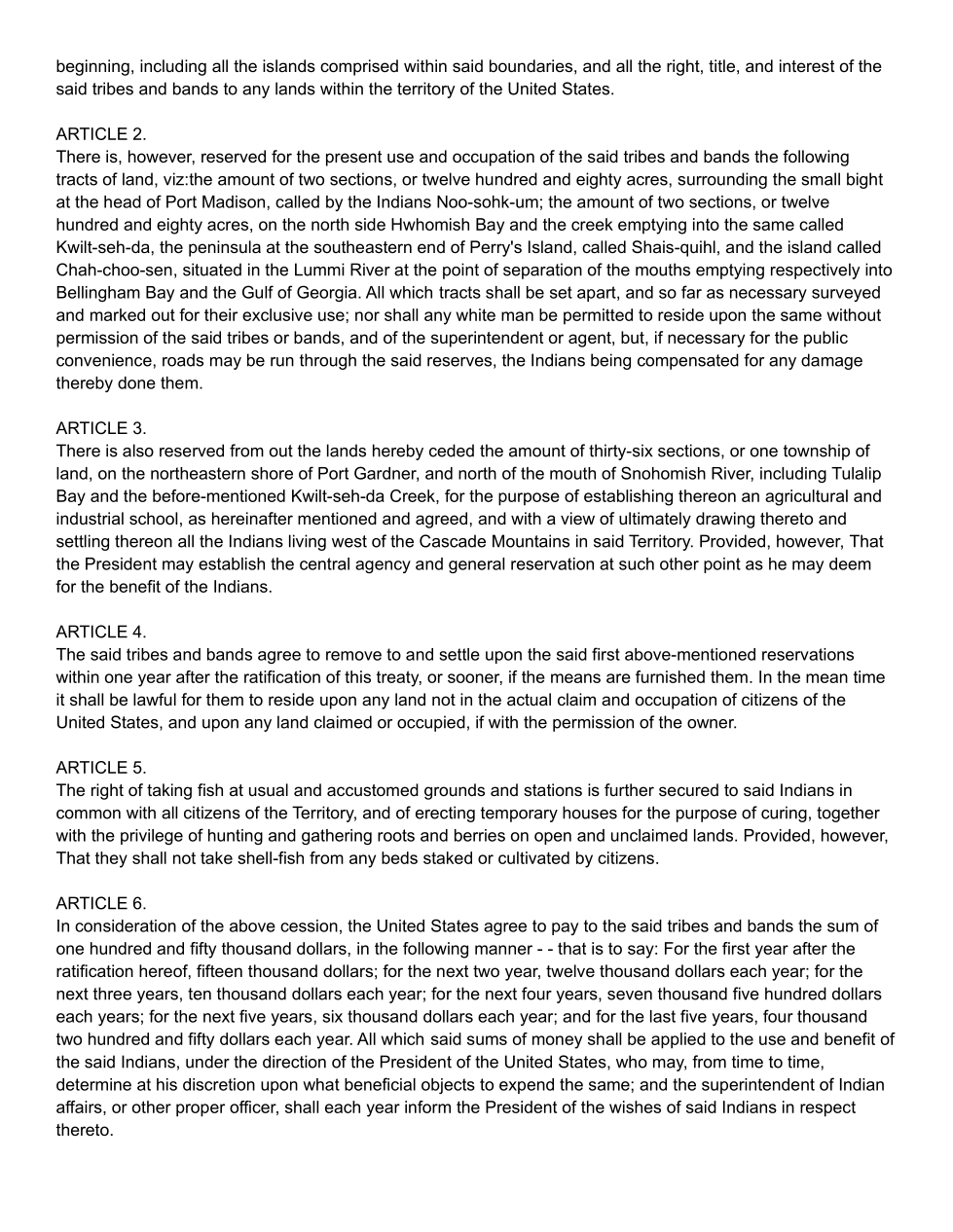
In this excerpt from the "Point Elliott Treaty", what is the purpose of Article 3? How does this article highlight some of the cultural differences in values between tribes and white populations?
…

3
Connect the message of Article 5 from this excerpt of the "Point Elliott Treaty" to what you know of the tribes who participated in this neogiation, to our civics unit last semester, and to modern day events.
…