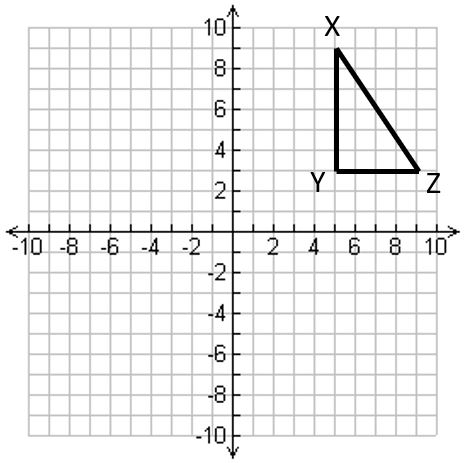
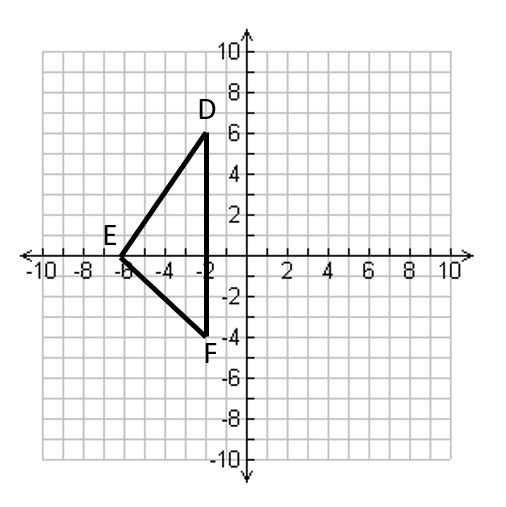
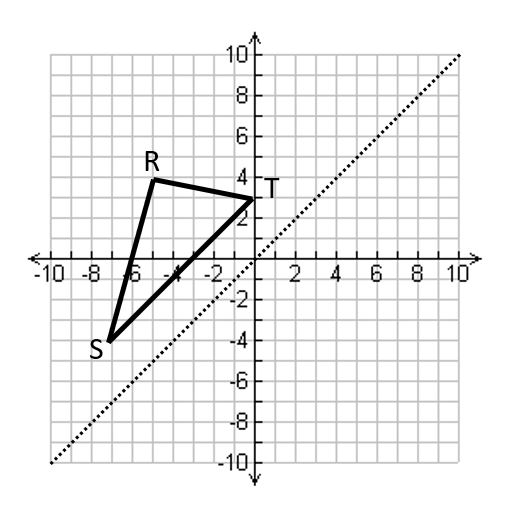
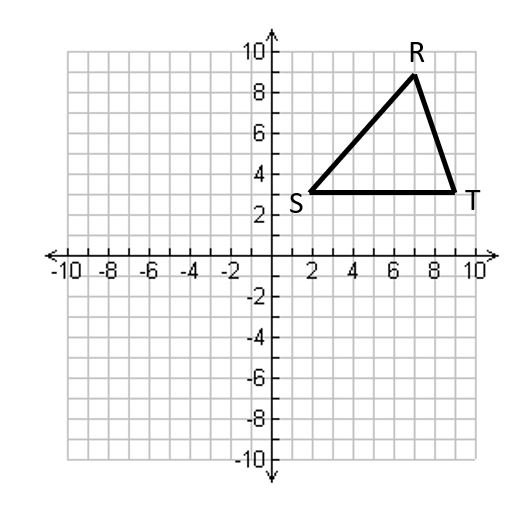
For #16-19, the graph of
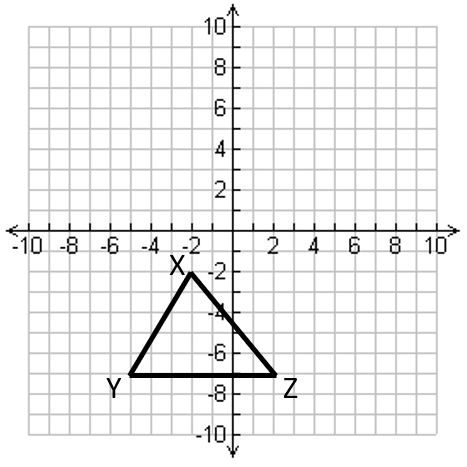
Use the translation (x, y) --> (x + 3, y + 4) to find the coordinates of X', Y', and Z', and then draw
1
Find X'
Find X'
1
Find Y'
Find Y'
1
Find Z'
Find Z'
1
An isometry preserves what two elements of a figure?
Which of the following is NOT an isometry?
A glide reflection consists of which two of the following transformations?
Use the following information for the next 4 questions:
Using the rule (x, y) --> (x + 3, y - 2), find the image of the following points.
(6, 0)
(-1, 2)
(-4, -4)
Use the following information for the next 4 questions:
Using the rule (x, y) --> (x - 1, y + 5), find the image of the following points.
(0, 6)
(-4, 7)
(4, 0)
Use the following information for the next 4 questions:
Using the rule (x, y) --> (x, y + 4), find the image of the following points.
(-1, 3)
(-4, 2)
(5, 9)
For #16-19, the graph of
Use the translation (x, y) --> (x + 3, y + 4) to find the coordinates of X', Y', and Z', and then draw
Find X'
Find Y'
Find Z'
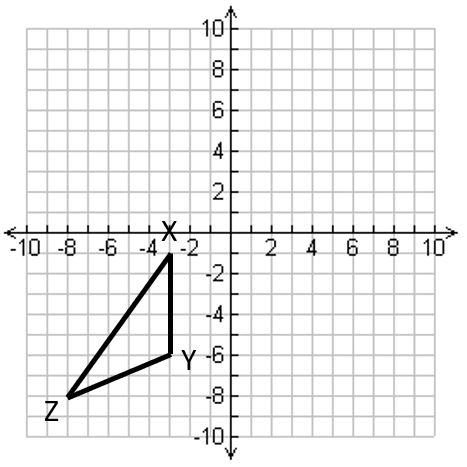
For #20-23, the graph of
Use the translation (x, y) --> (x - 4, y - 9) to find the coordinates of X', Y', and Z', and then draw
Find X'
Find Y'
Find Z'
For #24-27, the graph of
Use the translation (x, y) --> (x + 8, y + 8) to find the coordinates of X', Y', and Z', and then draw
Find X'
Find Y'
Find Z'
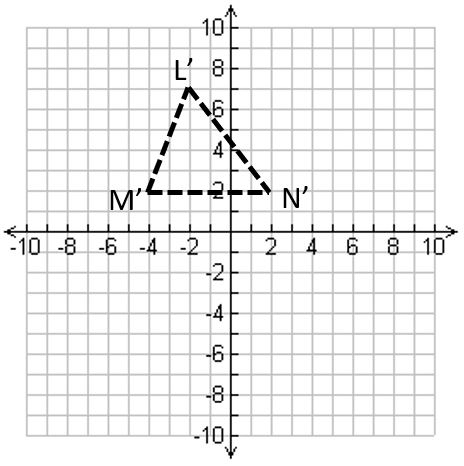
For #28-31, the translation (x, y) --> (x + 2, y - 3) was used to form
Find the coordinates of the original
Find L
Find M
Find N
Use the following information for the next 3 questions:
Find the component form of the vector that describes the translation from point P to Point P'. Use <x,y>
P(-3, 6) and P'(0, 1)
P(-7, 0) and P'(-2, 0)
P(4, 4) and P'(5, 9)
Using the point P'(4, 5), find the component form of the vector that describes the translation from point P(1, 3). Use <x,y>
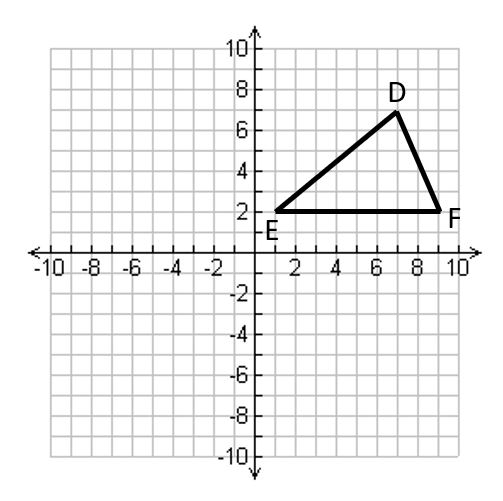
Use the graph of
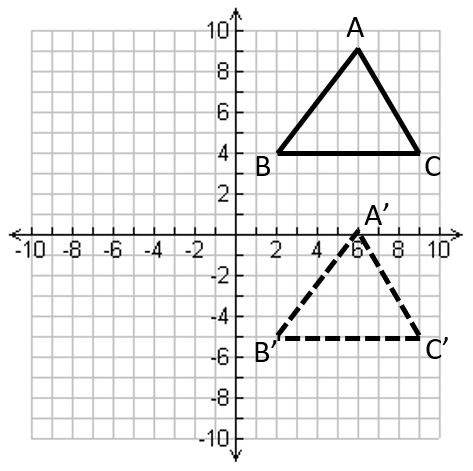
For #37-40, reflect the figure over the x-axis.
Find the coordinates of D', E', and D', and then draw
Find D'
Find E'
Find F'
For #41-44, reflect the figure over the y-axis.
Find the coordinates of D', E', and D', and then draw
Find D'
Find E'
Find F'
For #45-48, reflect the figure over the line y = x.
Find the coordinates of R', S', and T', and then draw
Find R'
Find S'
Find T'
For #49-52, reflect the figure over the line y = 2.
Find the coordinates of R', S', and T', and then draw
Find R'
Find S'
Find T'
(1, 5)
(11, 2)
(6, -6)
Graph
Graph
Graph
Graph
Graph
Graph
Graph
Graph