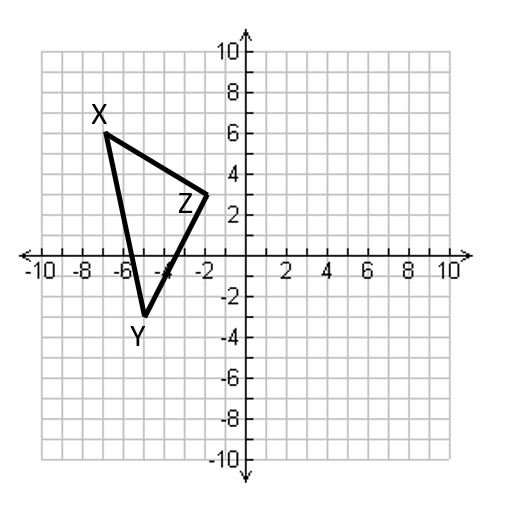
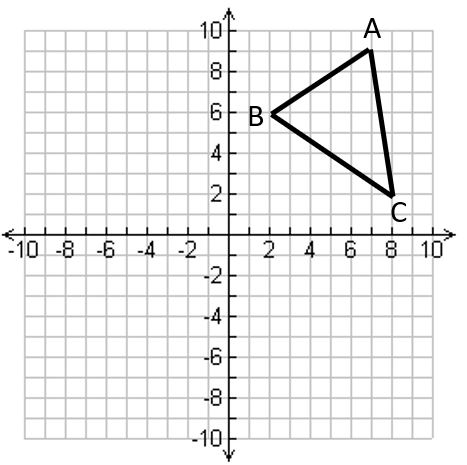
For #11-14, the graph of
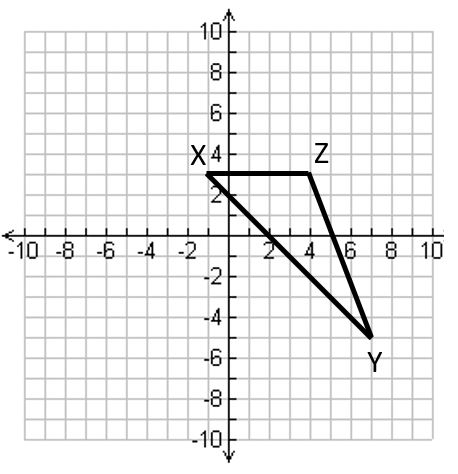
Use the translation (x, y) --> (x + 3, y + 4) to find the coordinates of X', Y', and Z', and then graph
1
Find X'
Find X'
1
Find Y'
Find Y'
1
Find Z'
Find Z'
1
An isometry preserves what two elements of a figure?
Which of the following is NOT an isometry?
Use the following information for the next 4 questions:
Using the rule (x, y) --> (x + 3, y - 2), find the image of the following points.
(6, 0)
(-1, 2)
(-4, -4)
Use the following information for the next 4 questions:
Using the rule (x, y) --> (x - 5, y - 1), find the image of the following points.
(10, 4)
(-3, 8)
(-9, 2)
For #11-14, the graph of
Use the translation (x, y) --> (x + 3, y + 4) to find the coordinates of X', Y', and Z', and then graph
Find X'
Find Y'
Find Z'
For #15-18, the graph of
Use the translation (x, y) --> (x + 7, y - 2) to find the coordinates of X', Y', and Z', and then graph
Find X'
Find Y'
Find Z'
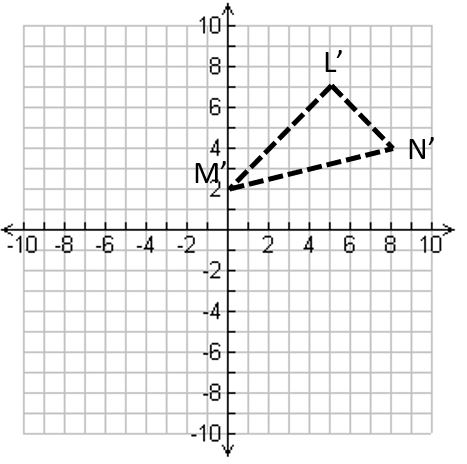
For #19-22, the translation (x, y) --> (x - 2, y + 1) was used to form
Find the coordinates of the original
Find L
Find M
Find N
For #23-24, find the component form of the vector that describes the translation from point P to point P'. Use <x,y>
P(-3, 6) and P'(0, 1)
P(-3, 6) and P'(-4, 8)
For #25-26, using the point P'(6, 4), find the component of the vector that describes the translation from point P. Use <x,y>
P(1, 3)
P(-1, 2)
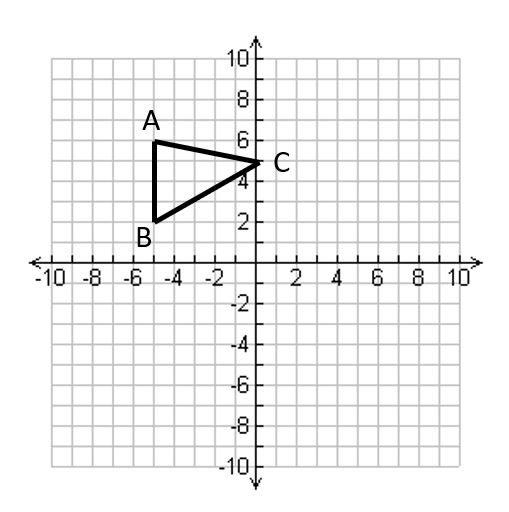
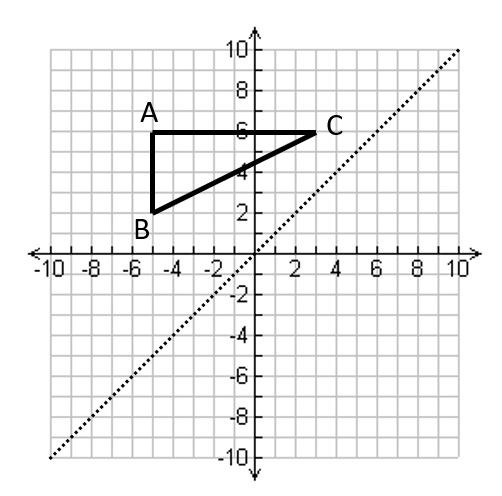
Use the graph of
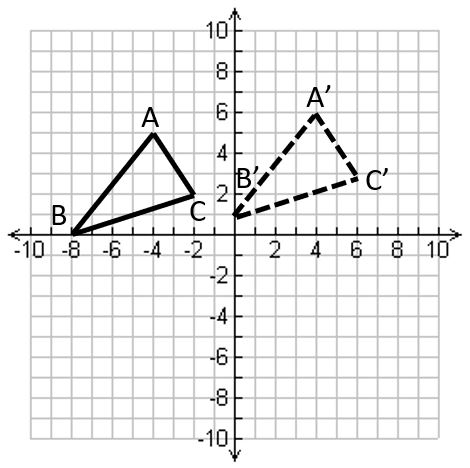
For #28-31, reflect the figure over the x-axis.
Find the coordinates of A', B', and C', and then graph
Find A'
Find B'
Find C'
For #32-35, reflect the figure over the y-axis.
Find the coordinates of A', B', and C', and then graph
Find A'
Find B'
Find C'
For #36-39, reflect the figure over the line y = x.
Find the coordinates of A', B', and C', and then graph
Find A'
Find B'
Find C'
For #40-43, reflect the figure over the line y = 2.
Find the coordinates of A', B', and C', and then graph
Find A'
Find B'
Find C'
For #44-46, rotate the following points 270 degrees about the origin.
(0, 3)
(4, 2)
(6, 5)
For #47-49, rotate the following points 90 degrees about the origin.
(2, 1)
(-3, 6)
(4, -1)
For #50-52, rotate the following points 180 degrees about the origin.
(-1, -2)
(3, -4)
(5, 3)
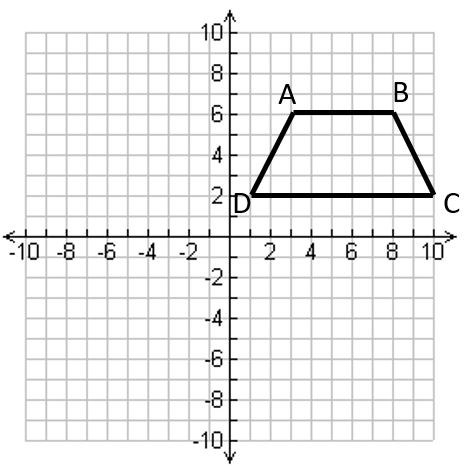
For #53-57, rotate the quadrilateral 90 degrees about the origin.
Find the coordinates of A', B', C', and D', and then graph Quadrilateral A'B'C'D'.
Find A'
Find B'
Graph Quadrilateral A'B'C'D'
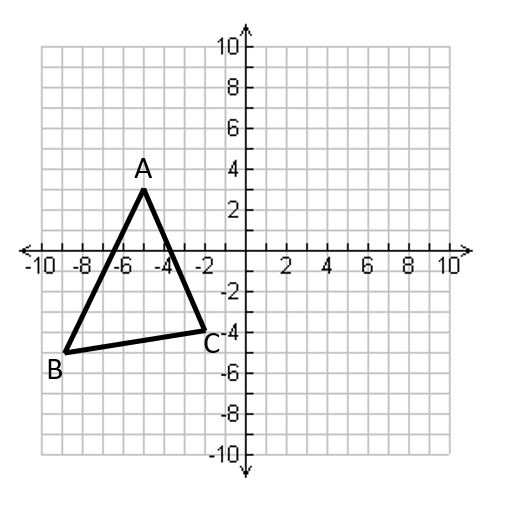
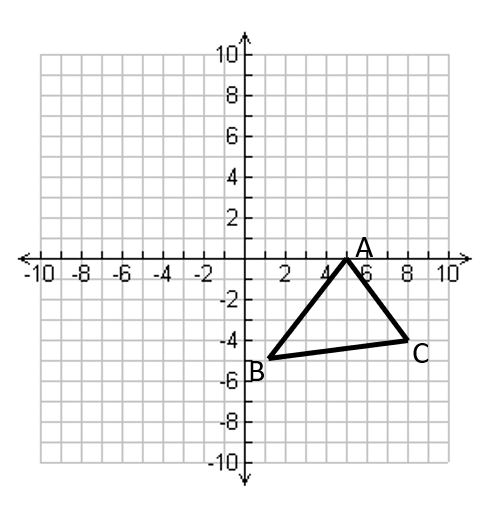
For #58-61, the graph of
Perform the transformations below in the order listed, give the coordinates of A'', B'', C'', and then graph both
Translation: (x,y) --> (x + 6, y)
Reflection: in the x-axis
Find A''
Find B''
Find C''
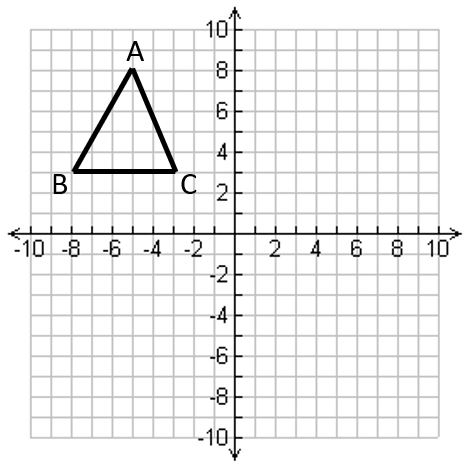
For #62-65, the graph of
Perform the transformations below in the order listed, give the coordinates of A'', B'', C'', and then graph both
Translation: (x,y) --> (x, y - 5)
Reflection: in the y-axis
Find A''
Find B''
Find C''
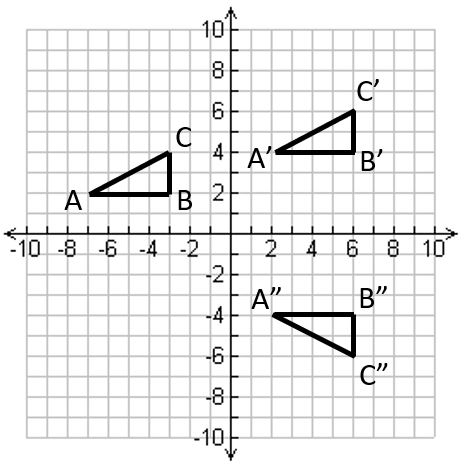
For #66-67, describe the two transformations in the composition below.
Translation: (x,y) --> _____________.
Reflection: ____-axis
The following 3 questions are Extra Credit. There is no penalty for wrong answers.
Rotate the following points 90 degrees clockwise about the origin.
(3,1)
(4,2)
(-2,5)
(1, 5)
(5, -7)
Graph
Graph
Graph
Graph
Graph
Graph
Graph
Find C'
Find D'
Graph
Graph