Log in
Sign up for FREE
arrow_back
Library
Biology final test 7°
By SOL ALEJANDRA QUINTERO CANO
star
star
star
star
star
Share
share
Last updated almost 5 years ago
20 questions
Add this activity
1
1
1
1
1
1
1
1
1
1
1
1
1
1
1
1
1
1
1
1
Question 1
1.
The letter E represents:
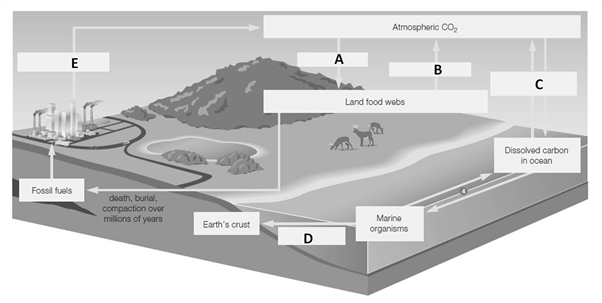
Cellular respiration
Photosynthesis
Burning fossil fuels
Sedimentation and formation of earth's crust
Question 2
2.
The letter D is related to the formation of:
Limestone rock
Greenhouse effect
Oxygen
Cellular respiration
Question 3
3.
Which one is not a consequence of burning fossil fuels is ..
Greenhouse effect
Plastic pollution
Global warming
Acidification of oceans and acid rain
Question 4
4.
The acididification of oceans caused by the excess of carbon dioxide in the atmosphere is a threat for marine organisms like fish or seals.
True
False
Question 5
5.
This is a living organism that helps to produce the majority of oxygen in the atmosphere.
Phytoplankton
Plants
Bacteria
Decomposers
Question 6
6.
The organisms that helps to transform the atmospheric nitrogen in simple nitrogen molecules and vice versa are
Animals
Plants
Scavengers
Bacteria
Question 7
7.
The process by which bacteria transform atmospheric nitrogen (in air) into nitrogen molecules that are used by plants is called.
Question 8
8.
Artificial fertilizers are an environmental concern because they can pollute water causing algal blooms.
True
False
Question 9
9.
The proccesses that balance the levels of carbon dioxide and oxygen in the atmosphere are:
Burning fossil fuels and photosynthesis
Cellular respiration and photosynthesis
Photosynthesis and acidification
Formation of limestone rock
Question 10
10.
Which gas is increasing in the atmosphere and threatening the world with the greenhouse effect?
Carbon dioxide
Carbon monoxide
Ozone
Fluorocarbon
Question 11
11.
What is the main source of increasing greenhouse gases?
Increased cellular respiration
Increased use of fossil fuels
Increased diffusion from the oceans
Increased volcanic activity
Question 12
12.
Nitrogen is released into the atmosphere by:
Nitrogen fixation
Decomposition
Denitrification
Ammonification
Question 13
13.
The greatest concentration of nitrogen on the planet Earth is found in:
Living organisms, including bacteria
Fossil fuels
Oceans
The atmosphere
Question 14
14.
Which cycle relies heavily upon bacteria?
water
carbon
nitrogen
phosphorus
Question 15
15.
Many marine organisms incorporate carbon into their shells. These shells become part of the
Atmosphere
Ocean
Land food web
Limestone rock
Question 16
16.
Groundwater is water:
That runs
over
the ground and drains into a specific waterway
In lakes and rivers
In soil and aquifers
In the ocean
Question 17
17.
Most fresh water exists as:
Ice
Soil water
Surface water (lakes, rivers)
Atmosphere
Question 18
18.
Does precipitation happen before or after condensation?
Before
After
During
Question 19
19.
How you can name the water that flows in rivers and streams into the oceans and lakes
Evaporation
Precipitation
Condensation
Runoff
Question 20
20.
What is the correct term for plants releasing water from their leaves, which then evaporates?
Photosynthesis
Transpiration
Condensation
Hibernation