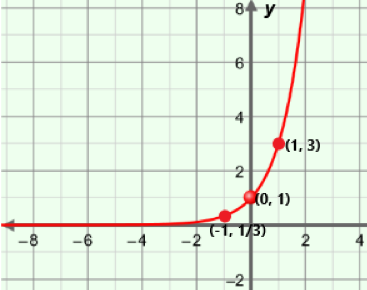
The parent function in red has been transformed to the blue function g(x). Write the equation for g(x).
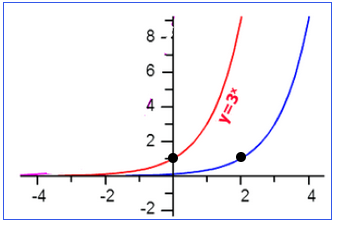
The parent function in red has been transformed to the blue function g(x). Write the equation for g(x).
In the function:
Describe the transformation that "h" has on the parent function.
In the function:
Describe the transformation that "a" has on the parent function.
Write a new exponential function that represents the indicated transformation of the parent
function .
Use g(x) to write the transformed function after “a reflection over the x-axis followed by a translation 7 units left”
Write a new exponential function that represents the indicated transformation of the parent
function .
Use g(x) to write the transformed function after “vertical shrink by a factor of 1/4, a translation 3 unit down.”
The parent function in red has been transformed to the blue function g(x). Write the equation for g(x).
Graph the function: (2 points)
Include at least 5 points in your table (4 points) and plot the "nice" points.
Using your graph from #6, what is the horizontal asymptote?
Graph the function: (2 points)
Include at least 5 points in your table (4 points) and plot the "nice" points.
Using your graph from #8, what is the range of the function?
Graph the function: (2 points)
Include at least 5 points in your table (4 points) and plot the "nice" points. (HINT: Start at x = -4)
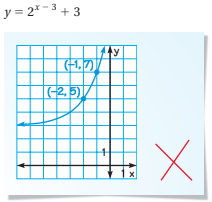
Describe the error in the graph below as it relates to the parent function.
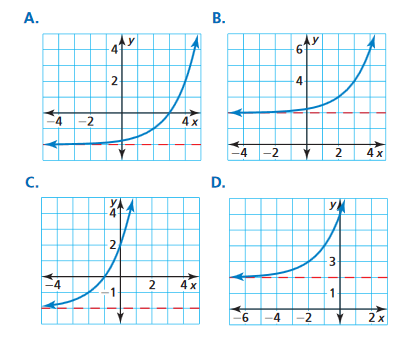
Give a reason in the show your work section to justify your answer. Which graph is f(x).
Give a reason in the show your work section to justify your answer. Which graph is g(x).
In the exponential function, identify the base, "b"