Asemmisa {{asɛmmisaAhyɛnsode}}
2.
Which of the following reactions releases most energy to the surroundings?
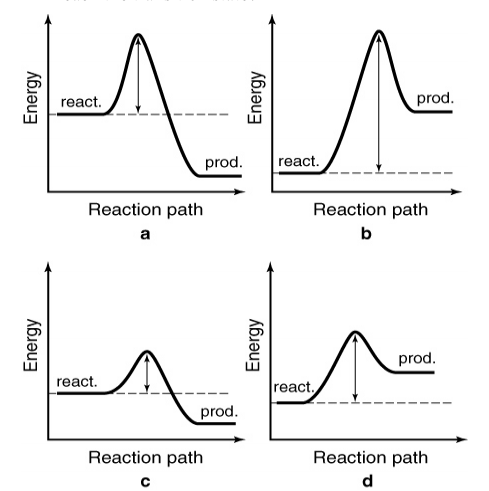
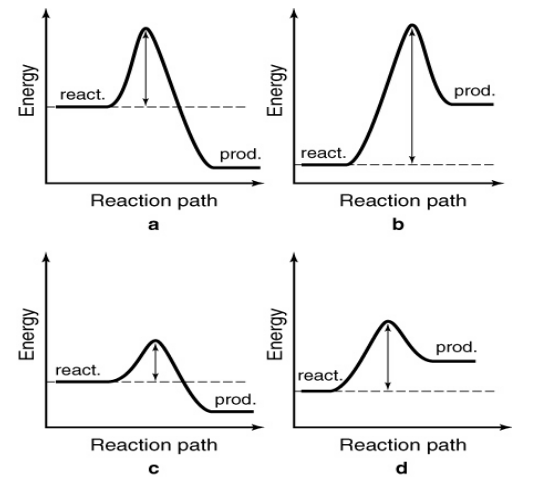
The energy profile graphs for four different reactions are shown. Which reaction requires the most energetic collisions to reach the activated complex?
The following energy profiles for four different reactions are shown. Which reaction is the most exothermic?
Consider the four energy profile graphs shown below:
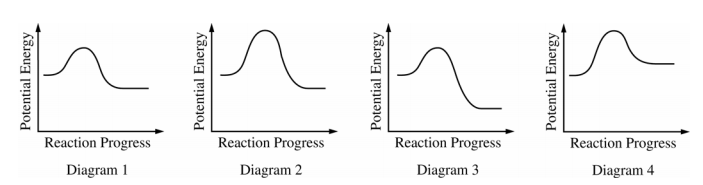
Identify the two diagrams that could represent the same reaction cataysed and uncatalysed.
graph 1
graph 2
graph 3
graph 4
Graph showing reaction with catalyst present
Graph showing reaction with NO catalyst present
Is the following statement True or False?
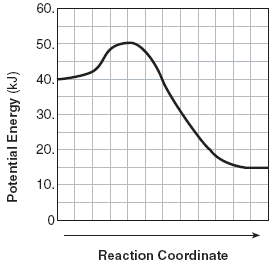
The following graph must be used to answer the questions that follow:
Match the following values for the graph shown above:
| Draggable item | arrow_right_alt | Corresponding Item |
|---|---|---|
∆H of reverse reaction | arrow_right_alt | 40 kJ |
∆H of forward reaction | arrow_right_alt | 15 kJ |
Energy released when new bonds form | arrow_right_alt | -25 kJ |
Potential energy of products | arrow_right_alt | 25 kJ |
Potential energy of reactants | arrow_right_alt | -35 kJ |
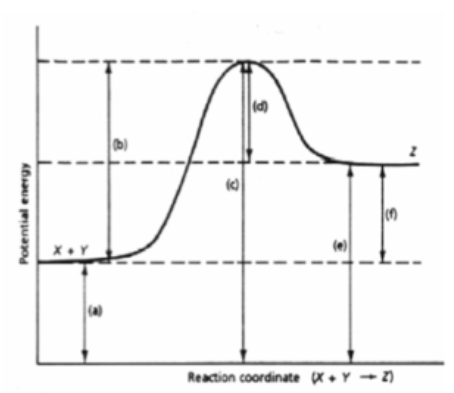
Use the following graph to answer the questions that follow:
Which of the letters (a-f) represents the energy of the products?
Which of the letters (a-f) represents the energy of the activated complex?
Which of the letters (a-f) represents the activation energy (forward reaction)?
Which of the letters (a-f) represents the heat of reaction (forward reaction)?
Which of the letters (a-f) represents the activation energy for the reverse reaction?