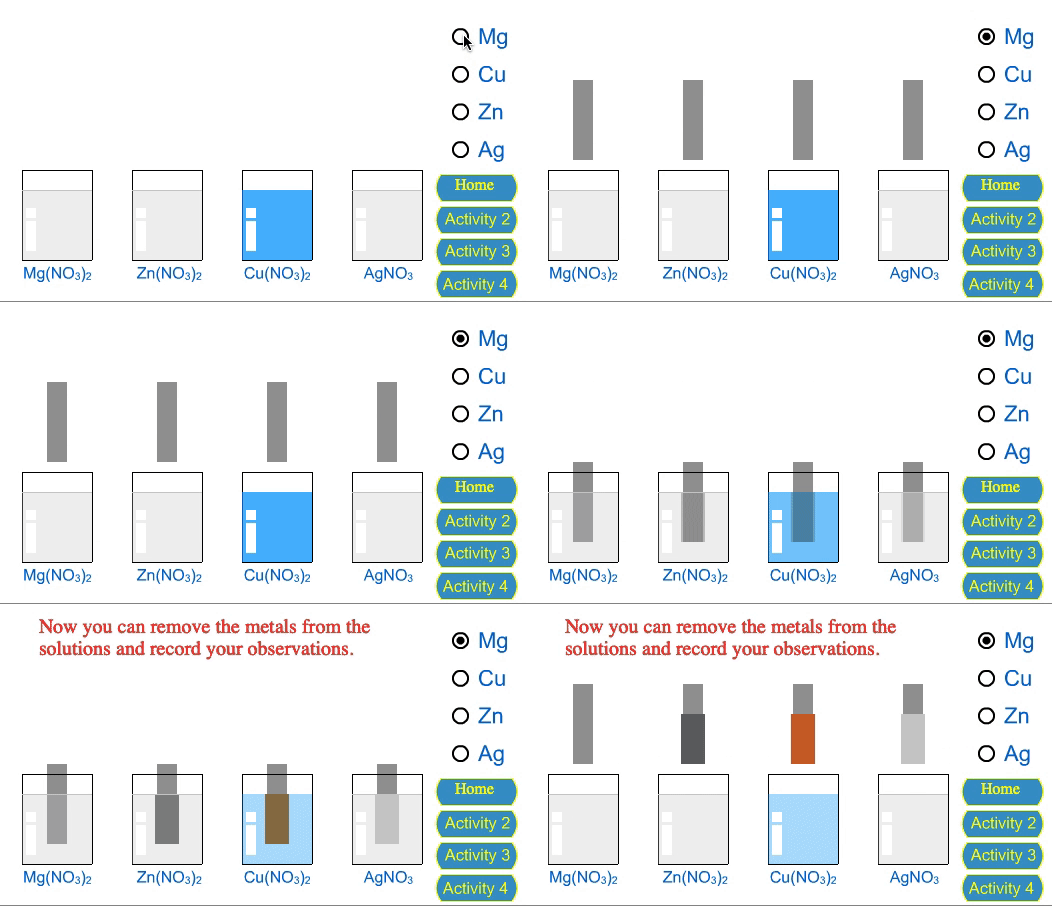
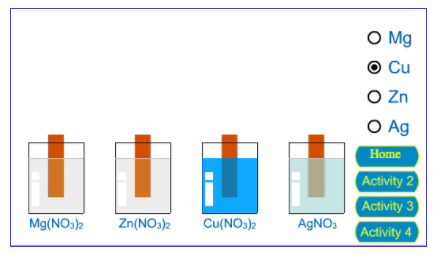
I have made and inserted gifs of the simulations for you, which you into this Formative.
The simulation in this investigation can be accessed at:
http://intro.chem.okstate.edu/1515F01/Laboratory/ActivityofMetals/home.html
Some metals react readily with others, displacing them out of a solution and sometimes, there is no reaction. In this simulation you need to observe in each case whether a reaction takes place between the two metals. Where a reaction does take place, describe your observations. You will also calculate the Eo cell value for each combination. [If the gifs in this section don't work, use this link to access a video: https://drive.google.com/open?id=1Wj9jd-HvyKbvzOMqjYe6fOkCOCwmx15x ]
Use the simulation to observe the reactivity of magnesium in each solution. FOR EACH BEAKER, FIRST record if a reaction takes place or does not take place. SECOND If a reaction takes place, record ALL your observations by choosing from the list of options. If there is no obvious change to the colour of a solution or the piece of metal, then no observation about the solution or piece of metal needs to be made.
No reaction takes place
Reaction takes place
Observation: A dark grey deposit forms on the metal
Observation: A silvery grey deposit forms on the metal
Observation: A reddish-brown deposit forms on the metal
Observation: The blue solution becomes lighter in colour
Observation: The blue solution becomes darker in colour
Observation: The colourless solution turns blue
Mg in Mg(NO3)2
Mg in Zn(NO3)2
Mg in Cu(NO3)2
Mg in AgNO3
TWO observations were seen in the Mg in Cu(NO3)2 experiment. Explain why each one occured.
Calculate the Eo cell values for each of the redox reactions with magnesium metal. Choose the correct answer (with the correct sign) for each combination from the list of options.
- 3,17 V
- 2,71 V
- 1,61 V
- 1,56 V
- 1,10 V
- 0,46 V
0,00 V
+ 0,46 V
+ 1,10 V
+ 1,56 V
+ 1,61 V
+ 2,71 V
+ 3.17 V
Mg in Mg(NO3)2
Mg in Zn(NO3)2
Mg in AgNO3
Mg in Cu(NO3)2

Use the simulation to observe the reactivity of copper in each solution. FOR EACH BEAKER, FIRST record if a reaction takes place or does not take place. SECOND If a reaction takes place, record ALL your observations by choosing from the list of options. If there is no obvious change to the colour of a solution or the piece of metal, then no observation about the solution or piece of metal needs to be made.
No reaction takes place
Reaction takes place
Observation: A dark grey deposit forms on the metal
Observation: A silvery grey deposit forms on the metal
Observation: A reddish-brown deposit forms on the metal
Observation: The blue solution becomes lighter in colour
Observation: The blue solution becomes darker in colour
Observation: The colourless solution turns blue
Cu in Mg(NO3)2
Cu in Zn(NO3)2
Cu in Cu(NO3)2
Cu in AgNO3
Calculate the Eo cell values for each of the redox reactions with copper metal. Choose the correct answer (with the correct sign) for each combination from the list of options.
- 3,17 V
- 2,71 V
- 1,61 V
- 1,56 V
- 1,10 V
- 0,46 V
0,00 V
+ 0,46 V
+ 1,10 V
+ 1,56 V
+ 1,61 V
+ 2,71 V
+ 3.17 V
Cu in Mg(NO3)2
Cu in Zn(NO3)2
Cu in Cu(NO3)2
Cu in AgNO3

Use the simulation to observe the reactivity of zinc in each solution. FOR EACH BEAKER, FIRST record if a reaction takes place or does not take place. SECOND If a reaction takes place, record ALL your observations by choosing from the list of options. If there is no obvious change to the colour of a solution or the piece of metal, then no observation about the solution or piece of metal needs to be made.
No reaction takes place
Reaction takes place
Observation: A dark grey deposit forms on the metal
Observation: A silvery grey deposit forms on the metal
Observation: A reddish-brown deposit forms on the metal
Observation: The blue solution becomes lighter in colour
Observation: The blue solution becomes darker in colour
Observation: The colourless solution turns blue
Zn in Mg(NO3)2
Zn in Zn(NO3)2
Zn in Cu(NO3)2
Zn in AgNO3
Calculate the Eo cell values for each of the redox reactions with zinc metal. Choose the correct answer (with the correct sign) for each combination from the list of options.
- 3,17 V
- 2,71 V
- 1,61 V
- 1,56 V
- 1,10 V
- 0,46 V
0,00 V
+ 0,46 V
+ 1,10 V
+ 1,56 V
+ 1,61 V
+ 2,71 V
+ 3.17 V
Zn in Mg(NO3)2
Zn in Zn(NO3)2
Zn in Cu(NO3)2
Zn in AgNO3

Use the simulation to observe the reactivity of silver in each solution. FOR EACH BEAKER, FIRST record if a reaction takes place or does not take place. SECOND If a reaction takes place, record ALL your observations by choosing from the list of options. If there is no obvious change to the colour of a solution or the piece of metal, then no observation about the solution or piece of metal needs to be made.
No reaction takes place
Reaction takes place
Observation: A dark grey deposit forms on the metal
Observation: A silvery grey deposit forms on the metal
Observation: A reddish-brown deposit forms on the metal
Observation: The blue solution becomes lighter in colour
Observation: The blue solution becomes darker in colour
Observation: The colourless solution turns blue
Ag in Mg(NO3)2
Ag in Zn(NO3)2
Ag in Cu(NO3)2
Ag in AgNO3
Calculate the Eo cell values for each of the redox reactions with silver metal. Choose the correct answer (with the correct sign) for each combination from the list of options.
- 3,17 V
- 2,71 V
- 1,61 V
- 1,56 V
- 1,10 V
- 0,46 V
0,00 V
+ 0,46 V
+ 1,10 V
+ 1,56 V
+ 1,61 V
+ 2,71 V
+ 3.17 V
Ag in Mg(NO3)2
Ag in Zn(NO3)2
Ag in Cu(NO3)2
Ag in AgNO3
Based on the results of Part A of this investigation, rank the metals in order from most reactive to least reactive:
Mg
Ag
Zn
Cu

Identify the half-reactions for this reaction:
Cu2+ + 2e- ➝ Cu
Cu ➝ Cu2+ + 2e-
Zn2+ + 2e- ➝ Zn
Zn ➝ Zn2+ + 2e-
Oxidation 1/2 reaction:
Reduction 1/2 reaction:
Is this reaction spontaneous or non-spontaneous?
Explain your answer above by refering to the relative strengths of the reducing agents. Complete the explanation by dragging the appropriate substance into each step of the explanation:
Zn
Zn2+
Cu
Cu2+
_____ is a better reducing agent
than _______
Therefore in the presence of _____ ,
_______ will/will not [don't need to distinguish]
be readily reduced to form ________

Identify the half-reactions for this reaction:
Cu2+ + 2e- ➝ Cu
Cu ➝ Cu2+ + 2e-
Zn2+ + 2e- ➝ Zn
Zn ➝ Zn2+ + 2e-
Oxidation 1/2 reaction:
Reduction 1/2 reaction:
Is this reaction spontaneous or non-spontaneous?
Explain your answer above by refering to the relative strengths of the reducing agents. Complete the explanation by dragging the appropriate substance into each step of the explanation:
Zn
Zn2+
Cu
Cu2+
_____ is a better reducing agent
than _______
Therefore in the presence of _____ ,
_______ will/will not [don't need to distinguish]
be readily reduced to form ________