Which one of the following redox reactions is NON-SPONTANEOUS?

Which one of the following redox reactions is NON-SPONTANEOUS?
Answer all the questions.
You may only refer to your Data Sheet with the Table of Standard Electrode Potentials during the test.
All other notes and devices must be removed from the room during the test.
Plagiarised answers will not be accepted.
Describe what happens at the cathode and anode in an electrochemical cell.
Oxidation
Reduction
Loss of electrons
Gain of electrons
Cathode
Anode
In a redox reaction, the reducing agent will ....
The balanced chemical equation below represents a redox reaction between aluminium and iodine.
Identify the agents.
Al
Al 3+(aq)
I2
I-(aq)
Reducing agent
Oxidising agent
Which one of the following redox reactions is NON-SPONTANEOUS?
Which one of the following solutions will oxidise Zn, but will not oxidise Sn under standard conditions?
Consider the following redox reaction.
Which one of the following is the standard potential for this cell?
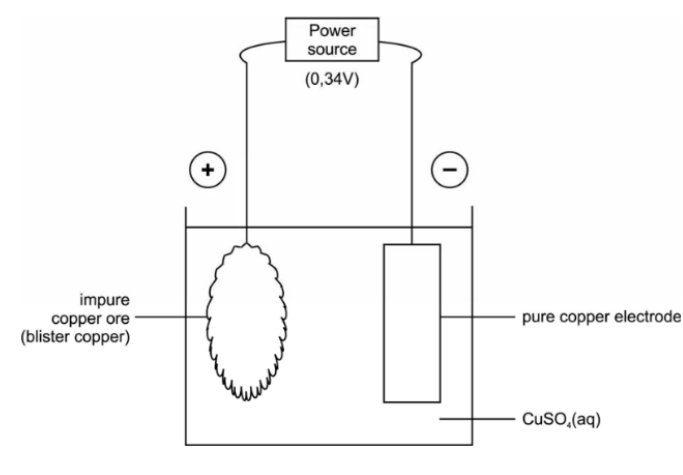
In the purification of copper, an impure piece of copper ore known as blister copper is connected as one of the electrodes, and a solution of copper sulphate is used as the electrolyte.
Blister copper can contain, in addition to Cu atoms, also silver (Ag), gold (Au), iron (Fe) and zinc (Zn) atoms.
Use your table of Standard Electrode Potentials to identify what is actually oxidised and reduced at the electrodes.
H2O
Cu
Cu2+
Ag
Ag+
Au
Au3+
Fe
Fe2+
Zn
Zn2+
Oxidised
Reduced
Which one of the statements is TRUE regarding the cathode in the purification of copper?
Question 1
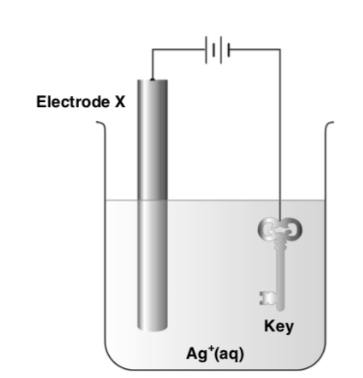
Yenzile sets up the following electrolytic cell with the aim of coating a key with silver metal:
The process used to deposit a metal onto a conductive object is called ....
Is the key the anode or cathode?
With reference to the relative strengths of the reacting substances (relative strengths of agents), explain why silver will be the predominant substance formed at the key. Choose from the list of possible options to complete the statement.
Ag
Ag+
water
reducing agent
oxidising agent
Ag is predominantly formed at the key because .......
is a much stronger ....
than water. This means that ...... will be reduced predominantly.
What is electrode X usually made of?
How does the mass of electrode X and the concentration of the electrolyte change during the electrolysis?
Increases
Decreases
No change
Mass of electrode X
Concentration of electrolyte
Question 2
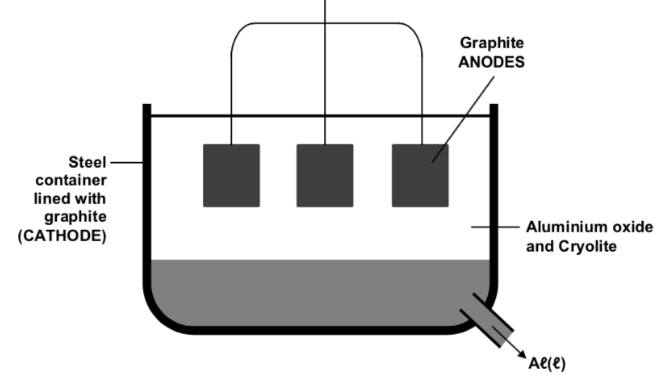
Aluminium is produced in modern times through the Hall-Héroult Process, whereby a molten aluminium oxide electrolyte is electrolysed between graphite electrodes. A simplified diagram of the cell is shown below.
Although the production of aluminium is expensive, it is worth the cost. Aluminium is light, so it is useful in the manufacture of aircrafts and cars. Aluminium is often used as window frames, particularly at the sea. It protects itself from corrosion by producing a layer of aluminium oxide on its surface, which is very tough and therefore difficult to remove.
What is another name for aluminium oxide?
From the information given above, write down one PHYSICAL property of aluminium that makes it a useful metal.
Given the above information, aluminium can protect itself from corrosion, so it is often used as window frames in coastal areas. Is aluminium a very reactive metal? [Hint: refer to your redox table].
Identify the reactions at the anode and cathode during the electrolysis of aluminium.
Al3+ + 3ē ➝ Al
Al ➝ Al3+ + 3ē
O2 + 4ē ➝ 2O2-
2O2- ➝ O2 + 4ē
Anode
Cathode
Why do the anodes need to be replaced regularly?
What is the purpose of adding cryolite to the electrolyte?
Explain briefly how the addition of cryolite to the electrolyte is economically beneficial.
Question 3: Reactivity series
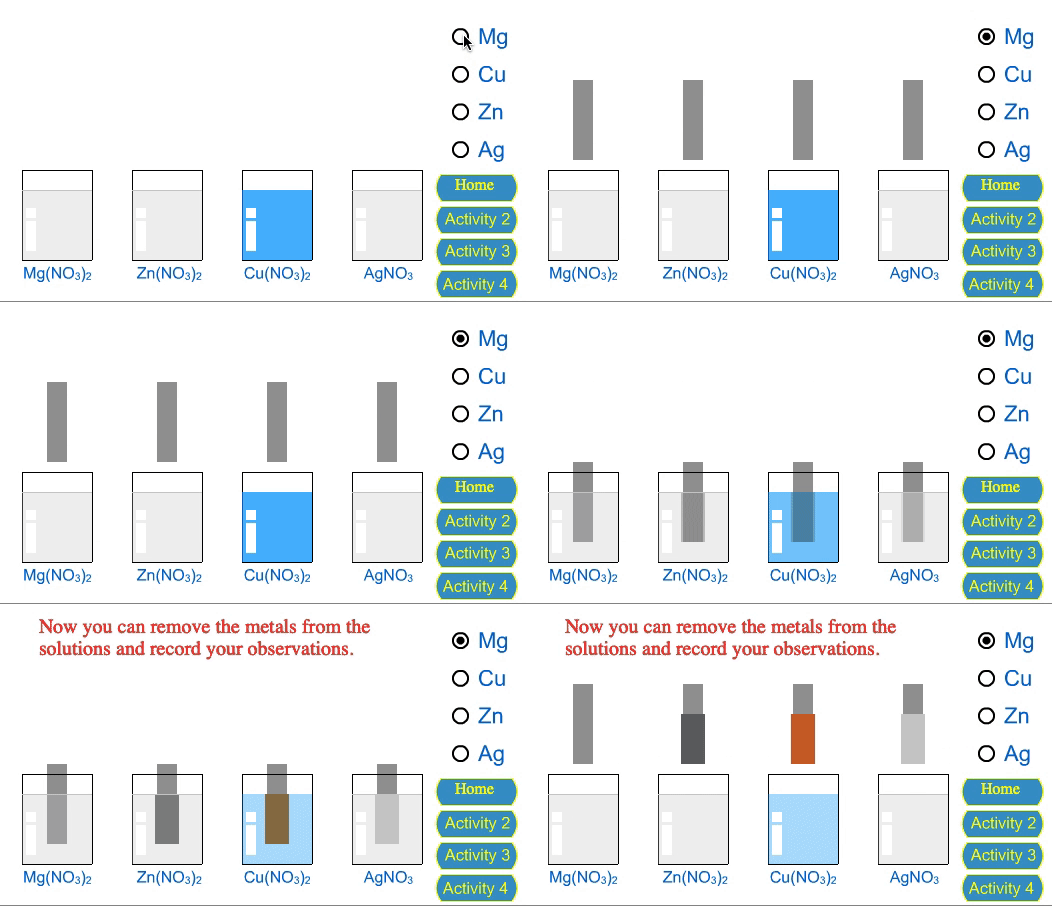
Some metals react readily with others, displacing them out of a solution and sometimes, there is no reaction. In this simulation you need to observe in each case whether a reaction takes place between the two metals. Where a reaction does take place, describe your observations. You will also calculate the Eo cell value for each combination. [If the gif doesn't work, use this link to access a video: https://drive.google.com/open?id=1Wj9jd-HvyKbvzOMqjYe6fOkCOCwmx15x ]
The reactions of Mg with various metal solutions
Use the simulation to observe the reactivity of magnesium in each solution. FIRST record if a reaction takes place or does not take place for each beaker. SECOND If a reaction takes place, record your observations by choosing from the list of options. If there is no obvious change to the colour of a solution or the piece of metal, then no observation about the solution or piece of metal needs to be made.
No reaction takes place
Reaction takes place
Observation: A dark grey deposit forms on the metal
Observation: A silvery grey deposit forms on the metal
Observation: A reddish-brown deposit forms on the metal
Observation: The blue solution becomes lighter in colour
Observation: The blue solution becomes darker in colour
Observation: The colourless solution turns blue
Mg in Mg(NO3)2
Mg in Zn(NO3)2
Mg in Cu(NO3)2
Mg in AgNO3
TWO observations were seen in the Mg in Cu(NO3)2 experiment. Explain why each one occured.
Calculate the Eo cell values for each of the redox reactions with magnesium metal. Choose the correct answer (with the correct sign) for each combination from the list of options.
- 3,17 V
- 2,71 V
- 1,61 V
- 1,56 V
- 1,10 V
- 0,46 V
0,00 V
+ 0,46 V
+ 1,10 V
+ 1,56 V
+ 1,61 V
+ 2,71 V
+ 3.17 V
Mg in Mg(NO3)2
Mg in Zn(NO3)2
Mg in Cu(NO3)2
Mg in AgNO3
Would you describe Mg as a highly reactive metal? Answer Yes/No and substantiate your answer.
Explain why the reaction between Mg and Cu(NO3)2 is SPONTANEOUS.
Mg
Mg2+(aq)
Cu
Cu2+(aq)
NO3 -(aq)
The reaction is spontaneous because ......
is a better reducing agent than ......
Therefore in the presence of ........,
......... will readily be reduced