2. Part A: Elizabeth buys 8 small juice boxes for the class party. Each small juice box holds 6 oz of juice. David buys 2 large juice boxes for the class party. Each large juice box holds 1 quart. How much juice, in ounces, do they have for the class party? Show your work
Question 3
3.
(Referring to your answer from Part A)
Part B: There are 12 students and 1 teacher in the class. If each person wants to drink 1 pint of juice, is there enough juice? Explain how to determine if there is enough juice for the party. Show your work.
Question 4
4.
Explain how you can find the volume, in cubic units, of the right rectangular prism below. What is the volume, in cubic units, of the right rectangular prism?
Question 5
5.
What is the volume, in cubic yards, of the figure?
Question 6
6.
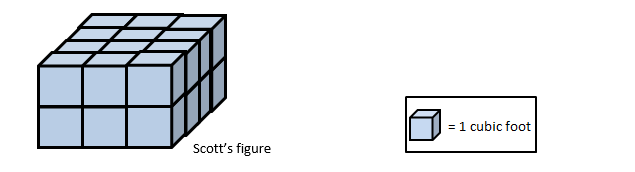
Scott made the figure below. Eliza made a similar figure. However, she used 4 times as many cubes. What is the volume of Scott’s and Eliza’s figures together? Show your thinking.
Question 7
7.
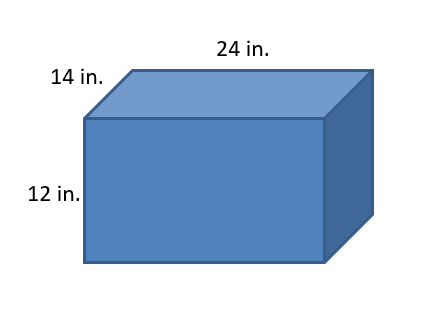
Find the volume, in cubic inches, of the right rectangular prism shown below. Show your work.
Question 8
8.
The area of the base of a cell phone is 10,366 square millimeters. The height of the cell phone is 7 millimeters. What is the volume, in millimeters, of the cell phone? (show your work)
Question 9
9.
What is the volume, in cubic inches, of the figure?
Question 10
10.
Which two conversions are correct to describe the width of a pencil?
0.002 m = 2 mm
0.5 in = 1 ft
1 in = 0.5 ft
20 m = 200 cm
0.2 cm = 2 mm
Denise has a tissue box in the shape of a cube.
She wants to know the volume of her tissue box.
What method will give Denise the volume of the box?
Fill the box will unit cubes and count the number of cubes.
Cover the top of the box with unit squares and count the number of squares.
Cover each face of the box with unit squares and count the number of squares.
Put a tape marked in units along the bottom edge of the box and count the number of units.