Use the axis of symmetry and one x-intercept shown, write an equation for the graph shown.
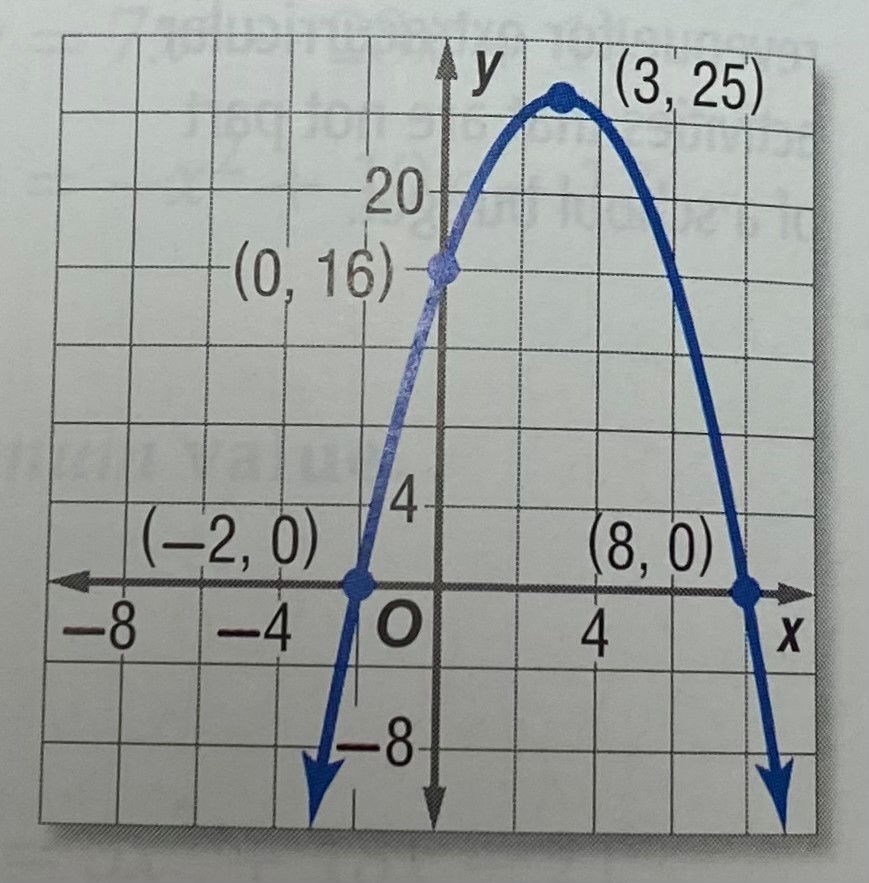
Use the axis of symmetry and one x-intercept shown, write an equation for the graph shown.
The average amateur golfer can hit a ball with an initial velosicty of 31.3 meteres per second. If hte ball is hit straight up, the height can be modeled by the equation h=-4.9t^2+31.3t, where h is the height of hte ball, in meters, after t seconds.
a. Graph the equation.
b. At what height is the ball hit?
c. What i the maximum height of the ball?
d. How long did it take for hte ball to hit the ground?
e. State a reasonable range and domain for this situation.
Let f(x)=x^2-9.
a. What is the domain of f(x)?
b. What is the range of f(x)?
c. For what values of x is f(x) negative?
Use the axis of symmetry and one x-intercept shown, write an equation for the graph shown.
Te graph of a quadratic function has a vertex at (2, 0). One point on the graph is (5, 9). Find another point on the graph. Explain how you you found it. (Graph paper is included in case you would like to use it, but is not required).
Are the following statements sometimes, always, or never true? Explain your reasoning.
a. The graph of y=x^2+c has a vertex at the origin.
b. The graphs of y=ax^2 and of y=-ax^2 are the same width.
c. The graph of y=x^2+c opens downward.
Compare and contrast completing the square, factoring, and graphing methods for solving the following equation: