# 809 - Termites
star
star
star
star
star
Last updated over 5 years ago
14 Nsɛmmisa

1
1
1
1
1
1
1
1
1
1
1
1
1
1
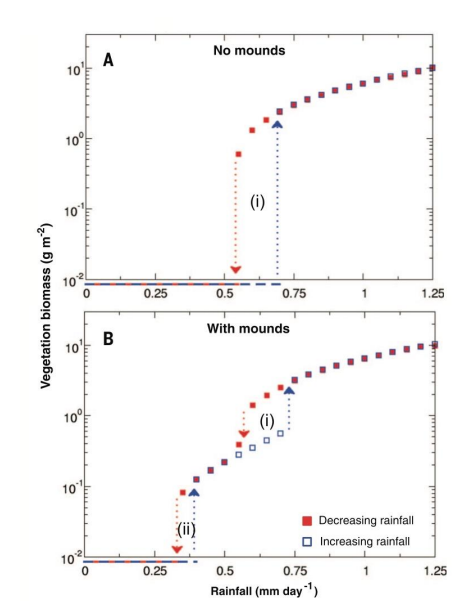
Caption: Diagrams showing how models predict the response of vegetation to increasing (blue squares) and decreasing (red squares) rainfall in ecosystems where termite mounds are not present (A) and are present (B). Each data point indicates the vegetation biomass in an area of land for a particular amount of rainfall. Figure A shows one cycle (i) of desertification (down red arrow) and revegetation (up blue arrow) in the absence of mounds. Figure B shows two cycles representing (i) loss and recovery of vegetation in the landscape between the mounds and (ii) desertification and revegetation of the entire system, including vegetation on the mounds.
BACKGROUND INFORMATION
In arid and semiarid savanna and grassland ecosystems (i.e., dryland ecosystems), a decrease in rainfall typically results in increasingly sparse vegetation, leading to uniformly spaced spots of vegetation (or vegetation patterns), and eventually complete loss of vegetation. The complete loss of vegetation, or desertification, is catastrophic to an ecosystem, and its effects can last for many years. More than 38% of the human population lives in dryland environments, which cover more than 40% of Earth’s surface. The risk of desertification is predicted to increase as drought intensity increases in response to global warming. Scientists have proposed using vegetation patterns as an early warning system to predict desertification.
In ecosystems with termites, vegetation tends to be concentrated on termite mounds, which are spread out across the landscape. Dr. Corina Tarnita and colleagues found that the pattern of vegetated termite mounds across a landscape resembles the spotty vegetation that occurs when a system is near desertification. But despite the similarities in these patterns, the fates of these two ecosystems may be very different. The presence of termite mounds in a landscape may actually provide resistance to desertification and a faster recovery of vegetation if desertification does occur. Termite mounds promote vegetation growth because the termites enrich the soil with nutrients found in their waste and they dig tunnels that help to increase water infiltration to plant roots. The researchers incorporated the positive effects of termite mounds on vegetation growth into an existing mathematical model used to predict how changes in the annual average rainfall alter vegetation patterns in a savanna ecosystem.
Panel A in the figure above shows a diagram of the modeled vegetation change as rainfall decreases (red) and increases (blue) in an ecosystem without termite mounds. Panel B shows a model of the vegetation change as rainfall decreases (red) and increases (blue) in an ecosystem with termite mounds. From these models, the researchers were able to predict the system’s “robustness,” measured by how well the vegetation resisted and then recovered from desertification. They then compared the modeled vegetation patterns against aerial photographs and data collected at their field site in Kenya, confirming that the vegetation patterns predicted by the models closely matched the actual data.
Graphs A and B both portray sudden shifts in biomass, but the shifts are different depending on whether or not the mounds are present. There is an increase and a decrease of biomass that occurs, but for this question, focus on the decrease - how does the decrease of biomass on Graph A compare to the decrease of biomass on Graph B? At what point does each of the decreases occur?
How does the vegetation biomass at 0.5 mm/day of rainfall differ in the two figures? Explain what is contributing to this difference
Which of the ecosystems represented by these figures is more vulnerable to desertification? Why?
Which of the ecosystems represented by these figures is more likely to recover from desertification sooner? Why?
If termite populations began to collapse in these areas, use the two graphs to predict the effect this might have on arid and semiarid ecosystems.
Provide one piece of evidence from the film to support each of this claim:
Termite mounds enhance ecosystem productivity.
Productivity refers to primary productivity, which is measured by amount of biomass production created by autotrophs (in other words, the amount of photosynthesis that is occuring)
Provide one piece of evidence from the film to support each of this claim:
Termite mounds enhance ecosystem stability.
The following photo is a portion of the savanna showing a Voronoi diagram overlaid on a landscape of termite mounds:
Using the tools, place a dot in the center of 20 random mounds that don’t touch the edge of the figure.
For each mound you marked, count the number of neighbors and record the data in this table. Be sure to keep track of which mounds you have and have not counted.
Using the grid, construct a histogram frequency distribution of each number of neighbors. Be sure to properly label the axes and include a title for the graph.
Calculate the Mean, based on the number of neighbors counted for 20 termite mounds.
To calculate mean, calculate the average number of neighbors of the 20 termite mounds.
Calculate the Median, based on the number of neighbors counted for 20 termite mounds.
The median is the middle value in a data set that is listed in numerical order. If there is an even number of data points, the mean between the middle two points should be calculated.
Calculate the Mode, based on the number of neighbors counted for 20 termite mounds.
The mode of a data set is the value that occurs most frequently in the set.
In the film, Dr. Corina states that the termite mounds “maximized the available space in the ecosystem.” Do the data from the Voronoi diagram you collected support her statement? Justify your answer.
Climate change models predict water stress in some savanna ecosystems. Provide two reasons why conservation efforts should be devoted to retaining termite populations.