The raindrops are doing what in the image?
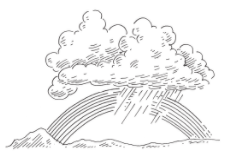
The raindrops are doing what in the image?
Which demonstrates that light travels in a straight line?
Refraction occurs when
Isla hung a picture of herself on the wall. She placed a piece of translucent material over her picture. Then she recorded her observations in her science notebook. Which observation did Isla most likely write in her notebook after looking at her picture behind the translucent material?
Predict: In which of these objects would you most likely see your reflection?
Which object would reflect the MOST light from a bulb?
Kinsey is having a challenging time reading the board at school. Her optometrist, or eye doctor, suggests that she get glasses. What is the best reason glasses would help Kinsey read?
When Keisha places a pencil into a cup of water she notices that part of the pencil underwater looks larger than it actually is. What property of light causes this to happen?
Quinn pours milk into one clear cup and water into another. He notices that he can clearly see through the cup with water, but not the cup with milk. Which of the following statements would explain why he can see through one cup, but not the other?
The raindrops are doing what in the image?
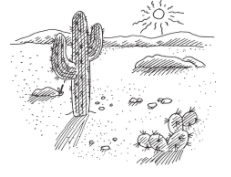
How do you know that the cactus is opaque?
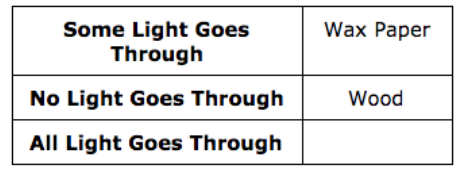
Which material would be entered into the empty box on the data table?
Students put shapes made of four different types of materials on a sunny window. Which shape is translucent?
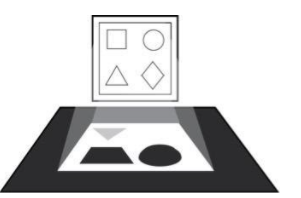
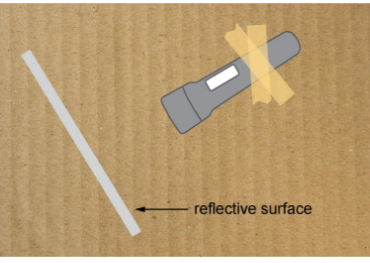
Maya builds a device that uses a flashlight and a reflective surface, like a mirror, to point the beam of light in different directions. The picture shows her device. How would the light be impacted if Maya changed the mirror to a prism?
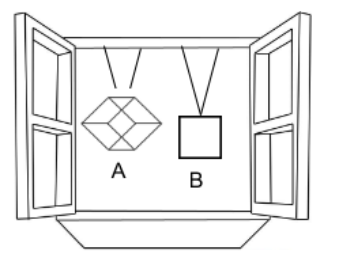
Jonathan notices his dad hung two objects in their window at home. When he walks by the window one day, he sees that light reacts differently when it hits both objects. When light hits object A, he can see a rainbow on the ground. When light hits object B, none of the light passes through. What is true of each object?
If the water were removed from this set-up, at what point would the light travel toward now?
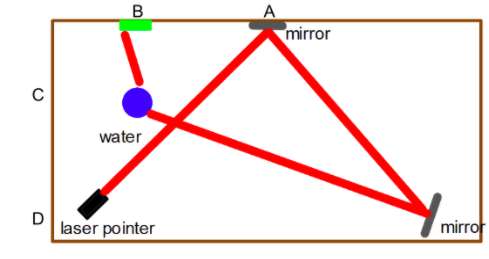
Look a point “A”. What is true of the light as it hits point “A”?
which item can be classified a TRANSPARENT?
In the diagram, sheet A and sheet B are made of different materials. A flashlight is used to
point light rays at each sheet.
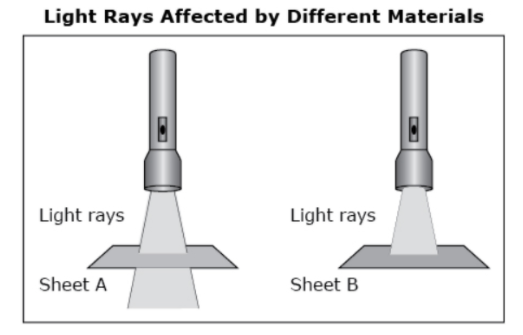
Part A: Based on the ways light rays travel when aimed at Sheet A and Sheet B, identify the type of material of each sheet using the terms opaque, transparent, or translucent and explain how you know. (4 points)
Sheet A is ____________________. I know this because _______________________________
Sheet B is ____________________. I know this because _______________________________
What is a prism?