Using the picture to help, what is the cause (in red) of all of the surrounding issues? (use increasing/decreasing)
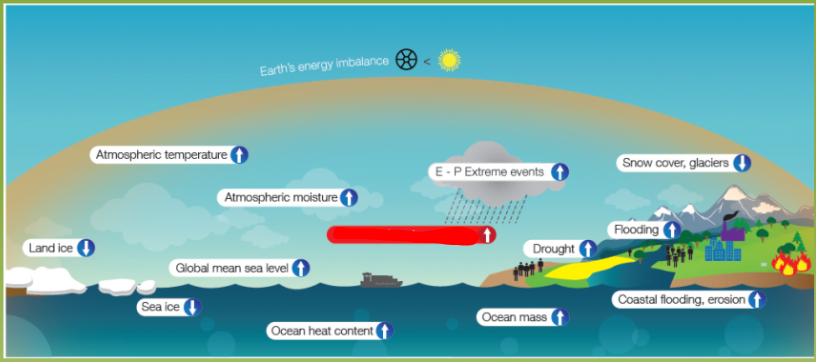
Using the picture to help, what is the cause (in red) of all of the surrounding issues? (use increasing/decreasing)
Use the PPT to answer the question.
Ocean warming is caused primarily by
Using the picture to help, what is the cause (in red) of all of the surrounding issues? (use increasing/decreasing)
How are marine species affected by ocean warming?
Use the PPT to answer the question.
What are the major threats to coral reefs?
What is coral bleaching caused by?
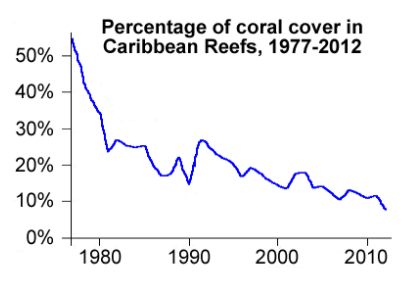
Look at the graph. What does it show?
Why do you think corals have declined since 1977?
Gizmo Warm-up
Coral reefs are some of the most diverse habitats on Earth, home to over a quarter of all marine species. The Coral Reefs Gizmo provides a simplified model of interactions among 10 key species in Caribbean reefs. In the Coral Reefs 1 exploration, you will focus on the effects of environmental factors on Caribbean reefs.
Click Advance year 10 times. Look carefully at the composition of the reef over time. Do you see any major changes?
Select the DATA tab.
Check that Staghorn coral, Star coral, Sponges, and Algae are selected. Populations are given as a percentage of normal populations. What do you notice about these populations?
On the right side of the Gizmo, select the SUMMARY tab. In a healthy reef, what are the values for Nutrient load, Water clarity, Coral cover, and the total number of fish species?
Introduction: In recent decades, global climate change has altered ocean conditions in the Caribbean. Average surface temperatures have risen about 0.25 °C – 0.5 °C. Many scientists think climate change will lead to stronger storms and may cause the ocean to be more acidic.
Predict: Coral reefs in the Caribbean are sometimes damaged by hurricanes. Of the two types of coral shown, which do you think is more resistant to storm damage? Explain.
Observe: Set the Storm severity to 50%. Click Advance year 10 times. What changes do you notice?
Analyze: On the DATA tab, select Staghorn coral, Star coral, Sponges, and Algae. Which organism was most hurt by increased storms, and why do you think this is so?
Predict: In the Caribbean, water temperatures typically range from 24 °C to 30 °C. What do you think might happen if temperatures rise much higher than 30 °C? Justify your reasoning.
Observe: Select the CORAL REEF tab. Click Return to original settings and Restart. Set the Ocean temperature to 33 °C. Click Advance year 10 times.
What changes do you notice?
Select the DATA tab. Which coral is most affected by bleaching?
Analyze: On the DATA tab, select every organism.
In general, how does the decline in corals affect the other organisms on the reef?
Predict: The pH of a solution is a measure of how acidic or basic it is. The greater the pH, the more basic the solution is. Corals and other marine invertebrates require less energy to make their exoskeletons and shells when ocean water is slightly basic. As carbon dioxide concentrations in Earth’s atmosphere rise, ocean water absorbs carbon dioxide and becomes more acidic. This process is called ocean acidification.
How do you think ocean acidification will affect the coral reef?
Observe: Click Return to original conditions and Restart. Set the Ocean pH to 7.6. Click Advance year 20 times.
What changes do you see on the CORAL REEF and DATA tabs?
Observe: Select the SUMMARY tab.
How has the loss of coral affected the number of fish species present on the reef?
Summarize: Many scientists predict stronger storms, warmer oceans, and lower ocean pH in the future.
If this occurs, how do you think these changes will affect Caribbean coral reefs? Test your ideas using the Gizmo.
Apply: In the 1970s, staghorn corals dominated Caribbean reefs. Since that time, staghorn corals have declined by over 90% and are now classified as critically endangered.
What do you think are the causes of this decline, and why do you think staghorn corals are so vulnerable?