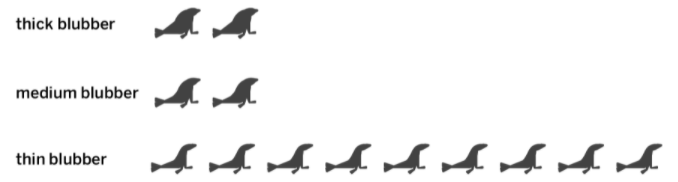
Harbor seals live in northern oceans and have a layer of blubber (fat) that keeps them warm. Seals can have blubber of different thicknesses.
Seals with thicker blubber are more likely to stay warm and survive in cold ocean waters. But, in warm ocean waters, thicker blubber can make the seals overheat and die.
The diagram above shows a population of seals that lived in an area of ocean. Scientists had previously only seen seals with medium or thin blubber in this area of ocean; they had never seen seals with thick blubber.
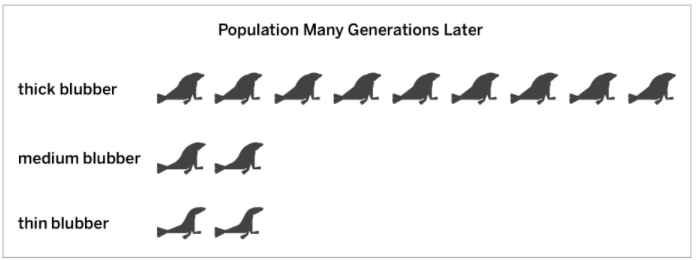
The diagram below shows how the population changed after many generations.
Explain what happened to the environment seals live in over many generations.
CFS:
accurately describes the relationship between environmental changes and population variations
describes the cause and effect relationship between environmental factors and species traits
Blue jays are birds that live in the forest. They can have beaks of different thicknesses.
Blue jays use their beaks to get to the seeds they eat. Blue jays with thinner beaks can easily reach and eat the seeds inside pinecones. Blue jays with thicker beaks can easily open and eat seeds with hard shells.
The diagrams below show three possible blue jay populations.
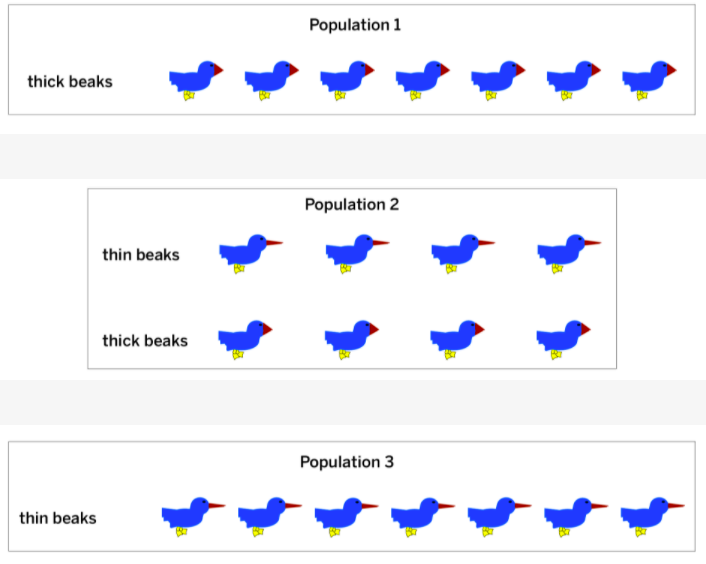
If their environment changes to have only seeds in pinecones, which of the following blue jay populations will most likely survive?
Populations 2 and 3 will most likely survive.
All the populations will survive because the blue jays will change the thickness of their beaks if they need to.
Only Population 2 will survive because it is the only population with variation.
Populations 1 and 2 will most likely survive.
Northern foxes can have different fur colors.
The foxes hunt squirrels for food. Foxes that have fur the same color as their environment are better at getting closer to squirrels and catching them.
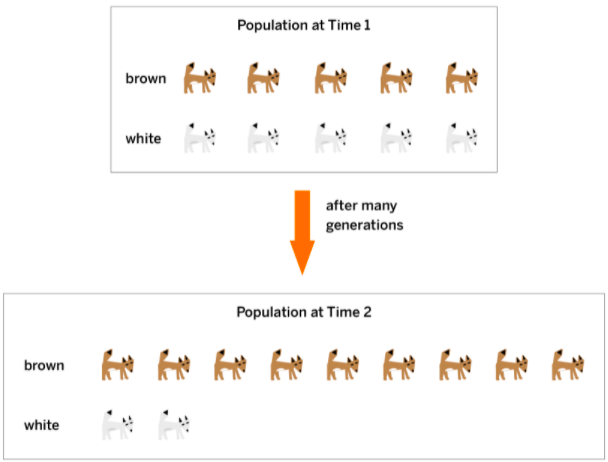
The diagram below shows a population of foxes that live in one area. At time 1, the population had the same number of brown and white foxes. At time 2, after many generations, there were many more brown foxes and fewer white foxes in the population.
How did the environment change between time 1 and time 2? How did the population change?
The environment became brown. With each generation, more brown foxes survived long enough to pass on the gene for brown fur to their offspring.
You cannot tell how the environment changed. With each generation, more foxes passed on the gene for brown fur to their offspring.
The environment became brown. Brown foxes are more likely to survive, so the white foxes changed to have brown fur.
The environment became brown. Brown foxes are more likely to survive, so both kinds of foxes passed on the gene for brown fur to their offspring.
Hummingbirds can have beaks of different lengths.
They use their beaks to reach to the nectar (their food) at the bottom of flowers. Hummingbirds with longer beaks can get food from long flowers. Hummingbirds with shorter beaks cannot reach the nectar in long flowers. If a hummingbird can’t easily reach its food, it will die.
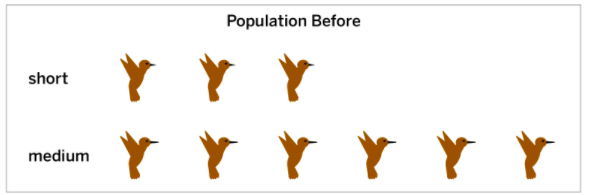
The population of hummingbirds once lived in an environment where there were very few long or medium flowers. The image above shows what the population looked like then. The environment changed so that mostly long and medium flowers now grow there.
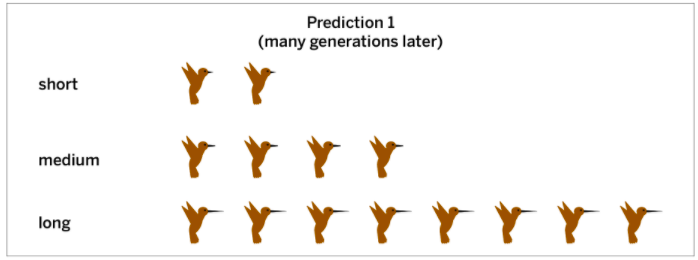
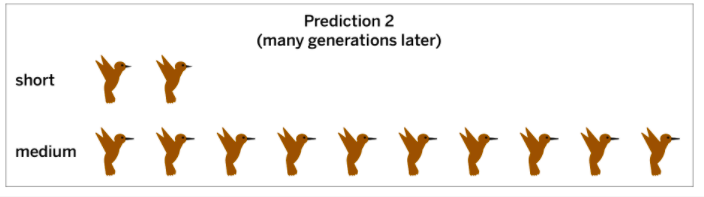
The diagrams below show two predictions for what the population could be like after many generations.
Which prediction best shows what the population could look like after many generations? What caused it to change?
Prediction 1 is best. Hummingbirds with long beaks are more likely to survive, so hummingbirds with short and medium beaks began to have offspring with a mutation in its genes for the long-beak trait so that their offspring would have a better chance to survive.
Prediction 2 is best. A hummingbird could have been born with a mutation in its genes for the long-beak trait and lived for a little while. Because long-beak hummingbirds are more likely to die, it would have been more likely to die before it had any offspring, so the final population will only have medium or short beak hummingbirds.
Prediction 1 is best. Two hummingbirds with short or medium beaks had a baby with a mutation in its genes for the long-beak trait. Because long-beak hummingbirds are more likely to survive, that baby survived long enough to pass on its mutation, so the long-beak trait became more common over generations.
Prediction 2 is best. A hummingbird could have been born with a mutation in its genes for the long-beak trait, but having a mutation in its genes would have caused it to die when it was born, so the final population will only have medium or short beak hummingbirds.
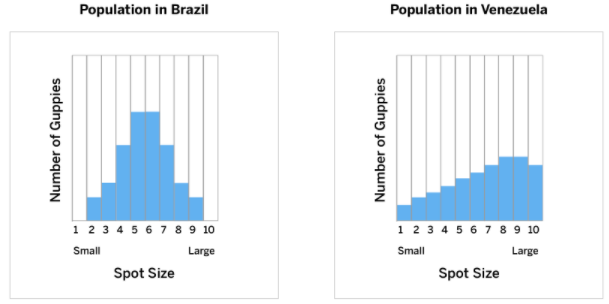
Scientists measured the spot size of guppies (small fish) in two different populations. Which population has more guppies with large spots?
They both have the same number of guppies with large spots.
The population in Venezuela has more guppies with large spots.
These bar graphs do not show which population has more guppies with large spots.
The population in Brazil has more guppies with large spots.
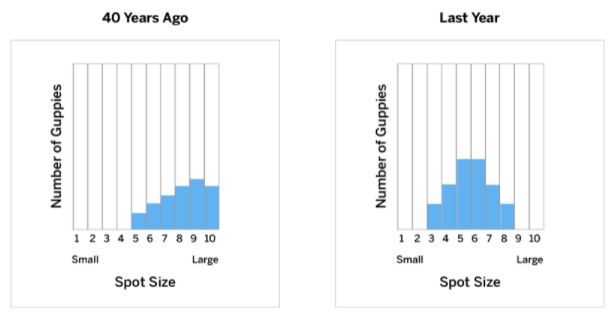
Scientists measured the spot size of all the guppies (small fish) that lived in a river 40 years ago. They measured the spot size of the guppy population again last year. When was there more variation in the spot size of guppies in the river?
These bar graphs do not show the amount of variation in the population.
There was the same amount of variation in spot size 40 years ago and last year.