9 - Mystery of the Missing Tusks: Part 1 - Analyzing Data on Tuskless Elephants
star
star
star
star
star
Last updated over 5 years ago
6 Nsɛmmisa

1
1
1
1
1
1
BACKGROUND INFORMATION
Both male and female African elephants usually have tusks, which are long front teeth that grow outside their mouths. Elephants use their tusks to strip bark off trees for food and to dig holes for water and minerals. Male elephants also use their tusks to fight with other males for females. Males without tusks risk being severely wounded and are less likely to be reproductively successful.
These images were taken by cameras in Gorongosa National Park in Mozambique. They show two different African elephants: an elephant that has tusks and an elephant that does not. This absence of tusks, which is called tusklessness, is a natural, but usually rare, trait in African elephants.
Scientists are studying how rates of tusklessness in elephant populations — both in Gorongosa and in other regions of Africa — have changed, and are continuing to change, due to poaching: the illegal hunting and killing of elephants in order to harvest their tusks for ivory.
Explore the Gorongosa National Park by clicking on the "Map of the Park" link.
A survey of African savanna elephants revealed that populations declined by 30% between 2007 and 2014. As of 2014, about 350,000 savanna elephants were living in Africa. Their current rate of decline is 8% per year, primarily due to illegal killing called poaching.
Why are so many elephants being illegally killed? And how is this poaching affecting elephant populations? You will explore these two questions by examining data from several studies and watching a video about elephants living in Gorongosa National Park in Mozambique.
Examining Data
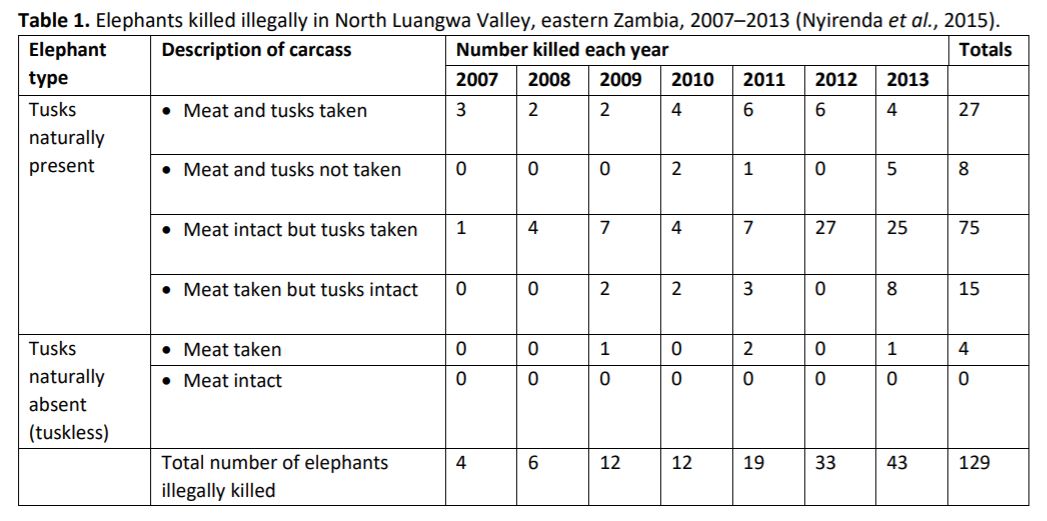
Table 1 shows the numbers of elephants that were illegally killed in a region of Zambia from 2007 to 2013. The elephants were categorized based on descriptions of their carcasses; these descriptions allow researchers to infer why the elephants were killed. The first four rows show categories of elephants that originally had tusks.
The fifth and sixth rows show categories of elephants that naturally do not have tusks, or are tuskless. Individual rows show whether meat and/or tusks were taken from the elephants after they were killed; researchers can infer that these elephants were killed for their meat and/or tusks.
Examine the data and then answer the questions after the table.
How did the total number of elephants that were illegally killed change from 2007 to 2013?
In general, did most of the elephants that were illegally killed have tusks, or were they naturally tuskless?
Calculate the total number of elephants that appear to have been illegally killed between 2007 and 2013 for:
a. only their meat
b. only their tusks
c. both their meat and tusks
Calculate the percentages of the illegally killed elephants between 2007 and 2013 represented by each group of elephants in Question 3.
a. percentage of elephants killed only for their meat
b. percentage of elephants killed only for their tusks
c. percentage of elephants killed for both their tusks and meat
Use the evidence above to make a claim about the main reason elephants were illegally killed in this region.
Suggest some ways to reduce the number of elephants that are illegally killed each year.